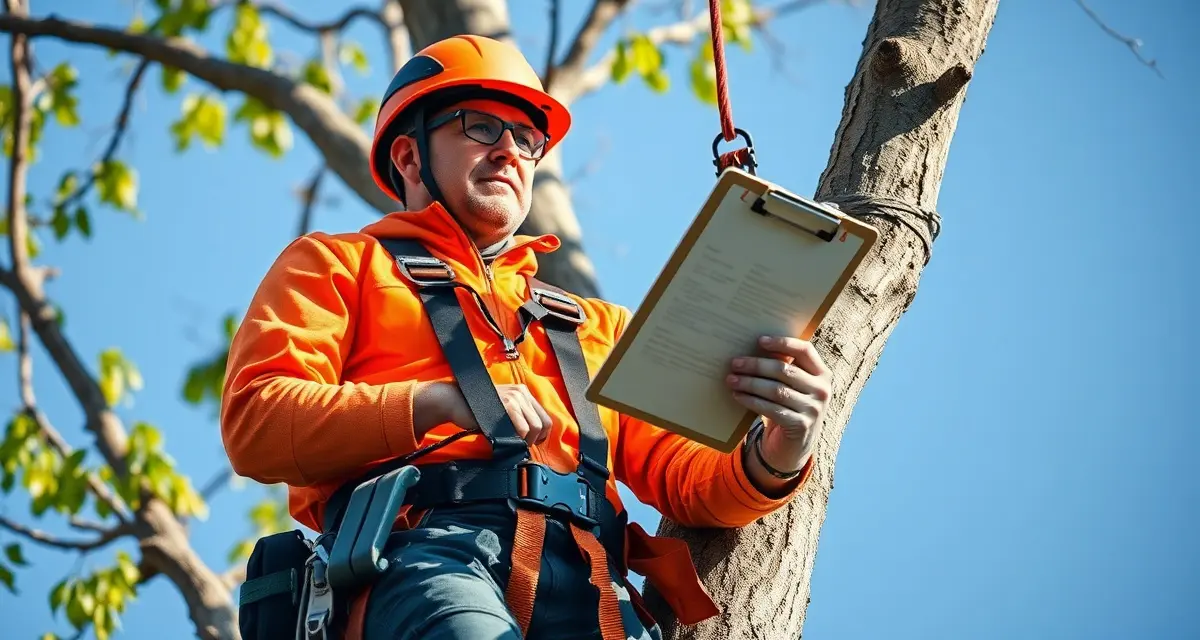
What Is ANSI Z133? The Safety Standard Every Tree Company Must Know
ANSI Z133 is the American National Standard for Arboricultural Operations: Safety Requirements. It covers every aspect of tree work safety: climbing procedures, aerial lift operations, chipper safety, chainsaw handling, communication protocols, and site safety practices.
ANSI Z133 violations are cited in 62% of serious tree service insurance claims. That's not a fringe statistic, it's the majority of serious claims. Compliance documentation isn't just about following rules. It's the difference between a claim that's covered and one that creates serious financial exposure.
No competitor, not Arborgold, not SingleOps, not ArboStar, has built ANSI Z133 checklist workflows into the core job dispatch flow. Which means most tree companies are either doing checklists on paper (which doesn't scale), doing them inconsistently (which creates gaps), or not doing them at all (which is the real exposure).
TL;DR
- ANSI Z133 is the national safety standard for commercial tree care -- compliance is required regardless of company size.
- Pre-job safety checklists create timestamped records that satisfy insurance auditors and TCIA accreditation requirements.
- Workers' comp premiums for tree service are among the highest in the construction trades -- documented safety programs can reduce rates.
- ISA certification tracking prevents lapses that affect contract eligibility for municipal and utility work.
- StumpIQ's compliance tools are pre-built for arboriculture and require no custom setup before first use.
What ANSI Z133 Actually Requires
The Z133 standard is published by the American National Standards Institute and maintained by the Tree Care Industry Association (TCIA). The current version is ANSI Z133-2017, though an update was in progress as of this writing.
The standard covers:
Personal Protective Equipment (PPE)
ANSI Z133 specifies PPE requirements for different tree work activities:
- Chainsaw operation: leg protection (chainsaw chaps), foot protection (cut-resistant boots), head protection (helmet with face shield or goggles), hearing protection, gloves
- Aerial work: climbing helmet meeting ANSI Z89.1, full-body harness meeting ANSI Z359 standards, appropriate footwear
- Chipper operation: eye and face protection, hearing protection, appropriate gloves (not loose)
- Ground crew around aerial operations: head protection at all times, appropriate footwear
PPE requirements are per-activity, the chainsaw operator's PPE is different from the ground crew's PPE. Documentation should reflect what each worker was wearing, not just "PPE was worn."
Minimum Approach Distances
ANSI Z133 establishes minimum approach distances for unqualified workers near energized electrical conductors. For workers not trained and equipped for electrical hazards:
- Distribution lines (under 50kV): 10 feet minimum
- Transmission lines (50-300kV): varies by specific voltage, considerably greater distances
- Unknown voltage: treat as highest voltage in the system
This matters for residential tree work anywhere near utility lines, which is most residential work. Documentation that the approach distance was assessed and respected protects you when a claim involves work near lines.
Communication and Site Safety
Z133 requires established communication protocols before work begins:
- Designated crew leader for the job
- Established communication method between climber and ground crew
- Drop zones identified and communicated before any aerial cuts
- Escape routes identified and communicated
These requirements aren't complex, any experienced tree crew does these things naturally. But "we always do it" is not the same as documented proof that it was done on the specific job where an incident occurred.
Specific Equipment Standards
Chainsaw safety, aerial lift operation, chipper operation, rigging, and many other specific activities have their own Z133 sections. If you use specialty equipment, cranes, aerial lifts, stump grinders, there's a Z133 section covering the safety requirements for that equipment type.
How to Document ANSI Z133 Compliance
The Problem with Paper Checklists
Paper pre-job checklists get lost, get skipped when the crew is in a hurry, and create no audit trail. When an insurance claim or legal dispute arises and someone asks "was the ANSI Z133 pre-job safety assessment completed on October 15th?", paper-based compliance provides inconsistent and often insufficient evidence.
Digital compliance documentation addresses all three problems:
- Can't be lost (stored in the job record)
- Can be enforced (job doesn't start until checklist is complete)
- Creates an audit trail (timestamp, crew member name, GPS coordinates)
Embedding Checklists in the Job Dispatch Workflow
The most effective compliance system is one where the safety checklist is in the path of starting the job, not a separate form that someone can forget.
StumpIQ embeds ANSI Z133 pre-job checklists into every dispatch order. Crews sign off digitally before work begins, creating an audit trail. The job status doesn't advance to "in progress" until the checklist is complete. This isn't just more convenient than paper, it's structurally more reliable because it requires completion rather than hoping for it.
What a Complete Z133 Compliance Record Includes
For each job:
- Pre-job checklist completion (timestamp, location, crew member names)
- PPE confirmation by activity and crew member
- Site hazard assessment (identified hazards, approach distances noted)
- Communication protocol confirmation (designated leader, communication method)
- Drop zones and escape routes documented
- Any special conditions or variances noted
This record, stored in the job file, is what you hand to your insurance carrier and attorney in the event of a claim.
ANSI Z133 and Insurance
Why Carriers Care About Z133 Compliance
From an insurance carrier's perspective, ANSI Z133 compliance is a risk indicator. Companies with documented compliance records have demonstrated that they take safety seriously and have systems to enforce standards. Companies without compliance records create uncertainty about what actually happened on the job.
When a claim is filed and the carrier investigates, one of the first questions is whether ANSI Z133 standards were followed. If you have digital records showing the pre-job checklist was completed by name, with a timestamp and GPS coordinates, that's evidence. If you don't, the absence of records can work against you.
Some carriers offer rate adjustments for companies that can demonstrate systematic Z133 compliance documentation, ask your carrier whether documented digital compliance affects your premium.
Z133 Violations and Claim Outcomes
A cited Z133 violation in a serious injury claim shifts the liability picture considerably. If an incident occurs and an investigation finds that the approach distance requirements weren't followed, or that required PPE wasn't worn, or that the pre-job safety assessment wasn't documented, those findings affect claim outcomes.
The 62% citation rate in serious claims reflects how often these documentation gaps appear in the worst-case scenarios.
The tree service safety dashboard
A complete compliance picture requires more than individual job checklists. Management needs visibility across all crews, all jobs, and all compliance events, flagging patterns before they become incidents.
A safety dashboard that shows checklist completion rates by crew, flags jobs where checklists were incomplete, and reports on any safety events across the operation gives management the visibility to address systemic issues before they generate claims.
Get Started with StumpIQ
StumpIQ's compliance tools -- ANSI Z133 checklists, ISA certification tracking, and incident reporting -- generate audit-ready records automatically from field submissions. If compliance documentation is a gap in your current workflow, StumpIQ closes it without custom configuration.
FAQ
What does ANSI Z133 require for tree service companies?
ANSI Z133 requires documented pre-job safety assessments, PPE compliance appropriate to each work activity, minimum approach distances from energized conductors, established communication protocols, and identified drop zones and escape routes before aerial cuts. It applies to all arboricultural operations and covers chainsaw use, aerial lift operation, chipper operation, climbing, and rigging. The standard is published by ANSI and maintained by TCIA.
Is ANSI Z133 legally required for arborists?
ANSI Z133 is technically a voluntary standard, not a federal regulation. But it becomes legally notable in two ways: first, OSHA's General Duty Clause can cite violations of recognized industry safety standards (including ANSI Z133) even without a specific OSHA rule; second, in insurance claims and legal proceedings, deviation from ANSI Z133 can be cited as evidence of negligence. In practice, following Z133 and documenting compliance is both a safety requirement and a legal protection.
How do I document ANSI Z133 compliance for my crew?
Digital pre-job checklists embedded in your dispatch workflow produce the most reliable documentation. When the checklist is a required step before a job can start, not a separate form, completion rates are consistently high. StumpIQ embeds ANSI Z133 checklists into every dispatch order with digital sign-off, creating a timestamped, GPS-tagged compliance record for every job. Paper checklists are an alternative but create inconsistent records and can be lost or claimed as retroactively completed.
What compliance documentation do tree service companies need to maintain?
Tree service companies should maintain: pre-job ANSI Z133 safety checklists for every job, PPE inspection records, ISA certification status and expiry dates for all certified staff, incident and near-miss reports, and equipment inspection logs. Timestamped digital records are the most defensible format for insurance audits and accreditation reviews.
How does TCIA accreditation affect a tree service company's compliance requirements?
TCIA accreditation requires companies to demonstrate a functional safety management system including documented pre-job safety briefings, maintained equipment inspection records, and qualified supervision meeting ISA certification standards. Companies pursuing accreditation for utility or municipal work need compliance tools that generate audit-ready records automatically.
Can compliance software reduce tree service insurance costs?
Documented safety programs are reviewed by workers' comp underwriters and can support lower classification rates or premium credits. Insurance carriers look for evidence that a company actively manages the known risks of tree work -- pre-job checklists, PPE tracking, and incident reporting are the primary evidence they evaluate.
Try These Free Tools
Sources
- Tree Care Industry Association (TCIA)
- International Society of Arboriculture (ISA)
- Occupational Safety and Health Administration (OSHA)
- American National Standards Institute (ANSI)