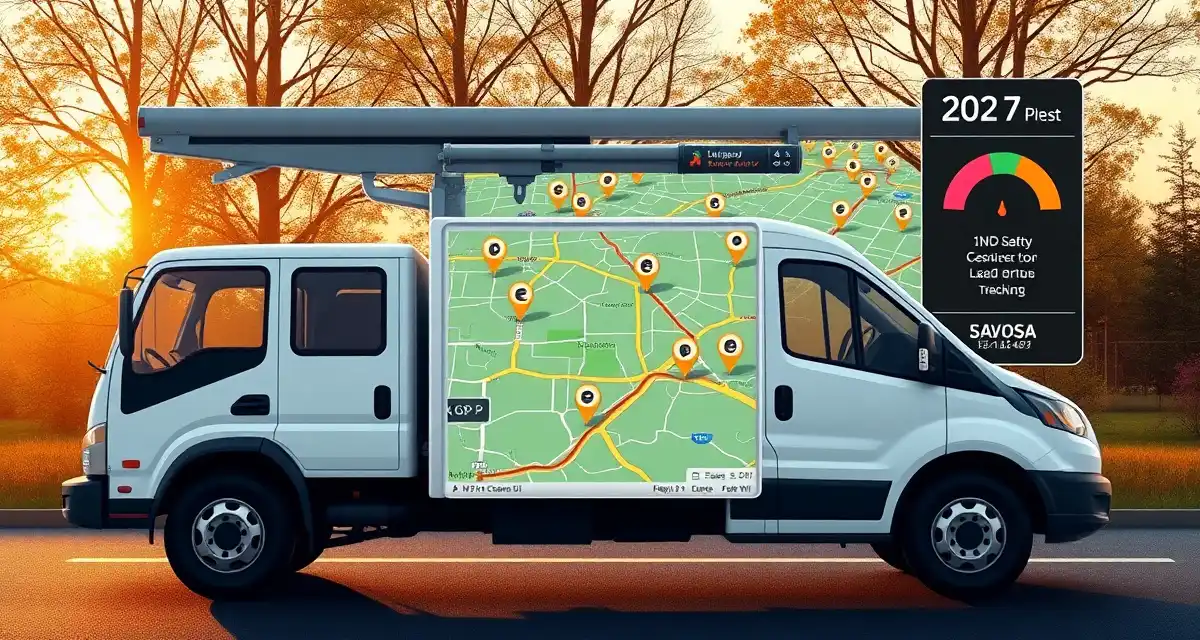
What GPS Tracking Does for Tree Service Companies: A Practical Guide
"Where's my crew right now?" is a question every tree company owner asks multiple times a day. GPS tracking answers it. But the real value of GPS for tree service goes considerably beyond knowing where your trucks are.
Tree companies with GPS crew tracking reduce fuel costs by an average of 14% through improved route efficiency in the first 3 months. That's a measurable return. But the productivity gains, accountability improvements, and customer service benefits compound on top of it.
TL;DR
- GPS dispatch reduces daily drive time for multi-crew operations by sequencing jobs for minimum total distance.
- Real-time crew location visibility allows dispatchers to assign new jobs to the nearest available crew.
- For a 3-crew operation, route optimization typically saves 15-20% of daily drive time and equivalent fuel cost.
- Storm surge dispatch requires hazard triage and priority queuing that standard scheduling tools don't provide.
- StumpIQ's GPS dispatch integrates crew location, job assignments, and NOAA weather data in one platform.
The Difference Between Vehicle Tracking and GPS Dispatch
These are two related but distinct capabilities.
Vehicle tracking is passive: a GPS device in the truck broadcasts location continuously. You can see where the truck is on a map. You can review movement history. You know if the truck moved after hours. This is valuable but limited.
GPS dispatch is active: the GPS location feeds into job scheduling and routing decisions. You see crew location, job status, estimated job completion time, and the next job on the schedule, all integrated. Dispatch decisions use live location data rather than phone calls.
Crew Control has basic GPS scheduling but lacks real-time location tracking depth, job progress is not linked to GPS position data. You see job assignments, but you can't see where the crew actually is or whether they've arrived.
StumpIQ's GPS layer shows crew location, job status, active equipment, and estimated completion time, all on one dispatch map. That unified view is what enables good dispatch decisions rather than phone-call-based guesswork.
What Good GPS Tracking Shows You
Real-Time Crew Location
The map shows each crew's current GPS location, updated in real time (typically every 30-60 seconds). You're not looking at where they were an hour ago, you're looking at where they are right now.
For a 4-crew operation, this means you can see at a glance:
- Crew 1: on site at [address], job started 45 minutes ago
- Crew 2: en route to next job, estimated arrival in 8 minutes
- Crew 3: completing job, GPS shows movement at the job site
- Crew 4: parked at the supply yard for 20 minutes (worth a call)
This visibility replaces 8-12 status calls per day.
Job Status Linked to GPS
The most useful form of GPS tracking for tree service links crew location to job status automatically. When a crew arrives at the job site GPS coordinates, the system logs arrival time. When they check in to start the job, the start time is GPS-confirmed.
This prevents the "we were there at 7:30" conversations when the GPS arrival log shows 8:10. It also protects crews from unfair accusations, the log confirms when they actually arrived, which resolves disputes both ways.
For crew accountability, GPS-linked job status is the core tracking mechanism.
Route Efficiency and Fuel
Route optimization based on real-time GPS data saves fuel by sequencing jobs efficiently rather than sending crews to the far end of the service area first and doubling back. The 14% fuel savings figure compounds across multiple crews, a 4-crew company spending $3,500/month on fuel saves about $490/month from GPS-optimized routing.
Beyond fuel, route efficiency increases daily job capacity. A crew that completes 7 jobs instead of 6 because routing eliminated 45 minutes of unnecessary driving produces 14% more daily revenue from the same labor cost.
Equipment Location and Accountability
Vehicle GPS shows where trucks are. But what about the chipper that's not currently attached to a truck? The stump grinder that was parked at a job site last week?
Equipment-level GPS or QR-based check-out tracking shows where major equipment is between jobs. Combined with vehicle GPS, this gives you full fleet visibility, not just trucks, but the expensive equipment that moves between them.
For equipment tracking in tree service, the GPS foundation connects to equipment-level tracking for the full picture.
GPS Tracking for Customer Service
ETAs That Are Actually Accurate
The most common customer frustration with service companies is inaccurate arrival windows. "We'll be there between 8 and noon" is not a customer service experience, it's a time tax on the customer's day.
GPS dispatch enables accurate ETA communication. When you can see that your crew is finishing the previous job, calculate their drive time to the next address, and send the customer a real ETA, "your crew is about 15 minutes away", the customer experience is completely different.
Automated SMS ETAs triggered by GPS events (crew leaves previous job, crew en route to your address) replace manual dispatcher calls for routine status updates.
Proof of Arrival and Completion
When a customer claims a crew never showed up or didn't complete the work, GPS logs provide objective evidence. The arrival time, time on site, and departure time are recorded. If the crew was on site for 3 hours, that's documented.
This protection works both ways. It protects the customer from inaccurate billing for time not spent. And it protects the company from unfair disputes.
GPS Tracking for Compliance
GPS logs create a secondary record that supports compliance documentation. For jobs with ANSI Z133 safety requirements, GPS-linked safety checklist completion, the crew's GPS location matches the job site coordinates when the checklist was signed, adds an additional layer of verifiability to compliance records.
For ISA-required work where documentation scrutiny may be higher, GPS timestamps reinforce the job record.
What to Look for in Tree Service GPS Tools
| Feature | Why It Matters |
|---|---|
| Real-time location updates | Effective dispatch requires current data, not 10-minute-old data |
| Job status integration | Location without job status is only half the picture |
| Equipment tracking | Trucks aren't the only thing that matters |
| Route optimization | Passive tracking vs. active routing improvement |
| Historical reports | Review movement history for disputes, efficiency analysis |
| Customer-facing ETA | Real-time ETAs improve customer experience |
| Offline capability | Signal gaps can't create tracking gaps |
For the crew dispatch workflow that integrates GPS tracking into operational decisions, see the dedicated guide.
Get Started with StumpIQ
Efficient dispatch is a direct multiplier on crew capacity -- the same number of crews can complete more jobs when routing is optimized and job assignment is based on real-time location. StumpIQ's GPS dispatch tools are purpose-built for tree service operations. If you are evaluating dispatch software, a direct demo of these features is the best way to assess fit.
FAQ
What does GPS tracking do for a tree service company?
GPS tracking shows real-time crew location, links location to job status for accountability, enables accurate customer ETA communication, improves route efficiency (average 14% fuel savings), provides objective records for customer disputes, and supports fleet management for vehicles and major equipment. The value goes well beyond knowing where trucks are, it's a tool for improving dispatch efficiency, crew accountability, and customer communication simultaneously.
Does GPS tracking for tree crews require special hardware?
It depends on the platform. Some GPS systems require hardware devices installed in vehicles. Others use the crew members' existing smartphones, the GPS chip in any modern phone provides the location data. StumpIQ's GPS crew tracking uses the crew's mobile device, so no hardware installation is required. For equipment tracking of assets that don't carry a phone (chippers, stump grinders), QR-based check-in/check-out or optional GPS hardware can supplement the mobile-based tracking.
How does GPS tracking improve tree service dispatch?
GPS dispatch improves on phone-based dispatch by giving the coordinator real-time information: current crew location, current job status, estimated completion time for the current job, and optimal routing to the next job. Instead of calling crews to ask where they are and when they'll finish, the dispatcher sees it on the map. This reduces status calls, improves routing decisions, enables accurate customer ETAs, and increases daily job capacity by minimizing idle time between jobs.
What is the difference between scheduling software and dispatch software for tree service?
Scheduling software assigns jobs to time slots and crew members. Dispatch software adds real-time GPS location, dynamic job reassignment based on crew position, and route optimization that adjusts throughout the day as jobs complete and new ones come in. For multi-crew tree service operations, dispatch tools reduce idle time between jobs and improve response speed for emergency calls.
How does GPS dispatch improve customer communication?
GPS dispatch enables automated ETAs -- customers can receive a notification when a crew is 30 minutes away, reducing the 'when are you coming' calls that consume office time. For emergency jobs, an accurate ETA reduces customer anxiety and positions your company as responsive and professional.
What data does GPS dispatch generate and how is it useful?
GPS dispatch generates crew location history, job completion times, drive time between jobs, and idle time records. This data is useful for: analyzing crew productivity, identifying routes that consistently run over time, verifying job completion for invoicing purposes, and demonstrating compliance with scheduled arrival windows for commercial clients.
Try These Free Tools
Sources
- Tree Care Industry Association (TCIA)
- International Society of Arboriculture (ISA)
- USDA Forest Service