How to Improve Crew Accountability in Your Tree Service Company
Every tree company owner knows the feeling: you're back at the office and you're not sure whether your crew arrived on time, whether they completed the safety checklist before cutting, or whether the job actually finished when they said it did.
That uncertainty is expensive. Tree companies with GPS-based crew accountability reduce labor cost overruns by an average of 19% in the first 6 months of use. The math makes sense, when crews know their arrival time, job start, and job end are all logged and visible, behavior changes.
This guide covers how to build a practical crew accountability system for your tree service company using GPS tracking and job logging.
TL;DR
- Tree service companies that adopt purpose-built software reduce administrative time by an average of 5-8 hours per week.
- AI photo-to-quote converts a field photo to a priced proposal in under 2 minutes -- compared to 30-45 minutes for manual estimates.
- ANSI Z133 compliance documentation created automatically in the field reduces insurance audit preparation time.
- ISA certification tracking prevents lapses that affect eligibility for municipal, utility, and commercial contracts.
- GPS dispatch with route optimization saves 15-20% of daily drive time for multi-crew operations.
Step 1: Define What "Accountable" Actually Means for Your Crew
Set Clear Expectations Before You Track Anything
Crew accountability isn't about surveillance. It's about having a shared understanding of what a successful job looks like, and a way to confirm it happened.
Before you introduce any tracking tools, define your standards:
- What time should crews arrive on site? (Not "leave the yard", arrive on site.)
- What must be completed before the first cut? (Safety checklist, hazard identification, communication with customer.)
- How does the crew signal job completion? (Photo, digital sign-off, customer confirmation?)
- Who reviews job logs and when?
Write these down. Share them with your crew. Then build the tracking around confirming they're happening.
Step 2: Implement GPS Arrival Verification
Stop Relying on "I Was There at 7:30"
Manual check-ins, text messages, phone calls, paper logs, require someone to remember to do them and someone else to receive and log the information. Both fail regularly.
GPS arrival verification solves this at the source. When a crew member arrives on site, the software logs the GPS timestamp automatically. No text needed. No phone call. No he-said/she-said about what time they showed up.
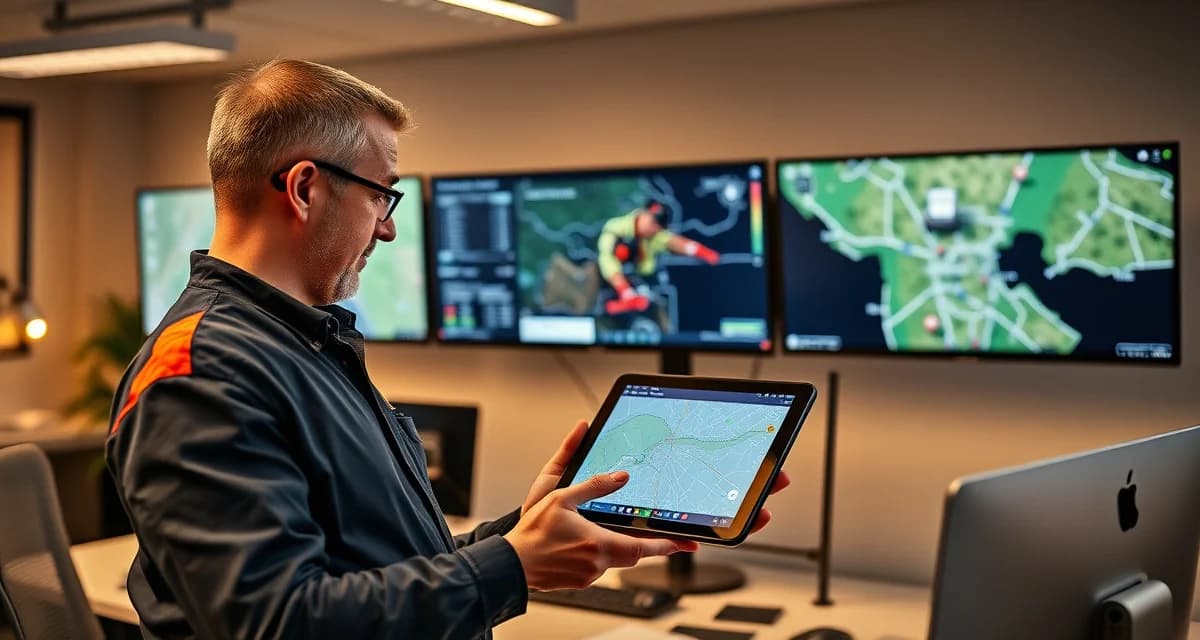
StumpIQ's crew dashboard logs arrival time, job start, safety checklist completion, and job end, all tied to GPS coordinates. You're not just seeing "they were near the job site", you're seeing when they arrived, when work actually started, and where the vehicle was during the job.
This matters particularly for crew dispatch in tree service, where job site locations vary daily and you can't rely on a fixed location to confirm presence.
Step 3: Embed Safety Checklists in the Job Flow
Make Compliance Automatic, Not Optional
The most common accountability gap in tree service isn't arrival time, it's safety documentation. Crews skip pre-job checklists because they're in a hurry, because the form isn't in front of them, or because nobody checks.
The fix: put the checklist in the path of starting the job. The crew can't log job start without completing the ANSI Z133 pre-job safety checklist. It's not a separate form. It's the unlock.
When safety documentation is embedded in the dispatch flow rather than living on a separate clipboard or PDF, completion rates go from sporadic to consistent.
Step 4: Log Job Completion with Photo or Customer Sign-Off
"Done" Means More Than Driving Away
Job completion logging serves two purposes: it confirms the job is finished and it creates a record in case a customer later claims work wasn't done properly.
Your completion process should require at least one of the following:
- Completion photo: crew takes a photo of the cleared site or completed work before leaving
- Customer digital sign-off: customer confirms job is complete via SMS link before crew leaves
- Manager review trigger: completion log automatically flags job for office review
The tree service safety dashboard in StumpIQ aggregates all these logs, arrival time, checklist completion, job start, completion sign-off, into a single job record you can pull up for any crew member at any time.
Step 5: Review and Respond to Accountability Data
The Logs Only Work If Someone Looks at Them
GPS data and job logs are only useful if there's a process for reviewing them. Build a lightweight weekly review into your management routine:
- Review any jobs where arrival was 15+ minutes late
- Flag any jobs with incomplete safety checklists
- Compare estimated job time to actual time, consistent over-runs indicate pricing or crew issues
When crews know the logs are reviewed and that late arrivals and missed checklists get addressed, accountability improves without constant direct supervision.
Common Mistakes to Avoid
Tracking without explaining: If you introduce GPS monitoring without explaining why, crews assume the worst. Walk them through what's being tracked and why it protects both you and them.
Over-monitoring small things: Focus accountability on the things that cost money, arrival time, safety checklists, job completion. Don't build a surveillance system around every coffee stop.
No follow-through: If you review the logs but never address chronic late arrivals or missed checklists, the tracking data becomes meaningless. Accountability requires consistent follow-through.
Only logging problems: Use the accountability data to recognize crews that are consistently on time and complete checklists properly. Positive reinforcement matters as much as correction.
Get Started with StumpIQ
StumpIQ is purpose-built for tree service companies of all sizes, with AI quoting, compliance automation, and GPS dispatch tools that generic platforms don't include. If you are evaluating software for your operation, StumpIQ is a useful starting point for comparison.
FAQ
How do I make sure my tree crews arrive on time?
GPS arrival verification is the most reliable method. When crew location is automatically logged when they arrive on site, there's no reliance on self-reporting. Set a clear arrival time standard, communicate it to the crew, and let the GPS log confirm it. Review the data weekly and address chronic late arrivals directly.
What GPS tools track crew accountability for tree service?
StumpIQ includes GPS crew tracking that logs arrival time, job start, safety checklist completion, and job end, all tied to geographic coordinates. This is more complete than scheduling tools like Crew Control, which show job assignments but don't verify whether crews arrived on time or completed pre-job requirements.
How do I handle a crew member who is consistently late to jobs?
Start with a direct conversation backed by specific data, "you arrived 25 minutes late on Tuesday and 40 minutes late on Thursday" is much harder to dispute than a general accusation. If the pattern continues after the conversation, document it formally and address it as a performance issue. Consistent late arrival costs real money in customer satisfaction and crew time, it's worth taking seriously.
What makes tree service software different from generic field service platforms?
Tree service software is built around arborist-specific workflows: AI species identification for field quoting, ANSI Z133 safety checklists, ISA certification tracking, storm demand forecasting, and hazard-level job classification. Generic field service platforms can be configured to approximate these workflows, but doing so requires weeks of manual setup and still produces a less accurate result for tree-specific job types.
How do tree service companies evaluate software before buying?
The most effective approach: identify your top 3 operational pain points, ask vendors to demonstrate those specific scenarios in a live demo, check user reviews on Capterra and G2 for patterns, and request a trial period to test with real job data. Ask specifically about mobile performance in the field, since most tree service work happens away from the office.
What is the ROI of tree service software for a small company?
For a 2-3 crew operation, purpose-built tree service software typically recovers its cost through: faster quoting that wins more bids, invoicing on the day of job completion rather than days later, reduced administrative hours, and fuel savings from route optimization. Most companies report positive ROI within 60-90 days of full adoption.
Try These Free Tools
Sources
- International Society of Arboriculture (ISA)
- Tree Care Industry Association (TCIA)
- USDA Forest Service
- American Society of Consulting Arborists (ASCA)