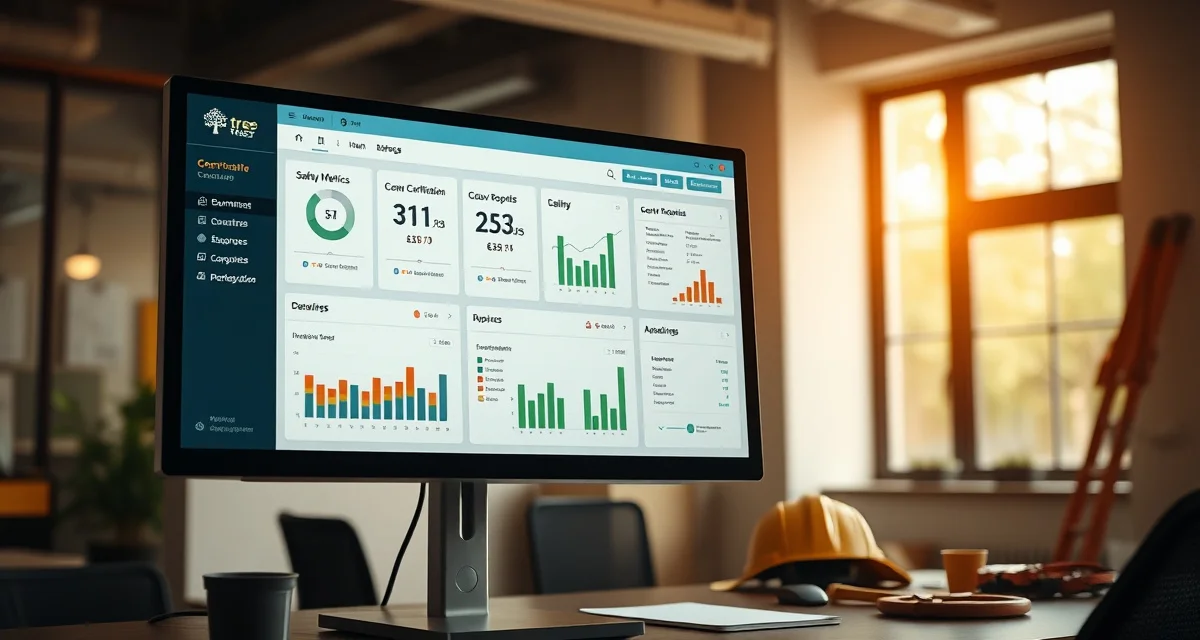
Tree Service Safety Dashboard: Track Crew Certifications and Incidents in One Place
Tree companies with active safety management software reduce recordable incidents by an average of 31% in the first year of use. The mechanism isn't complicated: when safety data is visible and actionable in real time, problems get caught before they become incidents. When it's buried in spreadsheets and paper files, they don't.
StumpIQ's safety dashboard turns compliance from a spreadsheet exercise into an active workflow crews and managers both use daily. Arborgold and SingleOps treat safety as a data field, not a workflow — no live dashboard, no automated alerts, no incident tracking. That's the gap this solves.
TL;DR
- ANSI Z133 is the national safety standard for commercial tree care -- compliance is required regardless of company size.
- Pre-job safety checklists create timestamped records that satisfy insurance auditors and TCIA accreditation requirements.
- Workers' comp premiums for tree service are among the highest in the construction trades -- documented safety programs can reduce rates.
- ISA certification tracking prevents lapses that affect contract eligibility for municipal and utility work.
- StumpIQ's compliance tools are pre-built for arboriculture and require no custom setup before first use.
What a Tree Service Safety Dashboard Should Show
A safety dashboard isn't just a place to store compliance records. It's a decision-making surface. Every time you open it, it should answer one question clearly: is my operation compliant right now, and if not, what needs attention?
Here's what StumpIQ's safety dashboard surfaces:
Certification Status at a Glance
Every crew member and their current certification status — ISA credentials, OSHA training, CDL and equipment licenses, First Aid/CPR. Color coded: green is current, yellow is expiring within 60 days, red is lapsed.
You can see the full picture in under 10 seconds. For a 6-crew company with 18 crew members, that's 10 seconds versus 20 minutes of cross-referencing a spreadsheet.
The dashboard links directly to ISA certification tracking — click any crew member and you see their full credential profile, upcoming renewal dates, and CEU completion status.
Pre-Job Checklist Completion Rate
Every dispatched job requires an ANSI Z133 compliance pre-job checklist before work starts. The dashboard shows your completion rate across all crews — what percentage of jobs started with a completed checklist in the last 30 days.
If that number drops below 95%, something is breaking in your workflow and you need to find out what. The dashboard makes this visible before it becomes a compliance problem or an insurance issue.
Open Incident Reports
Any reported near-misses or incidents show in the dashboard with status: new, under review, corrective action in progress, closed. Open incident reports that haven't been acted on stay visible until someone closes them.
This creates accountability. Incidents don't disappear into an email thread. They stay on the screen until they're resolved.
Equipment Inspection Status
Climbing equipment, cutting tools, aerial lifts — each with a last-inspection date and the next required inspection window. Equipment that's due for inspection shows up as yellow. Equipment with an overdue inspection shows as red and can be flagged to prevent dispatch.
You won't send a crew out with a chipper that's 3 weeks overdue on its blade inspection because the dashboard flagged it that morning.
Upcoming Safety Actions
Everything time-sensitive in one list: certifications expiring in the next 60 days, equipment inspections due this week, open corrective actions from incidents. Nothing falls off the list until it's resolved.
Who Uses the Safety Dashboard and How
Company Owners and Operations Managers
Weekly review of the full dashboard: certification status, checklist completion rates, open incidents, equipment due dates. 5–10 minutes is enough to catch anything that needs attention. The system does the daily monitoring — you do the weekly review.
Dispatchers
Before assigning a job, dispatchers see whether the assigned crew lead is certification-current and whether the required equipment has passed inspection. This is passive — the information appears as part of the dispatch workflow without requiring a separate lookup.
Crew Leads
Crew leads see their own certification status and upcoming renewals in their app profile. They complete the pre-job checklists and log any incidents or near-misses directly from the field. The compliance workflow is on their phone, not in an office.
Building Your Safety Dashboard: Initial Setup
Getting the safety dashboard live takes about 2–3 hours of initial configuration:
Enter all crew credentials: Name, certification type, certification number, issue date, expiry date. You can import from CSV if you're moving from a spreadsheet.
Configure equipment records: Every piece of inspectable equipment — chainsaw serial numbers, chipper ID, bucket truck ID, rigging equipment sets. Enter last inspection dates and set inspection intervals.
Customize checklist templates: StumpIQ ships with ANSI Z133 standard checklists. Adjust them for your specific job types and any additional requirements from your insurer or commercial clients.
Set alert recipients: Who gets notified about expiring certifications, failed inspections, and new incident reports? Configure this upfront so nothing goes to an empty inbox.
Once it's configured, the system maintains it. You're just reviewing what it surfaces rather than hunting for data.
Safety Dashboard vs. Spreadsheets: What Changes
Most companies making this switch come from some combination of spreadsheets, paper forms, and calendar reminders. Here's what actually changes:
| Metric | Spreadsheets/Paper | StumpIQ Dashboard |
|---|---|---|
| Certification review time | 20–30 min/week | 2 min/week |
| Renewal alert timing | When remembered | Automated at 60/30/7 days |
| Checklist completion tracking | Rarely tracked | Automatic, per job |
| Incident record retrieval | Filing cabinet search | Instant, searchable |
| Equipment inspection status | Manual calendar | Real-time with dispatch flag |
| Compliance proof for audit | Document hunt | Export in seconds |
The time saved is real. But the bigger value is the incidents that don't happen because the checklist happened, the certification that didn't lapse because the alert fired, the claim that didn't materialize because the equipment was inspected on schedule.
Get Started with StumpIQ
StumpIQ's compliance tools -- ANSI Z133 checklists, ISA certification tracking, and incident reporting -- generate audit-ready records automatically from field submissions. If compliance documentation is a gap in your current workflow, StumpIQ closes it without custom configuration.
FAQ
How do I build a safety dashboard for my tree service crew?
Start with a platform that integrates safety tracking into your operational workflow rather than treating it as a separate module. StumpIQ's safety dashboard connects certification tracking, ANSI Z133 pre-job checklists, equipment inspections, and incident reporting in one screen. Initial setup takes 2–3 hours: enter crew credentials, log equipment records, configure checklist templates. After that, the dashboard updates in real time as crews complete checklists and dispatchers record job outcomes. You review it weekly and the system alerts you to anything time-sensitive in between.
What safety data should I track for tree service crews?
At minimum: ISA and OSHA certifications with expiry dates and renewal windows, pre-job ANSI Z133 checklist completion rates, near-miss and incident reports with corrective action status, and equipment inspection dates for climbing gear, chainsaws, chippers, and aerial lifts. Add First Aid/CPR, CDL licenses, and any state-required contractor credentials specific to your market. The goal is to have a single source of truth that answers the question "is every crew member qualified and every piece of equipment fit for use right now" without having to check multiple systems.
Can safety software help lower my tree service insurance premiums?
It can, over time and with proper documentation. Workers' comp experience modification factors are driven by claim frequency and severity — safety management software reduces both by embedding compliance into daily workflow. Companies with 2+ years of documented checklist completion, low incident rates, and no major claims build an actuarial case for better rates. When you renew your policy, StumpIQ can export your full compliance history — checklist completion rates, incident records, corrective actions — as documentation for your broker. That's a tangible artifact that influences the underwriting conversation.
What compliance documentation do tree service companies need to maintain?
Tree service companies should maintain: pre-job ANSI Z133 safety checklists for every job, PPE inspection records, ISA certification status and expiry dates for all certified staff, incident and near-miss reports, and equipment inspection logs. Timestamped digital records are the most defensible format for insurance audits and accreditation reviews.
How does TCIA accreditation affect a tree service company's compliance requirements?
TCIA accreditation requires companies to demonstrate a functional safety management system including documented pre-job safety briefings, maintained equipment inspection records, and qualified supervision meeting ISA certification standards. Companies pursuing accreditation for utility or municipal work need compliance tools that generate audit-ready records automatically.
Can compliance software reduce tree service insurance costs?
Documented safety programs are reviewed by workers' comp underwriters and can support lower classification rates or premium credits. Insurance carriers look for evidence that a company actively manages the known risks of tree work -- pre-job checklists, PPE tracking, and incident reporting are the primary evidence they evaluate.
Try These Free Tools
Sources
- Tree Care Industry Association (TCIA)
- International Society of Arboriculture (ISA)
- Occupational Safety and Health Administration (OSHA)
- American National Standards Institute (ANSI)