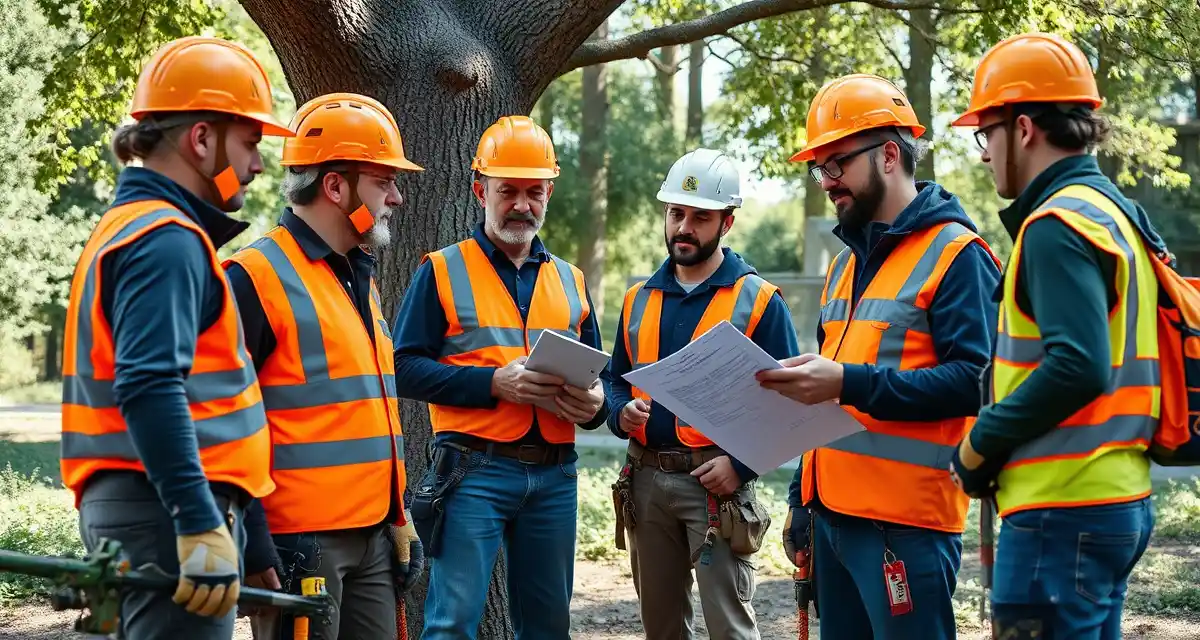
Tree Service Safety Compliance Checklist: ANSI Z133 and OSHA Requirements
Pre-job safety assessments aren't optional: OSHA data shows that failure to conduct them is cited in 58% of tree service injury investigations. When something goes wrong on a job site, investigators look first at whether your crew completed a pre-job hazard assessment. If they can't find the record, that's a compliance failure on top of the incident.
Most tree companies build their safety checklists in Word documents or on paper forms, manage them in binders, and rely on crew members to remember to complete them. That system fails when crews are rushed, when forms get wet, or when a supervisor isn't on-site to enforce the habit.
Here's a practical tree service safety compliance checklist covering ANSI Z133, OSHA 1910.268, PPE requirements, and equipment inspection, in language your crews can actually use.
TL;DR
- ANSI Z133 is the national safety standard for commercial tree care -- compliance is required regardless of company size.
- Pre-job safety checklists create timestamped records that satisfy insurance auditors and TCIA accreditation requirements.
- Workers' comp premiums for tree service are among the highest in the construction trades -- documented safety programs can reduce rates.
- ISA certification tracking prevents lapses that affect contract eligibility for municipal and utility work.
- StumpIQ's compliance tools are pre-built for arboriculture and require no custom setup before first use.
Site Hazard Assessment (Pre-Job, Every Job)
Before any chainsaw starts, your crew needs to walk the site and identify the hazards specific to that job. ANSI Z133 Section 5 requires a pre-job hazard assessment for every arboricultural operations site. This isn't paperwork, it's the foundation of everything else.
Overhead hazards:
- [ ] Utility lines identified and marked, distance from work zone noted
- [ ] Line clearance requirements confirmed (minimum 10 feet for most distribution lines)
- [ ] Overhead structures (rooflines, gutters, cables) within fall zone assessed
Ground hazards:
- [ ] Drop zone clear of bystanders and property
- [ ] Ground stability assessed, slopes, soft soil, buried utilities
- [ ] Vehicle and equipment parking positioned outside fall zone
- [ ] Public access control in place (cones, barricade tape, spotter if needed)
Tree condition:
- [ ] Dead wood identified and assessed for drop potential during work
- [ ] Decay, cavities, or structural defects noted
- [ ] Lean direction and fall zone planned before first cut
PPE Verification (Every Crew Member, Every Job)
ANSI Z133 specifies minimum PPE for every tree work scenario. Missing PPE is the fastest way to fail an insurance audit, companies without tracking systems fail 23% of them.
Required for all tree work:
- [ ] Class E hard hat (ANSI Z89.1) in serviceable condition, no cracks, no modifications
- [ ] Eye protection (ANSI Z87.1), safety glasses or face shield appropriate to task
- [ ] Hearing protection for chainsaw work
- [ ] Work boots, chain-saw-resistant for ground workers, as required by task
- [ ] High-visibility vest or clothing where vehicle traffic is present
For chainsaw operators (ground level):
- [ ] Chain-saw-resistant leg protection (chaps or pants meeting ASTM F1897)
- [ ] Cut-resistant gloves
For climbers:
- [ ] Saddle and harness inspected, stitching, buckles, webbing condition
- [ ] Climbing lines inspected, no fraying, kinking, or diameter reduction
- [ ] Helmet with chin strap
- [ ] Eye protection
- [ ] Foot spikes (spurs) inspected for point condition and strap integrity
Equipment Inspection (Pre-Use, Every Day)
Equipment failures during tree work cause injuries. Pre-use inspection catches problems before they become incidents.
Chainsaws:
- [ ] Chain tension and sharpness checked
- [ ] Chain brake tested and functioning
- [ ] Bar condition, no rails spread or damage
- [ ] Throttle lockout functional
- [ ] Muffler and spark arrestor in place
Chippers:
- [ ] Infeed chute clear, no blockages
- [ ] Feed roller engagement functional
- [ ] Discharge direction set and cleared
- [ ] Emergency stop tested
Climbing equipment (before each use):
- [ ] Carabiners, gate function and lockdown
- [ ] Pulleys, blocks, and lowering devices, sheave condition and sideplates
- [ ] Friction savers and false crotch setups, no wear-through on bark protectors
Aerial equipment (bucket trucks, lifts):
- [ ] Pre-operational checklist per manufacturer
- [ ] Outriggers fully deployed and on stable ground
- [ ] Boom and basket clearance from all work zone hazards
First Aid and Emergency Preparedness
ANSI Z133 Section 4.1 requires at least one first-aid and CPR certified crew member on every job. This isn't optional and it's not satisfied by having someone in the company with a lapsed certification.
- [ ] Certified first-aid/CPR crew member confirmed present on this job
- [ ] First aid kit on-site and stocked (check last inspection date)
- [ ] Emergency contact numbers accessible, local hospital, poison control, utility emergency line
- [ ] Nearest emergency access route identified from work site
- [ ] All crew members know the meeting point if evacuation is needed
Communication Setup
Before work starts, every crew member needs to know the plan.
- [ ] Job scope communicated to all crew members, what's coming down, what's staying
- [ ] Drop zone and escape routes reviewed with all crew
- [ ] Signals and communication method established (radio, hand signals if noise prevents verbal)
- [ ] Crew knows who has first-aid certification on this job
Making the Checklist Work Every Day
A checklist that lives in a binder in the truck doesn't work. Crews skip it when they're rushing to start, supervisors don't enforce it consistently, and the completed forms get lost before anyone reviews them.
No competitor ships a digital ANSI Z133 pre-job checklist, tree companies build them in Word or paper form and manage compliance manually. StumpIQ's crew app presents a digital ANSI Z133 checklist before every job, crews can't mark a job started without completing it. That's enforcement without a supervisor standing there.
The digital record also creates audit-ready documentation. When an insurance auditor or OSHA investigator asks whether your crew completed a pre-job assessment on a specific date, the answer is in the system, not in a filing cabinet hoping the paper is still legible.
Get Started with StumpIQ
StumpIQ's compliance tools -- ANSI Z133 checklists, ISA certification tracking, and incident reporting -- generate audit-ready records automatically from field submissions. If compliance documentation is a gap in your current workflow, StumpIQ closes it without custom configuration.
What should a tree service safety checklist include?
A complete tree service safety checklist covers five areas: site hazard assessment (utility lines, drop zones, ground conditions), PPE verification for each crew member, equipment inspection for chainsaws and chippers, first aid and emergency preparedness, and pre-job communication. ANSI Z133 specifies the minimum requirements for each category.
Is a pre-job safety checklist legally required for arborists?
ANSI Z133 requires a pre-job hazard assessment for every arboricultural operations site. While ANSI standards are technically voluntary, OSHA regularly references ANSI Z133 in enforcement actions and cites the absence of pre-job assessments in tree service injury investigations. In practice, not completing pre-job assessments is a liability exposure that affects both OSHA compliance and insurance coverage.
How do I make sure my crews complete safety checklists every day?
The most reliable enforcement method is making checklist completion a prerequisite for starting the job in whatever system your crews use to manage their day. Digital checklists that block job start until completion is confirmed outperform paper forms managed by honor system. If your crews use a mobile app for dispatch and job updates, the safety checklist belongs in that same app, not in a separate binder or paper system.
For more on compliance tools and safety documentation, see our guides on ANSI Z133 compliance for tree service and tree service safety dashboard.
What compliance documentation do tree service companies need to maintain?
Tree service companies should maintain: pre-job ANSI Z133 safety checklists for every job, PPE inspection records, ISA certification status and expiry dates for all certified staff, incident and near-miss reports, and equipment inspection logs. Timestamped digital records are the most defensible format for insurance audits and accreditation reviews.
How does TCIA accreditation affect a tree service company's compliance requirements?
TCIA accreditation requires companies to demonstrate a functional safety management system including documented pre-job safety briefings, maintained equipment inspection records, and qualified supervision meeting ISA certification standards. Companies pursuing accreditation for utility or municipal work need compliance tools that generate audit-ready records automatically.
Can compliance software reduce tree service insurance costs?
Documented safety programs are reviewed by workers' comp underwriters and can support lower classification rates or premium credits. Insurance carriers look for evidence that a company actively manages the known risks of tree work -- pre-job checklists, PPE tracking, and incident reporting are the primary evidence they evaluate.
Try These Free Tools
Sources
- Tree Care Industry Association (TCIA)
- International Society of Arboriculture (ISA)
- Occupational Safety and Health Administration (OSHA)
- American National Standards Institute (ANSI)