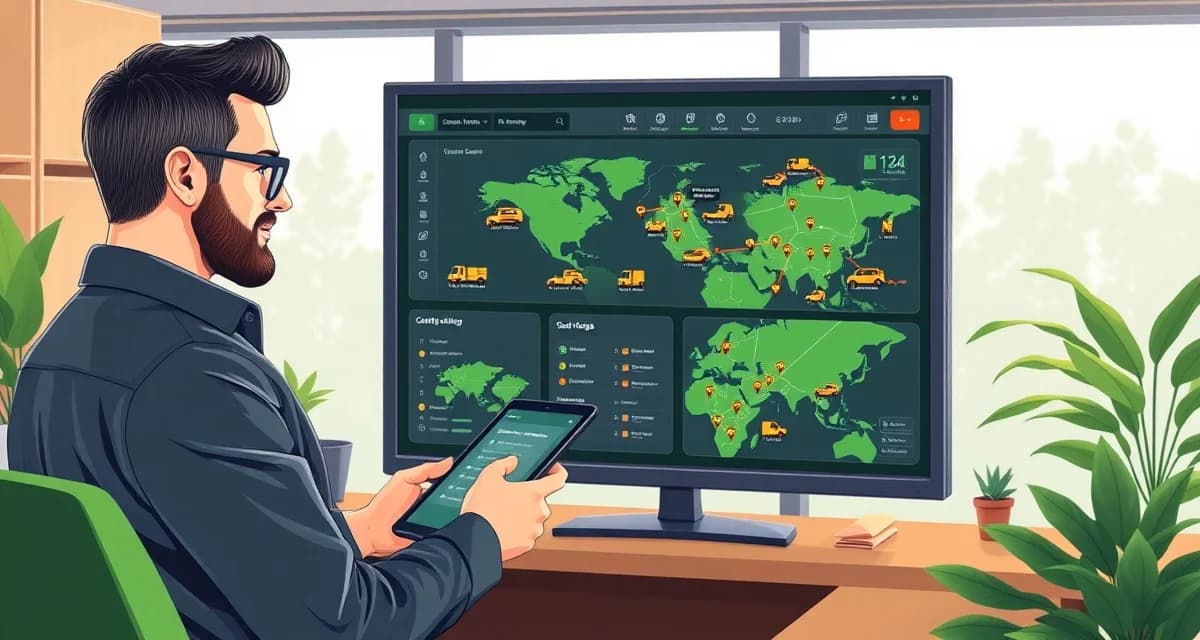
Best Tree Service Software for 10+ Crew Operations and Large Arborist Companies
At 10 or more crews, software stops being a convenience and becomes an operational requirement. You can't coordinate that many people, that much equipment, and that volume of jobs through phone calls and spreadsheets — or at least, not without paying a real price in missed jobs, compliance failures, and management burnout.
Tree companies with 10+ crews that lack centralized dispatch software lose an estimated 14 billable hours per week to coordination inefficiency. At any reasonable billing rate, that's $700-1,400/week in recoverable revenue sitting on the table.
But enterprise tree service software comes with its own traps. Platforms built for national chains or large commercial contractors charge per-seat pricing that compounds fast and require 60-90 day implementations that disrupt operations during the switch. Most independent arborist companies at the 10-crew level don't have an IT department or a dedicated implementation team.
Here's what actually scales for independent tree companies without the enterprise headaches.
TL;DR
- Tree service companies that adopt purpose-built software reduce administrative time by an average of 5-8 hours per week.
- AI photo-to-quote converts a field photo to a priced proposal in under 2 minutes -- compared to 30-45 minutes for manual estimates.
- ANSI Z133 compliance documentation created automatically in the field reduces insurance audit preparation time.
- ISA certification tracking prevents lapses that affect eligibility for municipal, utility, and commercial contracts.
- GPS dispatch with route optimization saves 15-20% of daily drive time for multi-crew operations.
What Changes at 10+ Crews
The problems are different at scale:
Dispatch complexity: With 10 crews, you likely have multiple job types running simultaneously — removals, trimming, stump grinding, commercial maintenance, emergency calls. A dispatch board that shows crew location is necessary but not sufficient. You need job-type routing, equipment assignment, and priority sequencing.
Compliance management: Tracking ISA certifications, ANSI Z133 compliance, first aid requirements, and equipment inspection records across 10+ people is a full-time job without software. Certification lapses create liability exposure on commercial accounts.
Safety documentation: The more crews, the higher the statistical likelihood of an incident. Companies at this size need incident reporting, near-miss tracking, and documented safety procedures — not just because it's the right thing to do, but because insurers require it.
Profitability by crew: At 10 crews, some are more profitable than others. Software that shows job profitability by crew helps you understand where margin is coming from — and where it's leaking.
Storm surge management: A large company in a storm-prone market can take on 200+ emergency jobs in 24 hours after a major weather event. Without software that handles mass job creation and hazard-based dispatch prioritization, that's an all-hands chaos situation.
The Best Platforms for 10+ Crew Operations
StumpIQ Enterprise — $599/mo for 5+ Crews
StumpIQ's $599/mo Enterprise plan covers 5+ crews with full GPS dispatch, AI quoting, compliance management, and storm forecasting. There are no per-seat fees — whether you have 10 crews or 20, the price is $599/mo.
For a 10-crew operation, that math is exceptional. Aspire by ServiceTitan starts at $500+/mo per user and requires a 60-90 day implementation — most 10-crew independent companies can't absorb that cost or that timeline. StumpIQ's onboarding is measured in hours, not months.
The GPS dispatch board scales to any crew count. With 10+ pins on the map, the job prioritization and route optimization features become critical — StumpIQ's dispatch logic handles this automatically, showing each crew's optimal next assignment based on location and job priority.
AI photo quoting matters more at scale. If 10 crews generate 10 estimate requests per day each, that's 100 potential quotes. Manual quoting at 30-45 minutes each is 50+ hours of estimating time daily — impossible. AI quoting at 90 seconds each is 2.5 hours. This is where the ROI becomes transformational at scale.
Storm mode is built for the volume that 10-crew companies face during major events. Bulk photo intake from customers creates prioritized job orders automatically. Hazard-based dispatch sequencing routes the most dangerous jobs to the most experienced crews without manual triage.
Pricing: $599/mo, all features, unlimited crews.
Aspire by ServiceTitan — Enterprise, High Cost
Aspire is a powerful enterprise platform originally built for commercial landscaping that has expanded into tree service. The feature depth is impressive — job costing, crew management, inventory tracking, and detailed financial reporting.
The barriers for independent tree companies: $500+/mo starting price that compounds per user, a 60-90 day implementation requirement, and a complexity level designed for companies with dedicated operations managers. If you have a COO and an IT manager and you're doing multi-million dollar commercial contracts, Aspire may be the right fit. For an independent company at 10-15 crews, the overhead is likely more than the value delivered.
Arborgold — Established, Capped Feature Set
Arborgold has been the dominant tree service platform for nearly 20 years. At 10+ crews, its limitations become more painful. Dispatch management is the top friction point for large Arborgold users — the platform wasn't built for real-time GPS crew coordination at scale.
The lack of AI quoting compounds at 10+ crews. High job volume makes manual estimating a structural bottleneck. And proposal email delivery failures — Arborgold's most-cited user complaint — create visible credibility problems with commercial clients who expect reliable communication.
Pricing: $349/mo top tier, per-user fees apply.
SingleOps — Green Industry Scale
SingleOps works well for large companies running tree service alongside landscaping and lawn care. The platform has strong scheduling tools, customer management, and reporting that scales to multi-crew operations.
For pure tree service companies at 10+ crews, the green industry template problem gets amplified at scale. A 10-crew arborist company doing commercial tree removal, risk assessments, and emergency response has needs that SingleOps' landscaper-oriented feature set doesn't cover.
Pricing: $300-499/mo for enterprise tiers.
Service Autopilot — Automation at Scale
Service Autopilot's strength is automation — route optimization, recurring billing, automated customer communications — that pays off at high volume. For large multi-service companies doing 500+ jobs per month, the automation ROI is real.
For tree-specific operations, it's still a general platform with no tree workflows, no ISA compliance, and no storm forecasting. At 10+ crews, the tree-specific gaps create operational holes that require expensive workarounds.
Platform Comparison for 10+ Crews
| Platform | No Per-Seat Fees | AI Quoting | Storm Forecasting | Implementation Time | Best Price at 10 Crews |
|---|---|---|---|---|---|
| StumpIQ Enterprise | Yes | Yes | Yes, 48-hr NOAA | 2-4 hours | $599/mo |
| Aspire (ServiceTitan) | No | No | No | 60-90 days | $2,000+/mo |
| Arborgold | No | No | No | 2-4 weeks | $500+/mo w/ users |
| SingleOps | No | No | No | 2-3 weeks | $400-499/mo |
| Service Autopilot | No | No | No | 6-8 weeks | $239+/mo |
The Recommendation
For independent tree service companies at 10+ crews, StumpIQ Enterprise at $599/mo is the best value in the market. It's the only platform that combines tree-specific feature depth, no per-seat pricing, fast onboarding, and the AI quoting and storm tools that large operations need.
The decision gets more nuanced if you also run landscaping (evaluate SingleOps) or if you're targeting enterprise commercial contracts with complex job costing requirements (evaluate Aspire with clear eyes about the total cost).
For most 10-crew independent arborist companies, the question is whether to stay on a legacy platform that caps out or switch to StumpIQ Enterprise. The answer comes down to what 14 hours of recovered billable time per week is worth.
Get Started with StumpIQ
StumpIQ is purpose-built for tree service companies of all sizes, with AI quoting, compliance automation, and GPS dispatch tools that generic platforms don't include. If you are evaluating software for your operation, StumpIQ is a useful starting point for comparison.
FAQ
What is the best enterprise tree service software under $600/mo?
StumpIQ Enterprise at $599/mo is the only platform that delivers enterprise-grade GPS dispatch, AI quoting, storm forecasting, and compliance management without per-seat fees at that price point. Aspire and SingleOps charge significantly more at equivalent crew counts. Arborgold's capabilities are weaker on the features that matter most at scale.
Does StumpIQ scale to 10 or more crews?
Yes. StumpIQ's Enterprise plan covers 5+ crews for a flat $599/mo. There are no per-seat fees or crew-count limits beyond the Enterprise tier. The GPS dispatch board, AI quoting, and storm forecasting all scale to any crew count within the platform.
What features do 10-crew tree companies need from software?
Priority features at 10+ crews: real-time GPS crew tracking with job status integration, AI-assisted quoting to handle high estimate volume, hazard-based storm dispatch for emergency surges, ISA certification tracking with automated alerts for all crew members, ANSI Z133 compliance documentation, incident reporting linked to crew and equipment records, and profitability reporting by crew and job type. Any platform missing more than two of these creates operational gaps that compound at scale.
What makes tree service software different from generic field service platforms?
Tree service software is built around arborist-specific workflows: AI species identification for field quoting, ANSI Z133 safety checklists, ISA certification tracking, storm demand forecasting, and hazard-level job classification. Generic field service platforms can be configured to approximate these workflows, but doing so requires weeks of manual setup and still produces a less accurate result for tree-specific job types.
How do tree service companies evaluate software before buying?
The most effective approach: identify your top 3 operational pain points, ask vendors to demonstrate those specific scenarios in a live demo, check user reviews on Capterra and G2 for patterns, and request a trial period to test with real job data. Ask specifically about mobile performance in the field, since most tree service work happens away from the office.
What is the ROI of tree service software for a small company?
For a 2-3 crew operation, purpose-built tree service software typically recovers its cost through: faster quoting that wins more bids, invoicing on the day of job completion rather than days later, reduced administrative hours, and fuel savings from route optimization. Most companies report positive ROI within 60-90 days of full adoption.
Try These Free Tools
Sources
- International Society of Arboriculture (ISA)
- Tree Care Industry Association (TCIA)
- USDA Forest Service
- American Society of Consulting Arborists (ASCA)