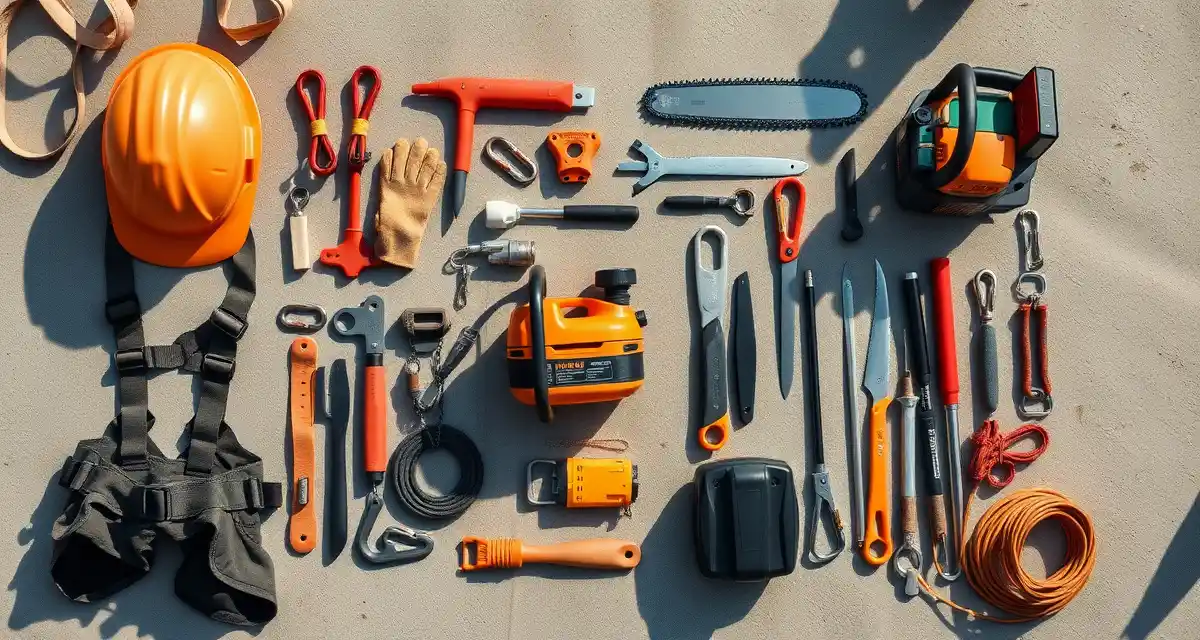
What Equipment Does a Tree Service Company Need to Start?
A fully equipped 1-crew tree service operation requires approximately $45,000-85,000 in equipment depending on job types and whether you need crane capability. That's a notable startup investment, and knowing what's truly necessary versus what can wait helps you deploy capital wisely.
Equipment lists in generic startup guides don't specify tree service requirements. ISA standards and ANSI Z133 specify minimum equipment for safe operations, and your insurance carrier will ask about your equipment before issuing coverage.
TL;DR
- Tree service companies that adopt purpose-built software reduce administrative time by an average of 5-8 hours per week.
- AI photo-to-quote converts a field photo to a priced proposal in under 2 minutes -- compared to 30-45 minutes for manual estimates.
- ANSI Z133 compliance documentation created automatically in the field reduces insurance audit preparation time.
- ISA certification tracking prevents lapses that affect eligibility for municipal, utility, and commercial contracts.
- GPS dispatch with route optimization saves 15-20% of daily drive time for multi-crew operations.
The Non-Negotiable Safety Equipment
Before any revenue-generating tools, you need compliant safety gear for every crew member. ANSI Z133 specifies the minimum personal protective equipment for arborist work.
Per climber:
- ANSI-rated climbing helmet with face shield: $150-300
- Hearing protection: $15-50
- Eye protection (separate from face shield for chainsaw work): $20-50
- Arborist climbing chaps (chainsaw-rated): $100-200
- Leather or cut-resistant gloves: $30-80
- Steel-toed work boots (ASTM F2413): $100-200
Per ground crew member:
- ANSI-rated hard hat: $30-80
- Hearing protection
- Eye protection
- Cut-resistant gloves
- Steel-toed boots
Total PPE investment per crew member: $400-700. Do not cut corners here. This is the equipment that prevents OSHA violations and serious injuries.
Cutting Tools
Chainsaws: You need at least two operational chainsaws before going to a job site. One failure in the field without a backup means an aborted job.
- Top-handle saw (climbing): $350-600. Used by the climber in the tree for limbing and bucking.
- Rear-handle saw (ground): $450-900. Used for ground felling and bucking larger sections.
Professional-grade saws (Stihl, Husqvarna) are the standard. Consumer-grade chainsaws are not adequate for production use.
Hand tools for pruning:
- Hand pruning saw (folding, arborist): $40-80
- Loppers (bypass): $60-120
- Pruning shears: $30-70
- Pole saw (manual): $60-150
Climbing System
This is where quality is critical. Climbing equipment failures cause fatalities. Purchase from reputable arborist suppliers, not hardware stores.
Per climber minimum kit:
- Arborist saddle/harness (ANSI-compliant): $200-500
- Climbing rope (16mm, 60 feet minimum): $100-200
- Rope snap (for attachment to saddle): $30-60
- Carabiners (several): $15-30 each
- Friction hitch: $15-25
- Throw line and throw weight: $40-80
- Rigging block: $80-150
- Rigging rope (for lowering sections): $100-250
Total per climber: $700-1,500 for a basic functional kit. More experienced climbers will add to this over time.
Vehicles and Trailers
Truck: You need at minimum a 3/4-ton pickup (F-250/RAM 2500 or equivalent) for towing capacity and payload. A 1-ton or flatbed is better once you're hauling sections regularly.
Used truck cost: $12,000-30,000 depending on year and condition.
Trailer: A tandem-axle wood/landscape trailer for hauling brush, sections, and equipment. 12-14 foot length is minimum.
Cost: $1,500-4,500 depending on size and condition.
Brush Chipper
A chipper is essential for any company doing volume removal or pruning. Hauling loose brush in a trailer is inefficient and costly for disposal.
Minimum for a 1-crew operation: 6-inch capacity drum chipper.
Cost new: $15,000-25,000
Cost used (good condition): $5,000-12,000
Don't start without a chipper if you're planning to do removal work. The disposal logistics without one will kill your margin on most jobs.
Equipment by Scale
Year 1 (solo operator, basic residential removal):
- 2 chainsaws + hand tools: $1,200-2,000
- Climbing system for 1 climber: $700-1,500
- PPE for 2 crew (yourself + 1 ground): $1,000-1,500
- Used pickup truck: $15,000-25,000
- Trailer: $2,000-4,000
- Used chipper: $5,000-12,000
- Total: $25,000-47,000
Year 2-3 (2-person crew, scaling residential):
- Add second climbing system: $700-1,500
- Additional PPE for expanded crew: $1,000-2,000
- Better truck (upgrade if needed): $10,000-20,000
- Basic aerial lift (bucket truck) for work-at-height: $15,000-40,000 used
- Additional investment: $27,000-64,000
Year 3-5 (3-4 crew, adding commercial work):
- Crane rental (for complex removals, don't buy until revenue justifies it)
- Second truck and trailer
- Aerial lift or spider lift for tight-access commercial work
- Stump grinder if stump grinding is a notable service
Equipment Tracking from Day One
StumpIQ's equipment tracking module tags every piece of equipment with a QR code and tracks location, last inspection date, and maintenance history. For new companies, starting this habit from day one builds the audit record that TCIA accreditation and insurance audits require.
StumpIQ's arborist business startup guide resources cover the full startup checklist alongside equipment.
Get Started with StumpIQ
StumpIQ is purpose-built for tree service companies of all sizes, with AI quoting, compliance automation, and GPS dispatch tools that generic platforms don't include. If you are evaluating software for your operation, StumpIQ is a useful starting point for comparison.
Frequently Asked Questions
What equipment do I need to start a tree service company?
The minimum viable kit for a 1-person tree service operation includes: two professional chainsaws ($1,200-2,000), a full climbing system ($700-1,500), PPE for 2 crew members ($1,000-1,500), a 3/4-ton pickup truck ($15,000-25,000), a trailer ($2,000-4,000), and a used brush chipper ($5,000-12,000). Total minimum investment: approximately $25,000-47,000 before business registration, insurance, and software.
What is the minimum equipment for a professional arborist operation?
A professional arborist operation must have: ANSI Z133-compliant PPE for every crew member (helmet, eye/ear protection, chaps, gloves, steel-toed boots), at least two operational chainsaws, a complete climbing system, a vehicle capable of towing, and a brush chipper. Operating without these minimums creates both OSHA violation risk and liability exposure.
How do I track and insure tree service equipment?
StumpIQ's QR-based equipment tracking tags each piece with a scannable identifier that records location, inspection status, and assignment history. This inventory record is the documentation your inland marine insurance carrier needs to issue coverage and process claims. Without a current equipment inventory, insurance claims for stolen or damaged equipment are considerably harder to process.
What makes tree service software different from generic field service platforms?
Tree service software is built around arborist-specific workflows: AI species identification for field quoting, ANSI Z133 safety checklists, ISA certification tracking, storm demand forecasting, and hazard-level job classification. Generic field service platforms can be configured to approximate these workflows, but doing so requires weeks of manual setup and still produces a less accurate result for tree-specific job types.
How do tree service companies evaluate software before buying?
The most effective approach: identify your top 3 operational pain points, ask vendors to demonstrate those specific scenarios in a live demo, check user reviews on Capterra and G2 for patterns, and request a trial period to test with real job data. Ask specifically about mobile performance in the field, since most tree service work happens away from the office.
What is the ROI of tree service software for a small company?
For a 2-3 crew operation, purpose-built tree service software typically recovers its cost through: faster quoting that wins more bids, invoicing on the day of job completion rather than days later, reduced administrative hours, and fuel savings from route optimization. Most companies report positive ROI within 60-90 days of full adoption.
Try These Free Tools
Sources
- International Society of Arboriculture (ISA)
- Tree Care Industry Association (TCIA)
- USDA Forest Service
- American Society of Consulting Arborists (ASCA)