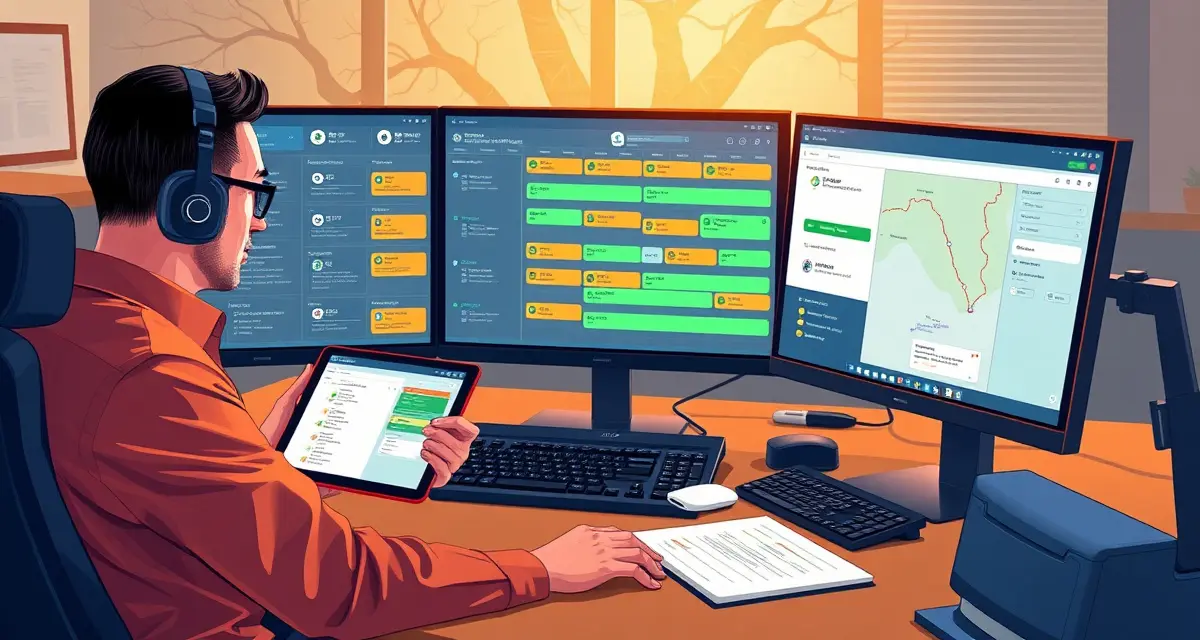
Storm Damage Tree Service Scheduling: Manage Surge Demand Without Losing Jobs
A single major storm event generates an average of 340% normal call volume for tree service companies in affected regions. If you're running 4 crews and your normal capacity is 12 jobs a day, a storm can put 40+ jobs in your queue by 8am. Without a system that was designed for surge, you're triaging with a whiteboard and a phone — and losing jobs to whoever answers faster.
StumpIQ pulls weather forecast data to flag surge days and reorders your dispatch queue by urgency before calls start coming in. When the storm hits, your team is already organized.
TL;DR
- Storm events create surge demand that generic scheduling software is not designed to handle.
- Hazard triage -- classifying emergency jobs by risk level before dispatch -- determines which crews go where first.
- NOAA-integrated storm forecasting allows 24-48 hour preparation before a storm makes landfall or passes through.
- Companies with storm-ready dispatch tools consistently capture more revenue during surge events than those relying on manual processes.
- Pre-built storm damage job types with appropriate hazard classifications reduce intake time during high-volume events.
Why Most Tree Service Software Fails During Storms
Jobber and Arborgold have no storm surge prediction. Dispatchers work from a flat job list with no demand forecasting — jobs sit in a queue ordered by when they came in, not by urgency, crew proximity, or safety risk.
That means a priority hazard tree hanging over a roof gets the same queue position as a standard post-storm cleanup. Your most experienced crew gets assigned based on who's free, not who's closest. Customers with dangerous situations wait while lower-priority jobs get cleared.
That's not a dispatcher failure. It's a tool failure.
The Storm Season Revenue Gap
Companies that handle storm surge well don't just survive the busy period — they grow revenue substantially. Storm work tends to carry higher margins because demand exceeds supply and customers accept premium pricing for fast response. The companies that capture that revenue are the ones that can take and fulfill 3x–4x their normal job volume without falling apart operationally.
The companies that lose it are the ones that miss calls, double-book crews, send the wrong equipment, or can't prioritize emergency jobs at the top of the queue.
How StumpIQ Handles Storm Surge Scheduling
48-Hour Demand Forecasting
StumpIQ integrates with weather forecast data to identify incoming storm events. When significant weather is projected for your service area — wind speeds, precipitation volume, storm severity — the platform flags the surge period and prompts you to pre-position.
This isn't just a calendar alert. It's operational: the system suggests pre-loading your dispatch queue with emergency response capacity, flags which crews to hold back from routine jobs, and surfaces your fastest equipment for priority staging.
You get 48 hours to prepare instead of 0.
Automatic Priority Scoring
When calls come in during a storm, StumpIQ scores incoming jobs by urgency:
- P1 — Immediate hazard: Tree on structure, hanging limbs over occupied areas, blocked road/driveway
- P2 — Safety risk: Leaning trees near structures, large widow-makers, root balls lifting infrastructure
- P3 — Cleanup required: Downed trees in yards, debris clearance, standard post-storm work
Customers can flag urgency during online booking or phone intake. The system auto-assigns P1 jobs to the nearest available crew regardless of queue position.
GPS-Integrated Routing
During surge, crew dispatch becomes a logistics problem. You might have 8 active crews and 60 jobs queued across a 40-mile service area. The optimal routing — which crew goes where, in what order — changes as jobs complete and new ones come in.
StumpIQ's dispatch board updates in real time. As jobs complete, the next assignment automatically surfaces for that crew based on proximity and priority. Dispatchers aren't rebuilding routes from scratch every 20 minutes — the system does that work.
Online Booking for Surge Intake
During a storm event, your phone lines are maxed. StumpIQ's customer booking portal handles intake overflow — customers book online, upload photos of their situation, and get a priority classification without calling. Your team isn't answering the same 3 questions 80 times.
The portal also sets customer expectations on response time by priority level, which reduces the "how long until you get here" calls that clog your phone lines during surge.
Preparing for Storm Season Before It Hits
The best storm season response starts in April, not October. Here's what that looks like in practice:
Review and update your emergency pricing: Storm work justifies surge pricing. Make sure your rate card reflects that and your quoting software applies it automatically to P1/P2 jobs.
Build your emergency crew capacity: Know which subcontractors or additional crews you can call in and have them staged in the system before season starts.
Test your intake volume: Run a drill where someone books 20 jobs in an hour. Does your system handle it? Does your booking portal stay responsive? If not, fix it before June.
Check equipment readiness: Chainsaw chains, chipper blades, bucket truck hydraulics — all of it. Equipment failures during storm surge aren't recoverable. StumpIQ's equipment inspection tracking helps ensure nothing goes to surge season unserviced.
What to Look for in Storm-Ready Dispatch Software
When evaluating any platform's storm handling capability, ask these questions:
- Does it integrate weather forecast data, or do dispatchers manually watch the weather?
- Does the system have job priority scoring, or is it a flat queue?
- Can you increase online booking capacity without a configuration change?
- Does GPS dispatch update in real time during peak load, or does it slow down?
- Is there a mobile app that works for both dispatchers and crew leads in the field?
Most platforms answer "no" to at least three of these. StumpIQ answers "yes" to all five.
StumpIQ Pricing for Storm-Ready Operations
Storm surge forecasting and priority dispatch are included in the Professional plan at $299/mo, which covers 2–5 crew operations. Enterprise at $599/mo adds unlimited crews and multi-location dispatch for companies covering larger service areas or running regional operations across storm corridors.
Solo at $149/mo doesn't include storm forecasting — it's designed for single-crew operators. If you're running more than one crew and operating in a storm-prone region, Professional is the tier you need.
Get Started with StumpIQ
Storm events are peak revenue periods for prepared tree service companies. StumpIQ's storm dispatch tools -- hazard triage, priority queuing, and NOAA weather integration -- give you the infrastructure to handle surge volume efficiently. If storm response is a meaningful part of your market, the right tools make a real difference.
FAQ
How do I manage too many storm damage calls at once?
The key is having a system that scores and prioritizes calls automatically instead of processing them in order of arrival. StumpIQ assigns urgency levels to incoming jobs based on hazard type, and P1 jobs (tree on structure, hanging limbs over occupied areas) jump the queue automatically. Combine that with an online booking portal that handles overflow intake without phone calls, and you can process 3x–4x normal volume without staffing a crisis call center.
Can tree service software predict storm demand in advance?
StumpIQ does this by integrating with weather forecast data to flag incoming surge events 48 hours ahead. When significant storm activity is projected for your service area, the platform surfaces it and suggests operational prep steps — pre-positioning crews, front-loading emergency capacity, staging equipment. No other major tree service software platform includes this. Arborgold and Jobber have no storm demand forecasting; dispatchers have to watch weather apps independently and react manually.
How do I prioritize emergency tree jobs during a storm?
Build a three-tier system: P1 for immediate structural or safety hazards, P2 for significant risk situations, P3 for cleanup and standard post-storm work. StumpIQ automates this classification based on job intake data and auto-assigns P1 jobs to the nearest available crew regardless of existing queue position. The customer who called after someone else but has a tree on their roof gets served first — which is both the right safety call and the one they'll pay a premium for.
What is storm surge management for tree service companies?
Storm surge management refers to the tools and processes that allow a tree service company to handle a sudden spike in emergency call volume following a severe weather event. Key capabilities include: priority dispatch based on hazard level, rapid job intake for incoming calls, pre-positioned crew scheduling before the storm, and customer communication at scale during a surge period.
How do tree service companies prepare for a storm before it arrives?
Preparation includes: extending crew availability windows, pre-positioning equipment near the projected impact area, notifying customers on maintenance contracts, setting up an emergency job intake queue, and briefing crews on the hazard classification system they will use during the event. Software with NOAA integration can trigger preparation workflows automatically when a watch or warning is issued.
What is the revenue opportunity from storm work for a tree service company?
Storm response revenue varies significantly by event severity and company capacity. A well-prepared company in a moderate storm area can generate 2-5x normal weekly revenue during a surge event. Companies with better dispatch tools capture more of this opportunity because they can take and route more jobs faster than competitors managing surge manually.
Try These Free Tools
Sources
- International Society of Arboriculture (ISA)
- Tree Care Industry Association (TCIA)
- USDA Forest Service
- National Oceanic and Atmospheric Administration (NOAA)