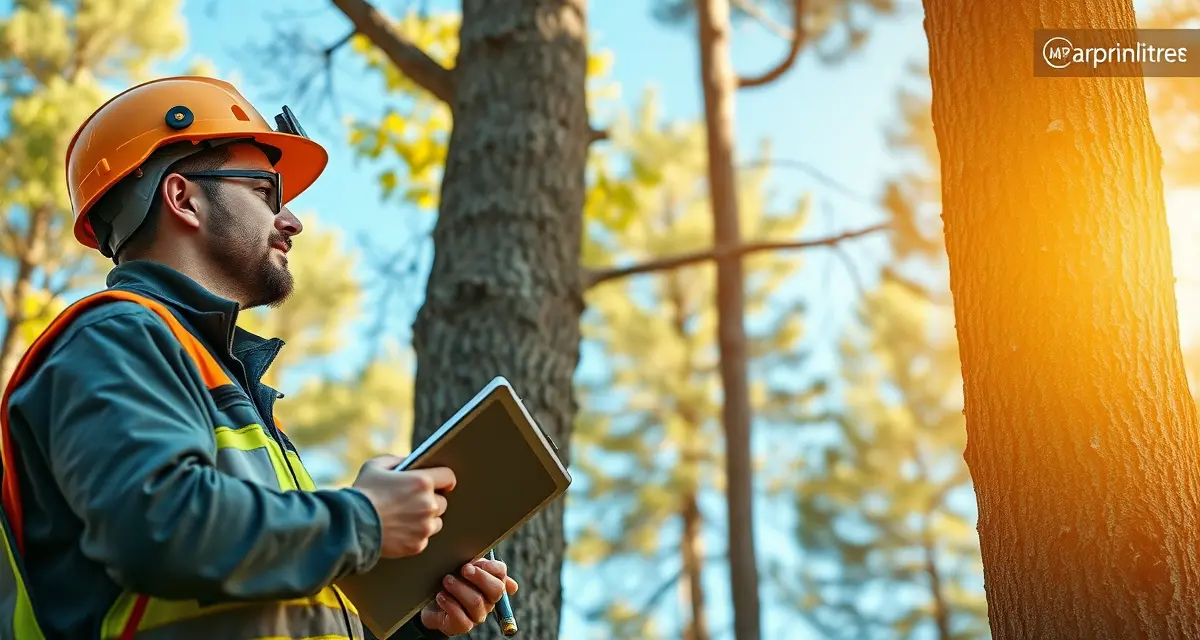
How to Conduct Tree Health Assessments: A Field Arborist's Guide
Professional tree health assessments average $175-350 per assessment, a high-value service that most tree companies leave on the table without a formal offering. The barrier isn't skill. It's usually time: field assessment is fast, but building the report afterward takes 1-2 hours without the right tools.
No major tree service platform has a structured health assessment form. Arborists use paper condition forms and build reports in Word later. StumpIQ's health assessment module guides field arborists through ISA condition rating criteria and generates a formatted report from mobile inputs.
This guide covers how to conduct thorough assessments efficiently and produce reports your clients can actually use.
TL;DR
- Tree service companies that adopt purpose-built software reduce administrative time by an average of 5-8 hours per week.
- AI photo-to-quote converts a field photo to a priced proposal in under 2 minutes -- compared to 30-45 minutes for manual estimates.
- ANSI Z133 compliance documentation created automatically in the field reduces insurance audit preparation time.
- ISA certification tracking prevents lapses that affect eligibility for municipal, utility, and commercial contracts.
- GPS dispatch with route optimization saves 15-20% of daily drive time for multi-crew operations.
The ISA Condition Rating Framework
The ISA TRAQ (Tree Risk Assessment Qualification) framework provides the standard language and structure for professional tree health and risk assessment. You don't need TRAQ certification for basic health assessments, but using the ISA condition rating system gives your reports credibility and ensures they meet the standards that municipal, insurance, and commercial clients require.
ISA Overall Tree Condition Rating:
- Excellent: No defects, vigorous growth, excellent structure
- Good: Minor defects, good vigor, sound structure
- Fair: Moderate defects, declining vigor, or structural concerns
- Poor: Multiple defects, declining health, notable structural issues
- Critical: Severe defects, imminent failure risk
- Dead or Dying: No viable canopy or imminent complete failure
Your assessment should rate each tree against these criteria based on observable conditions. For a basic health assessment, the visible crown, trunk, root flare, and root zone are your primary assessment areas.
Preparing for a Health Assessment Visit
Before arriving at the property, review the client's tree inventory record if they're an existing customer. Do any prior assessments note conditions that should be checked? Are there prior recommendations that haven't been implemented?
Equipment for every health assessment:
- Mallet for hollow sound testing
- 5-10x hand lens for bark and foliage detail
- Tape measure for trunk diameter measurement
- Camera or phone with StumpIQ assessment app
- Probe tool or penknife for wood sampling if decay is suspected
Documentation plan:
- Photo of the full tree, four directions if the situation warrants
- Photo of any specific condition of concern
- Photo of root flare and any surface root concerns
- Photo of crown, specifically any deadwood or structural issue
Conducting the Assessment: The Systematic Approach
A systematic assessment of each tree covers five zones. Do them in the same order every time. Consistency reduces the chance of missing something.
Zone 1: Root Zone
Start with the root flare and visible root zone, before looking up. What you see below often explains what you see above.
What to assess:
- Root flare definition: Is the trunk bell shape visible, or is the tree buried too deep?
- Surface root damage: Mechanical damage from mowing, paving, or construction
- Girdling roots: Are surface roots circling the trunk?
- Soil compaction: Hard, bare soil in the root zone is a stress indicator
- Fungal fruiting bodies: Conks or mushrooms at the base indicate internal decay
In StumpIQ: Enter root zone observations through the guided prompts. The app asks specifically about girdling roots, soil conditions, and fungal indicators.
Zone 2: Trunk
The trunk reveals structural condition and past damage history.
What to assess:
- Cracks and cavities: Size, depth, and orientation of any trunk defects
- Wound response: Are prior wounds callusing properly or remaining open?
- Bark abnormalities: Cankers, soft spots, bark inclusion, or discoloration
- Hollow sound: Strike the trunk with a mallet. Dead sound indicates internal cavity
- Lean: Is the lean notable? Is soil mounding or cracking at the base?
Zone 3: Structural Branch Unions
Where major branches meet the trunk is where most structural failures originate.
What to assess:
- Included bark: Bark tissue embedded in a branch union indicates weak attachment
- Codominant stems: Two stems of similar diameter with included bark is a high-failure risk
- Cracks: Any visible cracks at or near branch unions
- Deadwood in major scaffold branches: Large deadwood in primary scaffolding
Zone 4: Crown Structure
What to assess:
- Crown density: Full, reduced, or sparse?
- Crown dieback: What percentage of the crown is dead or dying?
- Leaf condition: Normal color, size, and density, or showing stress?
- Disproportionate lean in the crown: Crown leaning considerably beyond trunk lean
- Mechanical damage: Broken branches, storm scars, inappropriate pruning
Zone 5: Surroundings
What to assess:
- Proximity to targets: Structures, vehicles, utility lines, public areas
- Species in vicinity: Is there a pathogen or pest affecting nearby trees of the same species?
- Soil changes: Recent grading, trenching, or paving that affected root zone
- Previous work: Evidence of past pruning or treatment
Generating the Report
Without software, this is the 90-minute step. You return to the vehicle, open Word, and reconstruct your observations from field notes and photos. The final report has observations organized by section, condition ratings, and recommendations.
With StumpIQ's health assessment module, the report generates from the mobile inputs you made during the assessment. You complete the five-zone evaluation through guided prompts in the app. When you finish the last zone, you select Generate Report.
The output is a formatted PDF with your company header, the customer's information, the tree inventory details, condition ratings by zone with your observations, photos attached to the relevant sections, an overall condition rating, and recommended actions with suggested timing.
The report is client-ready in under 5 minutes of formatting review.
StumpIQ's tree health assessment software includes the assessment workflow and report generation. ISA certification tracking maintains your TRAQ and other credentials that establish your qualification for assessment reports.
Writing Recommendations That Clients Follow
The recommendations section of your report determines whether you generate follow-up revenue from the assessment.
Be specific: "Remove deadwood in east scaffold branch, approximately 3-inch diameter" is actionable. "Pruning recommended" is not.
Use clear risk language: "The included bark union at the southwest scaffold branch has a 40-60% failure probability in high wind without cable installation" communicates urgency better than "structural concern noted."
Prioritize recommendations: Label each recommendation as Immediate (within 30 days), Within One Year, or Monitor. Clients can act on priorities. A list of 8 recommendations without prioritization creates paralysis.
Connect recommendations to consequences: "Without removing the large deadwood in the upper crown, the first notable wind event will likely deposit that wood in the driveway or on the vehicle below." Specific consequences motivate specific action.
Get Started with StumpIQ
StumpIQ is purpose-built for tree service companies of all sizes, with AI quoting, compliance automation, and GPS dispatch tools that generic platforms don't include. If you are evaluating software for your operation, StumpIQ is a useful starting point for comparison.
Frequently Asked Questions
What should a tree health assessment include?
A complete tree health assessment covers the five zones: root zone condition, trunk integrity, structural branch unions, crown health, and site surroundings. The report should include ISA condition ratings, photos of conditions of concern, specific recommendations prioritized by urgency, and overall condition classification. The ISA TRAQ framework provides the standard structure for professional assessment documentation.
How do I rate tree condition using the ISA framework?
The ISA overall tree condition rating uses six categories: Excellent, Good, Fair, Poor, Critical, and Dead/Dying. The rating reflects a composite assessment of structural integrity, vigor, and defect severity. Each zone assessment contributes to the overall rating, with structural defects typically weighing more heavily than vigor indicators for risk-oriented assessments.
Can I generate a tree health report on my phone?
Yes. StumpIQ's mobile health assessment module guides you through the five-zone evaluation with specific prompts for each condition category. When the assessment is complete, the system generates a formatted PDF report with your observations, photos, condition ratings, and recommendations. The report is ready for client delivery within minutes of completing the field assessment.
What makes tree service software different from generic field service platforms?
Tree service software is built around arborist-specific workflows: AI species identification for field quoting, ANSI Z133 safety checklists, ISA certification tracking, storm demand forecasting, and hazard-level job classification. Generic field service platforms can be configured to approximate these workflows, but doing so requires weeks of manual setup and still produces a less accurate result for tree-specific job types.
How do tree service companies evaluate software before buying?
The most effective approach: identify your top 3 operational pain points, ask vendors to demonstrate those specific scenarios in a live demo, check user reviews on Capterra and G2 for patterns, and request a trial period to test with real job data. Ask specifically about mobile performance in the field, since most tree service work happens away from the office.
What is the ROI of tree service software for a small company?
For a 2-3 crew operation, purpose-built tree service software typically recovers its cost through: faster quoting that wins more bids, invoicing on the day of job completion rather than days later, reduced administrative hours, and fuel savings from route optimization. Most companies report positive ROI within 60-90 days of full adoption.
Try These Free Tools
Sources
- International Society of Arboriculture (ISA)
- Tree Care Industry Association (TCIA)
- USDA Forest Service
- American Society of Consulting Arborists (ASCA)