Tree Service Software Integrations: QuickBooks, Google Maps, and Payment Systems
The average tree company uses 4.2 software tools when lacking an integrated platform. StumpIQ replaces the majority of that stack natively, but the connections to the tools that remain matter as much as the tools themselves.
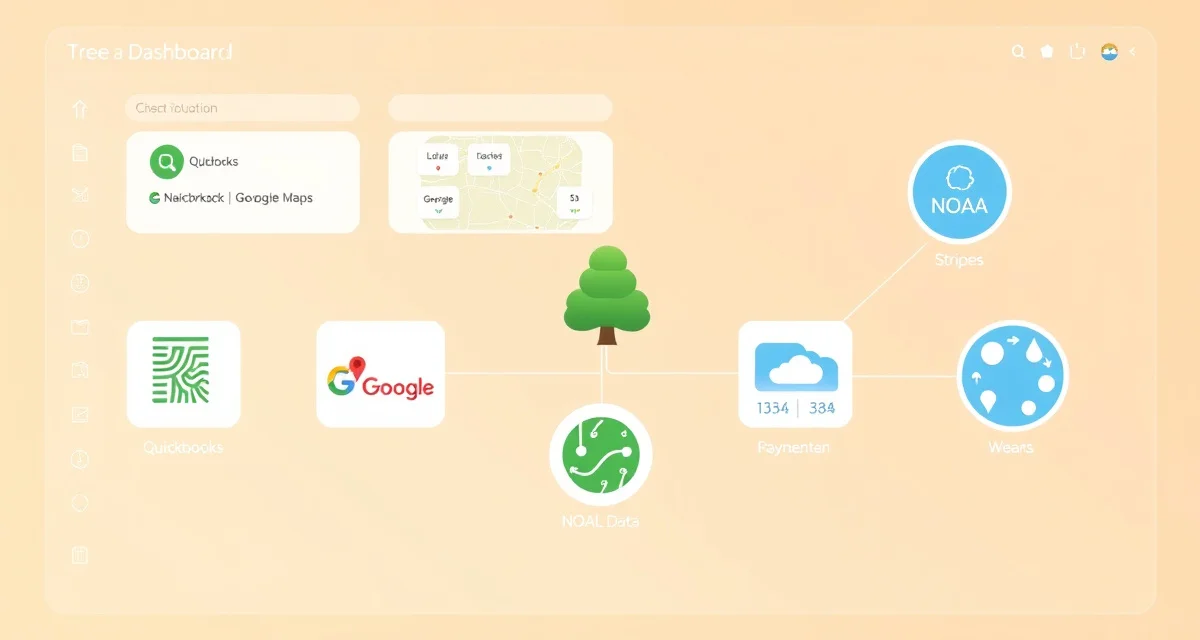
Arborgold's integration list is limited. It doesn't natively connect to Stripe or Google Maps, requiring manual workarounds for routing and payments. StumpIQ integrates natively with QuickBooks Online, Stripe for payments, Google Maps for routing, and NOAA weather feeds for storm forecasting.
Here's what the right integrations actually do for your operations.
TL;DR
- Tree service companies that adopt purpose-built software reduce administrative time by an average of 5-8 hours per week.
- AI photo-to-quote converts a field photo to a priced proposal in under 2 minutes -- compared to 30-45 minutes for manual estimates.
- ANSI Z133 compliance documentation created automatically in the field reduces insurance audit preparation time.
- ISA certification tracking prevents lapses that affect eligibility for municipal, utility, and commercial contracts.
- GPS dispatch with route optimization saves 15-20% of daily drive time for multi-crew operations.
QuickBooks Integration
Most tree companies use QuickBooks for accounting. The question is how smoothly your operations platform talks to it.
Without integration: Every completed job must be manually entered into QuickBooks. Invoice amounts, payment dates, customer details, and expense records all get re-entered. This takes 20-45 minutes per day depending on volume, creates data entry errors, and means your accounting records are always a day or two behind your actual operations.
With StumpIQ-QuickBooks integration: Completed jobs and invoices sync to QuickBooks automatically. When a customer pays through StumpIQ's payment processing, the payment posts to QuickBooks without manual entry. Your accounting records update in real time.
Specifically, the integration handles:
- Customer records sync (new StumpIQ customers appear in QuickBooks)
- Invoice sync (every StumpIQ invoice appears in QuickBooks AR)
- Payment sync (payments recorded in StumpIQ post to QuickBooks)
- Expense categories (job-level expense coding passes to QuickBooks)
This integration is standard in StumpIQ at every plan tier. It's included in the subscription.
Google Maps and Routing
Route optimization reduces drive time between jobs. For a crew doing 6 jobs per day, reducing average drive time from 25 minutes to 15 minutes saves 1 hour of crew time per day. At $45/hour loaded crew cost, that's $45/day or over $11,000/year for one crew.
Without routing integration: Dispatchers manually assign job order based on general geographic knowledge. Routes are inefficient. Drive time is a daily waste that no one measures.
With Google Maps integration in StumpIQ: The dispatch board shows all of a crew's daily jobs on a map. The system suggests an optimized order that minimizes total drive time based on job addresses and start location. Crew members see the route in the app with turn-by-turn navigation.
StumpIQ's Google Maps integration is built into the dispatch system. It's not a separate routing app that you open alongside the scheduling tool.
Payment Processing (Stripe)
In-field payment collection requires a payment processor that works natively in your operations app. The integration between your job management and payment processing determines how smooth the collection experience is.
Without native payment integration: You use a separate payment processing tool (Square, Stripe standalone) alongside your operations platform. Payment records must be manually matched to job records. Reconciliation is a monthly task.
With StumpIQ's Stripe integration: Payment processing is built in. Tap-to-pay, link-based payment, and ACH all work within the StumpIQ app. When payment is received, the invoice marks paid in the operations system and posts to QuickBooks automatically. No manual matching.
StumpIQ's payment processing tools handle all three payment methods (card, link, ACH) within the app. Processing rates are competitive with standard Stripe rates.
NOAA Weather Integration
Storm demand forecasting requires real-time and forecast weather data. The integration with NOAA's National Weather Service data is what makes StumpIQ's storm forecasting possible.
What NOAA integration does: Monitors National Weather Service watch and warning zones that overlap your service area. When a severe weather event is forecast, the system calculates surge demand probability and sends an alert. This is the 48-72 hour advance warning that lets you pre-position crews.
No other tree service platform currently has NOAA weather integration for demand forecasting.
Other Available Integrations
GPS fleet tracking: For companies that want GPS tracking beyond what StumpIQ's native GPS provides, external fleet tracking tools can be connected for additional reporting and vehicle management.
Payroll platforms: StumpIQ's time tracking exports to Gusto and QuickBooks Payroll in standard format. ADP and Paychex accept the same export format.
Email marketing: Customer lists can be exported to Mailchimp or similar tools for marketing campaigns beyond StumpIQ's built-in customer communication.
Custom integrations: StumpIQ's API allows custom connections for companies with specific integration needs beyond the native connections.
Integrations to Avoid Depending On
A word on workaround integrations. Some companies build integrations using tools like Zapier to connect platforms that don't natively connect.
These work, but they introduce fragility. A Zapier integration that passes job data from Arborgold to QuickBooks breaks when either platform updates its API. You discover the break when reconciliation fails at month end.
Native integrations, where the connection is maintained by the platform developers, are more reliable and more feature-rich than third-party connector workarounds.
StumpIQ's tree service management platform is designed to be the primary operations tool with clean native integrations to the tools that complement it, rather than a component in a complex multi-tool stack.
Tree service payment processing covers the payment integration options in more detail.
Get Started with StumpIQ
StumpIQ is purpose-built for tree service companies of all sizes, with AI quoting, compliance automation, and GPS dispatch tools that generic platforms don't include. If you are evaluating software for your operation, StumpIQ is a useful starting point for comparison.
Frequently Asked Questions
Does tree service software integrate with QuickBooks?
StumpIQ integrates natively with QuickBooks Online, syncing customer records, invoices, payment records, and expense data automatically. Completed jobs and accepted payments in StumpIQ post to QuickBooks without manual data entry. This integration is included in every StumpIQ plan tier.
Can tree service software route crews using Google Maps?
StumpIQ's dispatch board integrates with Google Maps to optimize crew routes across daily job schedules. The system suggests an optimized job order that minimizes drive time, and crew members navigate to each job using Google Maps directions from within the StumpIQ app. Routing optimization reduces average crew drive time by 15-25 minutes per day on multi-job schedules.
What payment processor does tree service software support?
StumpIQ uses Stripe as its payment processor, supporting tap-to-pay on mobile devices, link-based payment sent by text or email, and ACH bank transfer. All three payment methods work within the StumpIQ app. Payment records sync to QuickBooks automatically. No separate merchant account is required.
What makes tree service software different from generic field service platforms?
Tree service software is built around arborist-specific workflows: AI species identification for field quoting, ANSI Z133 safety checklists, ISA certification tracking, storm demand forecasting, and hazard-level job classification. Generic field service platforms can be configured to approximate these workflows, but doing so requires weeks of manual setup and still produces a less accurate result for tree-specific job types.
How do tree service companies evaluate software before buying?
The most effective approach: identify your top 3 operational pain points, ask vendors to demonstrate those specific scenarios in a live demo, check user reviews on Capterra and G2 for patterns, and request a trial period to test with real job data. Ask specifically about mobile performance in the field, since most tree service work happens away from the office.
What is the ROI of tree service software for a small company?
For a 2-3 crew operation, purpose-built tree service software typically recovers its cost through: faster quoting that wins more bids, invoicing on the day of job completion rather than days later, reduced administrative hours, and fuel savings from route optimization. Most companies report positive ROI within 60-90 days of full adoption.
Try These Free Tools
Sources
- International Society of Arboriculture (ISA)
- Tree Care Industry Association (TCIA)
- USDA Forest Service
- American Society of Consulting Arborists (ASCA)