How to Manage a Deep Root Fertilization Program for Tree Customers
Deep root fertilization programs have a 78% annual renewal rate when customers receive timely reminders. That drops to 23% when reminders are missed. That gap is entirely a process problem, and it's entirely fixable.
ArboStar tracks fertilization history but has no automated return-visit scheduling or customer notification for annual treatment reminders. Companies using it remember to remind some customers and forget others. The customers who don't get reminders renew at 23%. The ones who do renew at 78%. The difference is a system.
This guide covers how to build a fertilization program that turns one-time applications into reliable annual revenue.
TL;DR
- Tree service companies that adopt purpose-built software reduce administrative time by an average of 5-8 hours per week.
- AI photo-to-quote converts a field photo to a priced proposal in under 2 minutes -- compared to 30-45 minutes for manual estimates.
- ANSI Z133 compliance documentation created automatically in the field reduces insurance audit preparation time.
- ISA certification tracking prevents lapses that affect eligibility for municipal, utility, and commercial contracts.
- GPS dispatch with route optimization saves 15-20% of daily drive time for multi-crew operations.
Why Deep Root Fertilization Is a High-Value Service
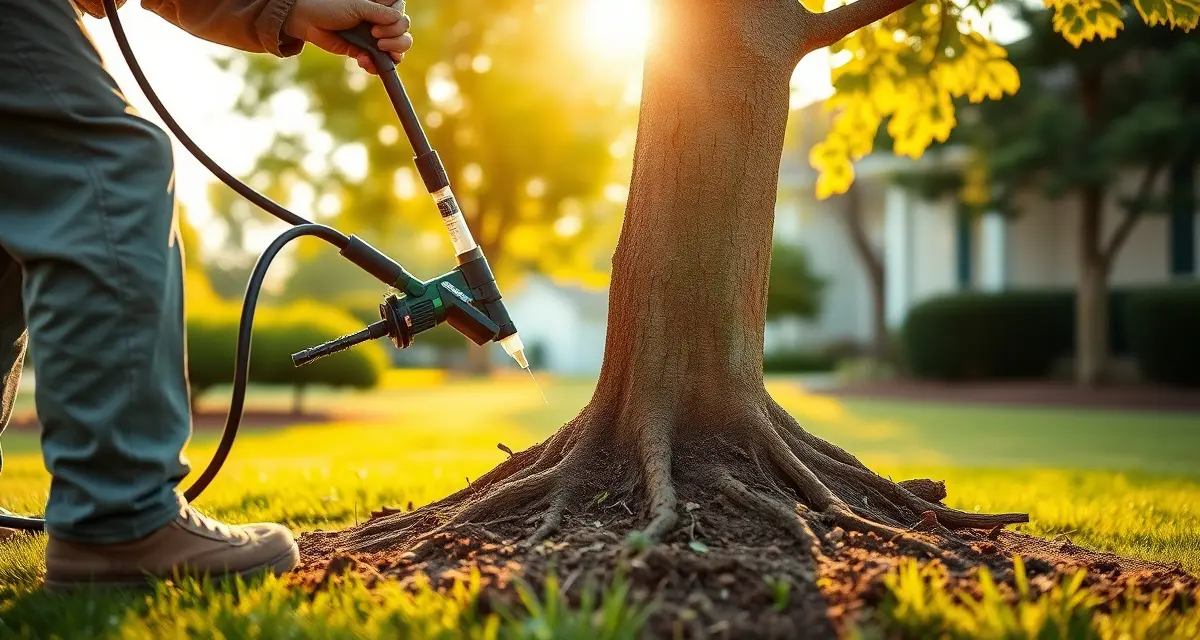
Deep root fertilization, injecting liquid fertilizer solutions directly into the soil at root depth, delivers nutrients that surface applications can't reach efficiently in compacted or competitive soils. For trees in maintained landscapes, parking lots, street tree planting strips, and areas with competing turf, it's often the most effective treatment available.
From a business perspective, it's an annual recurring service with low crew time requirements, high margin, and strong renewal rates when managed well. A single application takes 45-90 minutes for a residential site. At $250-450 per application, the margin is excellent.
Setting Up Your Fertilization Service
Equipment requirements:
Deep root fertilization requires a soil injection system. Options:
- Hydraulic soil injector (most common): A probe attached to a pump unit, injecting fertilizer solution under pressure at 8-12 inch depth. Cost: $800-2,500.
- Gas-powered units: More output for commercial sites but higher initial cost. Cost: $3,000-6,000.
- Backpack unit: Low-volume option for smaller sites. Cost: $300-600.
You'll also need a mixing tank for solution preparation, appropriate fertilizer products (soil analysis guides selection), and PPE for fertilizer handling.
Product selection:
The fertilizer formulation should match the soil conditions and tree species. A soil test before the first application identifies deficiencies that guide product selection. For a standard residential program without soil testing, a balanced NPK formulation (typically 30-10-8 or similar) applied at label rates is a workable starting point.
Specialty applications (iron supplementation for chlorosis, calcium for soil structure, etc.) require specific product selection based on visible or tested deficiency symptoms.
Application rates and spacing:
Injection spacing of 18-24 inches in a grid pattern under the drip line, at 8-12 inch injection depth, at manufacturer-recommended rates. For large trees, extend the injection zone to 1.5 times the drip line radius to reach the full active root zone.
Building the Fertilization Program Workflow
Initial Assessment
Before recommending fertilization, assess whether it's indicated. Trees with healthy foliage, good growth rate, and no stress symptoms may not need supplemental fertilization. Overfertilizing causes its own problems.
Document the baseline condition at the first application. Photo the canopy, note foliage color and density, and measure growth increment if visible. This baseline lets you demonstrate the program's benefit at the annual renewal conversation.
Service Agreement
Structure fertilization as a service agreement, not a one-time job.
A clear agreement covers:
- Service frequency (annual, biannual, or as-needed)
- Product type and application rate
- Price per application
- Scheduling terms (spring, fall, or specific months)
- Customer notification process
The agreement makes renewal an expectation, not a re-sell. When renewal time comes, you're confirming an expected visit, not convincing a customer to buy something new.
Scheduling and Reminders
StumpIQ's deep root fertilization scheduling includes automated return-visit scheduling tied to the original application date. When you complete a fertilization job and close it in StumpIQ, the system automatically schedules a reminder for the customer outreach window, typically 10-11 months later for annual programs.
The reminder appears in your dashboard as a scheduled outreach task. You (or your office) send the confirmation message to the customer:
"Hi [Name], it's [month] and time for your annual tree fertilization. We'd like to schedule your spring application. When are you available? Expect about an hour on-site."
StumpIQ's tree service management tools also let you run a seasonal campaign targeting all customers with past fertilization jobs due for renewal in a given window. A February campaign targeting all customers with spring fertilization programs books the season's schedule before demand peaks.
Treatment Record Keeping
For each tree treated, record:
- Species and DBH
- Product applied and application rate
- Date and technician
- Soil conditions at application
- Any observations (pest activity, canopy changes, soil anomalies)
This record is your evidence of program history when the customer asks "is this actually working?" or when you're recommending a product change based on response.
In StumpIQ, treatment records attach to the tree inventory for each customer's property. The next technician who visits the property can see the full fertilization history without asking the customer to recall past applications.
Pricing Fertilization Programs
Standard deep root fertilization pricing runs $8-15 per DBH inch for residential applications, with minimums of $150-250 per site visit. The wide range reflects regional market variation and service scope.
A 12-inch oak gets $96-180 per application at $8-15 per inch. A property with three trees of that size gets $288-540 per annual application. At these prices, the margin on a well-organized route is excellent.
Commercial and HOA fertilization programs run lower per-inch rates for volume (often $5-8/inch) but generate larger total invoices from the number of trees treated.
Upsell Opportunities During Fertilization Visits
A fertilization visit puts your technician at the property for 45-90 minutes. Use that time to observe and record.
What to look for:
- Pest and disease indicators: Scale insects, borers, leaf disease, root rot symptoms
- Structural concerns: Cracks, cavities, included bark, co-dominant stems
- Deadwood: Obvious deadwood that a crew should address
- Other trees on the property not in the fertilization program: Are there trees that would benefit from adding to the program?
Every observation should go into StumpIQ's tree inventory record for the property. notable findings should generate a follow-up communication:
"During your fertilization visit today, our technician noticed what appears to be an emerald ash borer infestation in your ash tree. We'd recommend a treatment consultation. Want to schedule an assessment?"
This observation-to-recommendation workflow turns a routine fertilization visit into additional revenue for both pest management and assessment services.
Get Started with StumpIQ
StumpIQ is purpose-built for tree service companies of all sizes, with AI quoting, compliance automation, and GPS dispatch tools that generic platforms don't include. If you are evaluating software for your operation, StumpIQ is a useful starting point for comparison.
Frequently Asked Questions
How do I set up a recurring fertilization program for tree customers?
Create a service agreement that specifies the treatment schedule, product, and pricing. When the initial application is completed in StumpIQ, the system schedules an automatic outreach reminder for the renewal window. When the reminder fires, your team sends a confirmation message and books the return visit. The automated reminder is what keeps renewal rates high.
What is the right treatment interval for deep root fertilization?
Most deep root fertilization programs run annually for actively managed landscape trees. Trees under notable stress (compacted soil, drought, construction impact) may benefit from biannual applications. Trees in lower-competition, naturally fertile soils may need treatment every 2-3 years. A soil test before the first application identifies deficiencies that guide the frequency recommendation.
How do I track fertilization products and rates per tree?
StumpIQ's tree inventory module stores fertilization history per tree, including product, application rate, date, and technician. For each tree in the fertilization program, the record shows the complete treatment history. This documentation supports warranty claims, insurance requirements for commercial property treatments, and renewal conversations where the customer wants to see what they've been getting.
What makes tree service software different from generic field service platforms?
Tree service software is built around arborist-specific workflows: AI species identification for field quoting, ANSI Z133 safety checklists, ISA certification tracking, storm demand forecasting, and hazard-level job classification. Generic field service platforms can be configured to approximate these workflows, but doing so requires weeks of manual setup and still produces a less accurate result for tree-specific job types.
How do tree service companies evaluate software before buying?
The most effective approach: identify your top 3 operational pain points, ask vendors to demonstrate those specific scenarios in a live demo, check user reviews on Capterra and G2 for patterns, and request a trial period to test with real job data. Ask specifically about mobile performance in the field, since most tree service work happens away from the office.
What is the ROI of tree service software for a small company?
For a 2-3 crew operation, purpose-built tree service software typically recovers its cost through: faster quoting that wins more bids, invoicing on the day of job completion rather than days later, reduced administrative hours, and fuel savings from route optimization. Most companies report positive ROI within 60-90 days of full adoption.
Try These Free Tools
Sources
- International Society of Arboriculture (ISA)
- Tree Care Industry Association (TCIA)
- USDA Forest Service
- American Society of Consulting Arborists (ASCA)