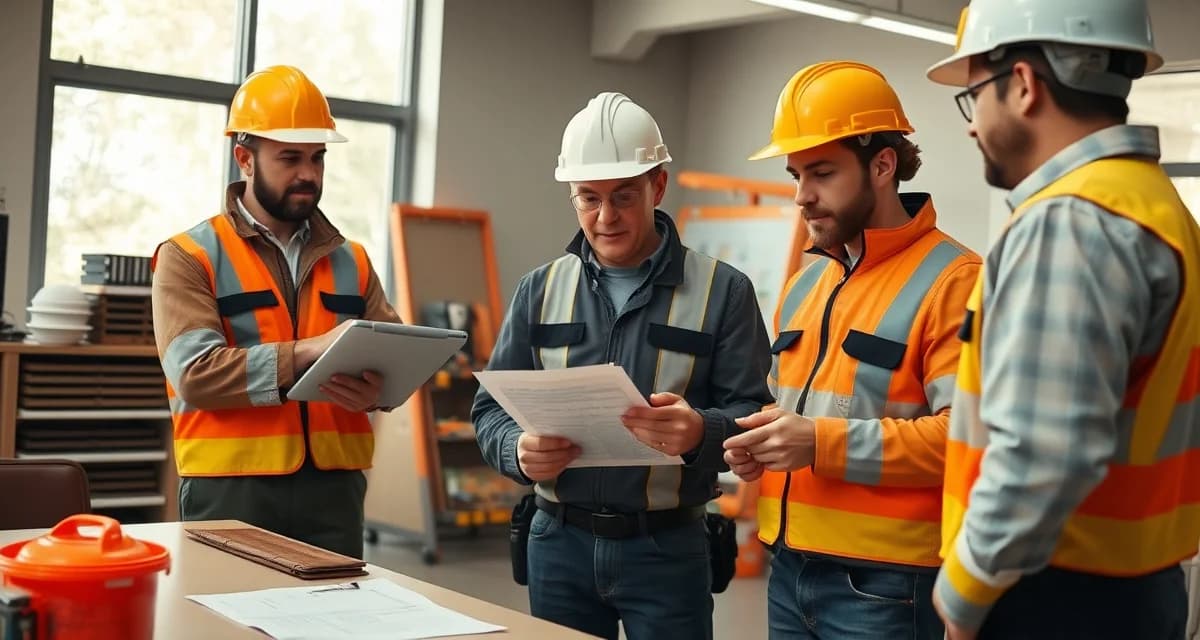
Tree Service Near-Miss Reporting: Why and How to Document Close Calls
OSHA safety research shows that for every workplace fatality, there are approximately 600 near-miss incidents in the same operation. Tree service has one of the highest fatality rates of any trade in the US. That math should focus every tree company owner's attention on near-miss reporting.
A near-miss is exactly what it sounds like, an event that came close to causing injury or death but didn't. A branch that fell four feet from where a crew member was standing. A chipper kickback that nobody got caught in. A climber's rope that slipped before the backup caught it. These events end without injury. They also signal that a real incident is close.
No competitor platform has a near-miss reporting module, tree companies log near-misses in paper forms or not at all. StumpIQ's safety module includes mobile near-miss reporting tied to the specific job, crew, and equipment involved, creating an actionable record.
TL;DR
- Tree service companies that adopt purpose-built software reduce administrative time by an average of 5-8 hours per week.
- AI photo-to-quote converts a field photo to a priced proposal in under 2 minutes -- compared to 30-45 minutes for manual estimates.
- ANSI Z133 compliance documentation created automatically in the field reduces insurance audit preparation time.
- ISA certification tracking prevents lapses that affect eligibility for municipal, utility, and commercial contracts.
- GPS dispatch with route optimization saves 15-20% of daily drive time for multi-crew operations.
Why Should Tree Service Companies Track Near-Miss Incidents?
Near-misses are the most valuable safety data your company generates, and most companies throw it away.
The reason to report and analyze near-misses isn't legal compliance, there's no OSHA requirement to report near-misses (unlike injuries, which trigger reporting requirements). The reason is prediction. Near-miss patterns tell you where your next injury is coming from before it happens.
If your crew reports three near-misses involving chipper operation in a 6-month period, you know you have a chipper safety problem before anyone loses a hand. If two of those three near-misses involved the same piece of equipment, you know you have a maintenance issue. If all three happened on the same crew, you know you have a training or supervision gap.
Without reporting, you have zero data. You're waiting for an injury to tell you what the near-misses would have told you months earlier, at a fraction of the cost in human and financial terms.
Companies that run active near-miss reporting programs typically see injury rates drop 20-40% over 2-3 years. The mechanism is straightforward: you find the hazards, you fix them, and incidents that would have become injuries don't happen.
How Do I Set Up a Near-Miss Reporting System for My Crew?
A near-miss reporting system needs two things to work: a process that makes reporting easy, and a culture that makes reporting normal. The systems problem is easier to solve than the culture problem.
Step 1: Remove every barrier to reporting. If reporting a near-miss requires filling out a 4-page form, submitting to a supervisor who might view it negatively, or wondering whether it will affect your employment status, crews won't report. The easier and more consequence-free reporting is, the more you get.
A mobile-first reporting tool that takes 2-3 minutes to complete, description of the event, location, equipment involved, contributing factors, captures reports in the moment, before details are forgotten. Paper forms in the truck work only if crews actually complete them and supervisors actually collect and review them, which rarely happens consistently.
Step 2: Connect reports to specific jobs, crews, and equipment. A near-miss report that says "something happened with the chipper" is almost useless. A report linked to a specific job address, the crew that was working it, the specific piece of equipment involved, and a description of the contributing factors is actionable. StumpIQ's safety module ties near-miss reports to job records, crew assignments, and equipment, so the analysis work is already started when the report comes in.
Step 3: Close the loop with crew. If crews report near-misses and never hear anything back, they'll stop reporting. After every near-miss report, acknowledge it. Investigate the contributing factors. If you make a change as a result, additional training, equipment replacement, procedure update, tell the crew that their report led to that change. This is what builds a reporting culture: showing that reports produce action, not just paperwork.
Step 4: Review reports as a pattern, not just events. A single near-miss report is a data point. Ten near-miss reports over a season are a pattern. Review your reports monthly to look for repeated equipment, locations, activities, or crew configurations. That pattern analysis is where the prevention value lives.
Step 5: Act before the injury. When a pattern emerges, act on it. Replace the equipment with repeated failures. Schedule additional training for the activity with repeated close calls. Review the procedure that contributed to multiple near-misses. The whole point of near-miss data is to intervene before the 601st event becomes a fatality.
Does Near-Miss Tracking Reduce Tree Service Injury Rates?
Yes, consistently, when the program is implemented with genuine reporting culture and management follow-through.
The mechanism is evidence-based safety management rather than assumption-based safety management. Most tree companies manage safety by posting rules and conducting occasional toolbox talks. That approach addresses general hazards but doesn't find the specific failure modes active in your operation right now.
Near-miss data finds those specific failure modes. When you know that your crew has had three close calls involving working in the drop zone of a specific job type, you can redesign your procedure for that job type before anyone gets hurt. That's the difference between reactive and preventive safety management.
Insurance carriers increasingly look at near-miss reporting programs as evidence of mature safety management. Companies with documented programs and low injury rates after implementing near-miss tracking sometimes qualify for favorable treatment at workers' comp renewal. The financial case runs the same direction as the safety case.
Tree service is a genuinely dangerous trade. The companies that build lasting safety records aren't the ones who got lucky, they're the ones who built systems to find and fix hazards before they become incidents. Near-miss reporting is the foundation of that system.
For more on safety tools and documentation, see our guides on tree service safety dashboard and tree service safety incident reporting.
Get Started with StumpIQ
StumpIQ is purpose-built for tree service companies of all sizes, with AI quoting, compliance automation, and GPS dispatch tools that generic platforms don't include. If you are evaluating software for your operation, StumpIQ is a useful starting point for comparison.
Why should tree service companies track near-miss incidents?
Near-miss data is predictive where injury data is retrospective. OSHA research shows 600 near-misses precede every workplace fatality in a given operation. Companies that capture and analyze near-miss patterns identify hazardous conditions before they produce injuries, typically seeing 20-40% injury rate reductions after implementing active reporting programs.
How do I set up a near-miss reporting system for my crew?
Reduce friction first, mobile reporting that takes 2-3 minutes beats paper forms. Connect reports to specific jobs, crews, and equipment so the data is actionable. Close the loop with crew by acknowledging reports and communicating when their reports produced changes. Review for patterns monthly and act on them before the next incident.
Does near-miss tracking reduce tree service injury rates?
Yes, in companies where reporting is genuinely encouraged and management acts on the data. The key variables are reporting culture (crews won't report if they fear consequences) and management follow-through (every report that gets filed and ignored teaches the crew that reporting doesn't matter). Programs that get both right consistently produce injury rate reductions over 2-3 years.
What makes tree service software different from generic field service platforms?
Tree service software is built around arborist-specific workflows: AI species identification for field quoting, ANSI Z133 safety checklists, ISA certification tracking, storm demand forecasting, and hazard-level job classification. Generic field service platforms can be configured to approximate these workflows, but doing so requires weeks of manual setup and still produces a less accurate result for tree-specific job types.
How do tree service companies evaluate software before buying?
The most effective approach: identify your top 3 operational pain points, ask vendors to demonstrate those specific scenarios in a live demo, check user reviews on Capterra and G2 for patterns, and request a trial period to test with real job data. Ask specifically about mobile performance in the field, since most tree service work happens away from the office.
What is the ROI of tree service software for a small company?
For a 2-3 crew operation, purpose-built tree service software typically recovers its cost through: faster quoting that wins more bids, invoicing on the day of job completion rather than days later, reduced administrative hours, and fuel savings from route optimization. Most companies report positive ROI within 60-90 days of full adoption.
Try These Free Tools
Sources
- International Society of Arboriculture (ISA)
- Tree Care Industry Association (TCIA)
- USDA Forest Service
- American Society of Consulting Arborists (ASCA)