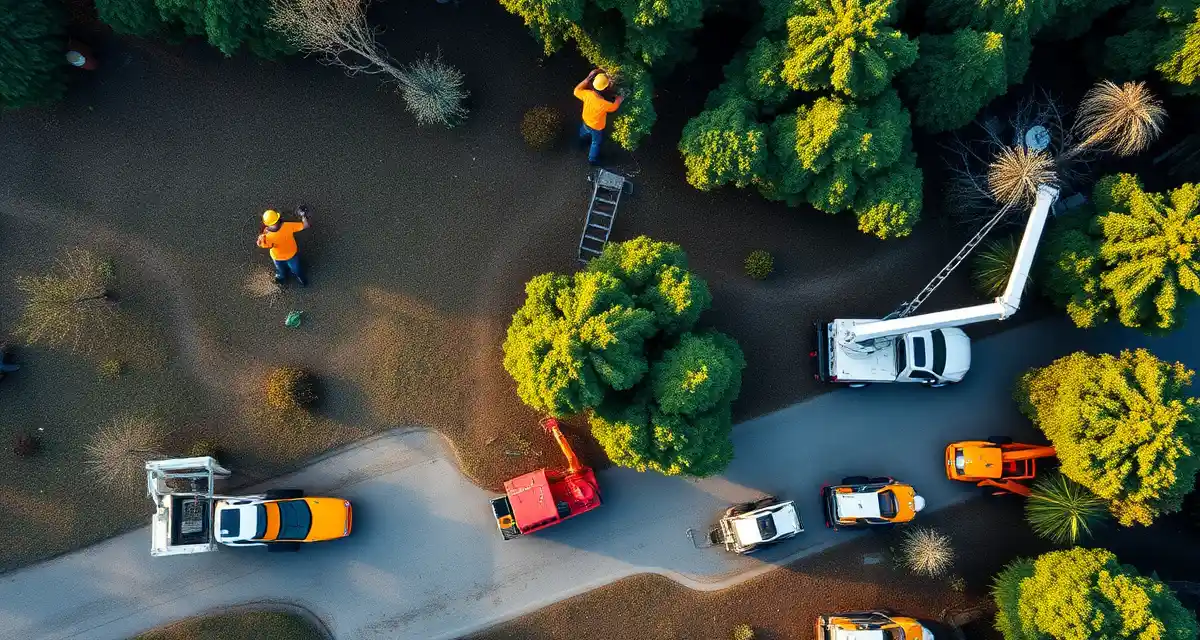
Best GPS Crew Tracking for Large Tree Service Operations 6+ Crews: Ranked and Compared
At 6 or more crews, GPS tracking is enterprise infrastructure. You're not asking "where is my crew?", you're managing a fleet operation with multiple simultaneous job sites, heavy equipment in rotation, subcontractors blended in with employees, and dispatch decisions that need to happen in seconds based on accurate real-time data. Survey data shows enterprise tree companies report GPS crew tracking as their top operational challenge after reaching growth milestones, because the tracking tools that served a 3-5 crew operation typically don't scale to 8-10+ crews without notable gaps.
Arborgold and SingleOps don't optimize GPS crew tracking for enterprise tree company management, they're designed for mid-market company profiles that don't share the operational complexity of a large multi-crew operation. For a company running 6 or more crews, the GPS requirements go well beyond location: you need fleet-level visibility, equipment tracking alongside crews, subcontractor location management, and dispatch optimization that works across a wide service area.
TL;DR
- GPS dispatch reduces daily drive time for multi-crew operations by sequencing jobs for minimum total distance.
- Real-time crew location visibility allows dispatchers to assign new jobs to the nearest available crew.
- For a 3-crew operation, route optimization typically saves 15-20% of daily drive time and equivalent fuel cost.
- Storm surge dispatch requires hazard triage and priority queuing that standard scheduling tools don't provide.
- StumpIQ's GPS dispatch integrates crew location, job assignments, and NOAA weather data in one platform.
What Enterprise GPS Tracking Looks Like
At 6+ crews, GPS tracking involves several distinct requirements that smaller operations don't face:
- Fleet-level visibility: All crews, all equipment, all subcontractors on one map simultaneously
- Multi-zone dispatch: Crews assigned to service area zones with routing that respects zone assignments
- Equipment utilization reporting: Chipper hours, grinder usage, vehicle mileage, for maintenance scheduling and cost accounting
- Subcontractor tracking: Where your subs are without requiring them to use your internal app
- Historical route data: For billing disputes, OSHA investigations, and crew performance reviews
- API integration: GPS data feeding into payroll, accounting, and compliance systems
1. StumpIQ
StumpIQ's GPS crew tracking is designed for enterprise tree company management, proportional to the operational complexity of running 6+ crews simultaneously. The dispatch map shows all crews, all equipment, and all subcontractors simultaneously with live job status. Multi-zone dispatch assigns crews to service areas automatically, with routing optimization applied within each zone.
Equipment utilization reporting tracks time on site, mileage, and scheduled maintenance intervals for all equipment. For a large operation where equipment scheduling is its own management challenge, this data prevents the "where is the chipper?" problem that slows multi-crew operations.
Pricing: $599/mo for 5+ crews. No per-device hardware costs, all tracking runs on smartphones and existing equipment.
What works for large companies: Multi-zone dispatch, equipment utilization reporting, subcontractor GPS visibility, and historical route data for compliance and billing purposes.
What to know: Purpose-built for tree service. If your enterprise operation includes landscaping divisions or other service lines, those operations would use separate platforms.
2. Arborgold
Arborgold is a tree-specific platform that scales to enterprise operations. Its dispatch tools include multi-crew visibility and tree-specific job types, which remain relevant at the 6+ crew level.
Pricing: $349/mo for larger plans.
What works for large companies: Tree-specific compliance documentation alongside GPS dispatch. Established presence in the professional tree industry at enterprise scale.
What to know: Mobile performance concerns that affect smaller companies become more notable at enterprise scale. At 10 crews relying on the mobile app simultaneously, slow load times create operational friction that compounds across many daily interactions. The platform's limitations in mobile UX are well-documented.
3. Verizon Connect / Samsara / Fleet Tracking
Dedicated fleet tracking platforms (Verizon Connect, Samsara, GPS Insight, Motive) provide the most precise vehicle-level GPS data available. At the enterprise level, these platforms offer historical route playback, driver behavior scoring, maintenance scheduling, and detailed utilization reports that most operations software doesn't match.
Pricing: $25-50/vehicle/mo plus hardware installation. For a 10-vehicle fleet, that's $3,000-6,000/year in tracking costs plus hardware.
What works for large companies: Industry-leading GPS precision, deep fleet analytics, driver behavior monitoring, and integration with fleet management workflows.
What to know: Fleet trackers are vehicle management tools, not tree service operations platforms. You'll run them alongside your operations software, with no native integration. Data from the fleet tracker doesn't automatically connect to job records, compliance documentation, or billing. Total cost at enterprise scale can be substantial.
4. Aspire
Aspire is a commercial-grade field service platform designed for large landscaping and tree operations. Its dispatch and GPS tools are built for enterprise scale, with multi-location management, complex scheduling, and deep job cost tracking.
Pricing: Enterprise pricing, typically $400-800+/mo for larger operations.
What works for large companies: Built for enterprise complexity. Multi-location operations, complex scheduling rules, and detailed job cost tracking are all part of the design.
What to know: Aspire's primary user base is landscaping companies. Tree service features are present but not the platform's deepest investment area. ISA compliance and arborist-specific workflows require configuration work.
5. ServiceTitan
ServiceTitan's commercial field service platform includes GPS tracking and dispatch tools for large operations. It's used by many enterprise service companies and has a sophisticated dispatch interface.
Pricing: Enterprise pricing, typically $200-600+/mo depending on module selection.
What works for large companies: Enterprise-grade dispatch, deep reporting, and scalable infrastructure for large operations.
What to know: ServiceTitan is not tree-service-specific. Tree companies using it need to configure workflows for arborist operations. Setup investment is notable, and the platform is complex enough to require dedicated admin support.
6. SingleOps
SingleOps scales to enterprise tree operations more effectively than many mid-market platforms. Its dispatch and scheduling tools handle the complexity of 6+ crews, and its green industry focus makes tree service configuration more straightforward than a fully generic platform.
Pricing: $299-499/mo for enterprise plans.
What works for large companies: Green industry focus means tree service workflows are more recognized than in generic platforms. Scales reasonably to 6-10 crews.
What to know: Still requires considerable configuration for tree-specific workflows. GPS depth and equipment tracking are less developed than dedicated fleet platforms. Best for operations that want a single platform rather than best-of-breed tools for each function.
The Enterprise GPS Decision
At 6+ crews, the GPS question often becomes: use an integrated operations platform with built-in GPS, or use a dedicated fleet tracker alongside your operations platform?
The integrated approach has notable advantages in daily operations: dispatch decisions use GPS data directly, job completion updates alongside location, and billing is tied to real-time job status rather than manual reporting. The trade-off is GPS precision, dedicated fleet trackers typically provide more detailed vehicle data than smartphone-based tracking.
Crew dispatch software that integrates GPS with job management is generally more operationally efficient than separate systems. Equipment tracking tools built into the operations platform eliminate the equipment-location question without adding another tool to the enterprise software stack.
What Matters at Enterprise Scale
Fleet-level simultaneous visibility. At 8-10 crews, a map that can't show all crews, all equipment, and all subcontractors simultaneously creates the same visibility gap you had without GPS at all.
Zone-based dispatch rules. Enterprise operations cover large geographic areas. Dispatch rules that respect zone assignments and service areas prevent the inefficiency of routing crews across zones without discipline.
Equipment utilization data. At this scale, equipment is a notable asset and cost center. Tracking hours, mileage, and maintenance intervals from within your operations platform connects equipment data to job cost accounting.
API and integration capability. Large operations use multiple enterprise tools. GPS data that can feed into payroll, OSHA reporting, and accounting via API reduces manual data transfer across systems.
Subcontractor tracking. Enterprise tree companies often use subcontractors for overflow and specialty work. GPS visibility of sub locations alongside employees is essential for coordinated dispatch.
Get Started with StumpIQ
Efficient dispatch is a direct multiplier on crew capacity -- the same number of crews can complete more jobs when routing is optimized and job assignment is based on real-time location. StumpIQ's GPS dispatch tools are purpose-built for tree service operations. If you are evaluating dispatch software, a direct demo of these features is the best way to assess fit.
Frequently Asked Questions
What is the best GPS crew tracking for enterprise tree company management with 6+ crews?
For dedicated tree service enterprise operations, StumpIQ provides fleet-level GPS with equipment tracking, multi-zone dispatch, and subcontractor visibility at pricing designed for large operations. For companies needing the highest-precision vehicle tracking alongside their operations platform, a dedicated fleet tracker like Samsara combined with a tree service operations platform provides the most detailed data at the cost of integration complexity.
How does GPS crew tracking change when a tree company has six or more crews?
At 6+ crews, GPS tracking becomes fleet management. The questions shift from "where is my crew" to "what is my equipment utilization," "how efficiently are crews routing between jobs," and "where are my subs relative to incoming calls." Fleet-level analytics, zone-based dispatch, and historical data for compliance purposes all become operational necessities rather than nice-to-haves.
Which GPS crew tracking platform works best at enterprise scale?
At 6+ crews, prioritize platforms with simultaneous fleet visibility, multi-zone dispatch rules, equipment utilization tracking, subcontractor GPS capability, and API integration with enterprise tools. StumpIQ covers all of these for tree service operations, while dedicated fleet trackers offer superior vehicle-level precision at the cost of integration overhead.
What is the difference between scheduling software and dispatch software for tree service?
Scheduling software assigns jobs to time slots and crew members. Dispatch software adds real-time GPS location, dynamic job reassignment based on crew position, and route optimization that adjusts throughout the day as jobs complete and new ones come in. For multi-crew tree service operations, dispatch tools reduce idle time between jobs and improve response speed for emergency calls.
How does GPS dispatch improve customer communication?
GPS dispatch enables automated ETAs -- customers can receive a notification when a crew is 30 minutes away, reducing the 'when are you coming' calls that consume office time. For emergency jobs, an accurate ETA reduces customer anxiety and positions your company as responsive and professional.
What data does GPS dispatch generate and how is it useful?
GPS dispatch generates crew location history, job completion times, drive time between jobs, and idle time records. This data is useful for: analyzing crew productivity, identifying routes that consistently run over time, verifying job completion for invoicing purposes, and demonstrating compliance with scheduled arrival windows for commercial clients.
Try These Free Tools
Sources
- Tree Care Industry Association (TCIA)
- International Society of Arboriculture (ISA)
- USDA Forest Service