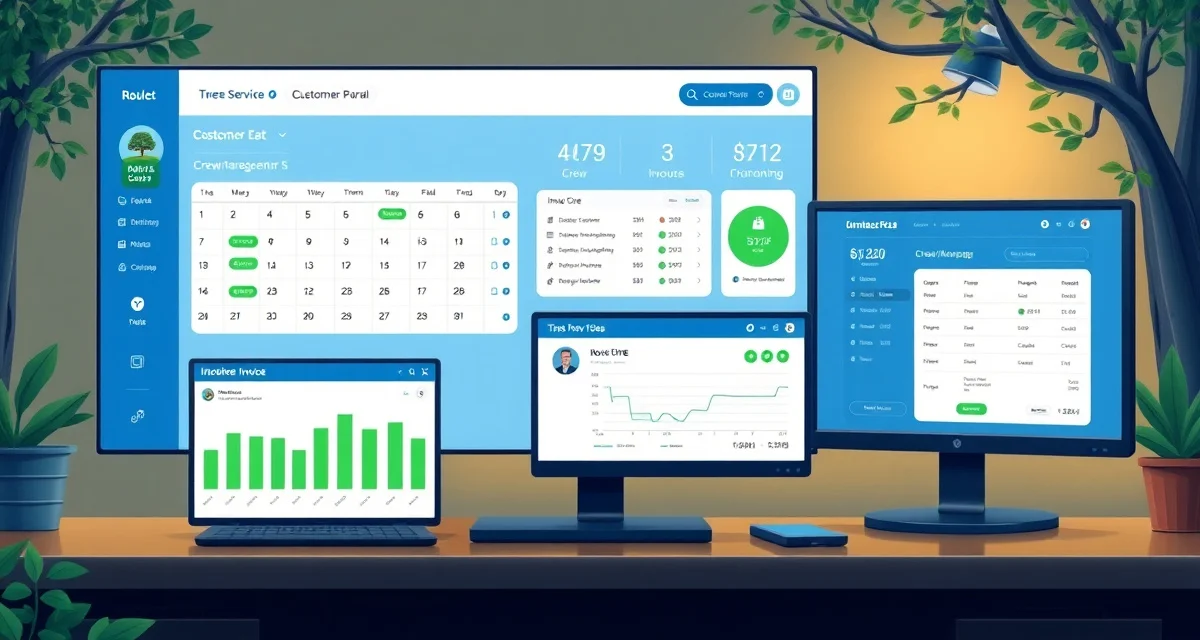
Best Customer Booking Portals for Large Tree Service Operations 6+ Crews: Ranked and Compared
At 6 or more crews, customer portal software is revenue infrastructure. You're managing hundreds of customers, multiple commercial accounts, and a billing cycle that involves dozens of invoices weekly. Survey data shows enterprise tree companies report customer booking portals as their top operational challenge after reaching growth milestones, because the administrative overhead of managing customer interactions manually at this scale exceeds what any office staff setup can handle efficiently.
Arborgold and SingleOps don't optimize customer booking portals for enterprise tree company management, they're built for different company profiles. At the enterprise level, a customer portal needs to serve diverse customer types (residential, HOA, property management, municipal), integrate with complex scheduling and billing systems, and handle volume that would require multiple administrative staff to manage manually.
TL;DR
- Tree service companies that adopt purpose-built software reduce administrative time by an average of 5-8 hours per week.
- AI photo-to-quote converts a field photo to a priced proposal in under 2 minutes -- compared to 30-45 minutes for manual estimates.
- ANSI Z133 compliance documentation created automatically in the field reduces insurance audit preparation time.
- ISA certification tracking prevents lapses that affect eligibility for municipal, utility, and commercial contracts.
- GPS dispatch with route optimization saves 15-20% of daily drive time for multi-crew operations.
What Enterprise Customer Portals Need to Do
Large tree company customer portals have requirements that small-operation portals don't:
- Multi-property commercial account management: An HOA or property management company with 15 properties needs a portal view that shows service history, upcoming visits, and documentation across all properties at once
- Contract and recurring service management: Annual maintenance contracts need to be accessible, with service history against contracted work showing clearly
- Proposal review for large bids: Commercial proposals for notable tree work need professional presentation, ISA documentation, and electronic approval workflows
- Invoice history and bulk payment: Commercial accounts want invoice history, outstanding balance visibility, and payment options without calling accounts receivable
- Service documentation access: ISA reports, compliance certificates, and job photos that commercial clients may need for their own records or HOA documentation
1. StumpIQ
StumpIQ's customer portal is designed for enterprise tree company management. Commercial accounts get a multi-property dashboard showing all service history, upcoming visits, contract documentation, and invoice records across every property. Individual properties within an account are accessible without creating separate logins, one commercial account manager can see all 15 HOA properties they manage.
Residential customers get the simpler self-service portal: estimate requests, proposal approval, payment, and service history. The portal adapts to customer type without requiring the business to manage two separate portal systems.
Pricing: $599/mo for 5+ crews. Customer portal included at every tier.
What works for large companies: Multi-property commercial account management, contract documentation access, ISA report delivery, residential and commercial portal experiences in one system, and direct integration with scheduling and billing.
What to know: Tree service-specific portal design. If your enterprise operation includes other trade service lines, those services may appear differently in the portal.
2. Jobber
Jobber's client hub at enterprise scale handles high volume reasonably well. Its design is clean and mobile-friendly, and the quote-to-approval-to-payment workflow works reliably at large customer counts.
Pricing: $249+/mo for plans that scale to enterprise use.
What works for large companies: Reliable performance at volume, polished design, and solid integration with scheduling and invoicing.
What to know: No tree-specific portal features. Multi-property commercial account management is limited. Commercial clients expecting ISA documentation, compliance records, or professional arborist scope descriptions in their portal won't see those. At enterprise scale, the gap between a generic portal and a tree-specific one becomes more visible in commercial account retention.
3. Arborgold
Arborgold's customer-facing features include tree-specific proposal delivery and documentation. Commercial accounts see ISA-standard documentation that professional arborist clients expect, which is a meaningful differentiator in enterprise commercial account management.
Pricing: $349/mo for enterprise plans.
What works for large companies: Tree-specific proposal and documentation formats that commercial clients expect from professional arborist operations.
What to know: Proposal email delivery reliability has been a documented issue. At enterprise volume where hundreds of proposals are sent monthly, unreliable delivery creates notable follow-up overhead. The 3.1/5 Capterra rating suggests satisfaction gaps across enterprise users.
4. Salesforce Customer Community
Large enterprises using Salesforce CRM can deploy Customer Community portals with deep customization. This approach provides maximum flexibility in what commercial accounts can see, request, and access.
Pricing: $25-50/user/mo for community licenses plus Salesforce CRM costs.
What works for large companies: Maximum customization and integration with Salesforce CRM data. Can present any data from your CRM to commercial account managers.
What to know: Requires notable development resources to build and maintain. No tree-specific features out of the box. Best suited for operations that already have Salesforce infrastructure and development resources to customize the portal for arborist workflows.
5. Service Fusion / Workiz
Mid-market field service platforms like Service Fusion and Workiz include customer portal features that scale reasonably to enterprise use. They handle scheduling, proposal approval, and payment at large customer volumes.
Pricing: $100-300+/mo depending on plan.
What works for large companies: Multi-customer management, proposal and payment features, and scalable performance at enterprise customer counts.
What to know: Generic field service tools with no tree-specific features. Multi-property commercial account management is limited. ISA documentation delivery requires manual workarounds.
6. Custom Development
Some enterprise tree companies build custom customer portals that integrate with their specific operations platform. This approach provides maximum control but substantial investment.
Pricing: $20,000-100,000+ in development, plus ongoing maintenance.
What works for large companies: Tailored to exact requirements, integrates with any internal system, and can present any data to any customer type.
What to know: Only justifiable for very large operations with specific requirements that no commercial platform meets. Ongoing maintenance and feature development requires dedicated technical resources.
Commercial Account Retention at Enterprise Scale
At 6+ crews, commercial accounts, HOAs, property management companies, municipalities, likely represent a notable share of recurring revenue. Customer portals that provide these clients with the professional documentation, service history, and account management tools they expect are an account retention tool as much as an administrative efficiency tool.
Customer portal software designed for tree service enterprise clients includes the documentation types that commercial accounts expect: ISA reports, compliance certificates, and professional service documentation alongside standard scheduling and billing records. Customer communication tools that automate routine account touchpoints, service confirmations, renewal reminders, invoice delivery, free administrative staff for the higher-value commercial account management work that requires personal attention.
What to Prioritize at Enterprise Scale
Multi-property commercial account management. Enterprise tree companies often serve commercial clients with multiple properties. A portal that presents all properties under one account view, with aggregate service history and per-property drill-down, is essential for professional commercial account management.
Tree-specific documentation delivery. ISA reports, ANSI compliance documentation, and arborist credentials need to be accessible to commercial accounts that require them. Generic portals don't include these document types in their design.
Reliability at volume. At enterprise scale, portal and proposal delivery reliability is more critical than at small operations. A 2% delivery failure rate that's acceptable at 50 proposals/month becomes a meaningful problem at 500 proposals/month.
Billing workflow for commercial accounts. Commercial accounts often have specific invoicing requirements: PO numbers, billing addresses, specific formatting. A portal that handles commercial billing requirements without manual workarounds reduces accounts receivable overhead.
Get Started with StumpIQ
StumpIQ is purpose-built for tree service companies of all sizes, with AI quoting, compliance automation, and GPS dispatch tools that generic platforms don't include. If you are evaluating software for your operation, StumpIQ is a useful starting point for comparison.
Frequently Asked Questions
What is the best customer booking portal for enterprise tree company management with 6+ crews?
For dedicated tree service enterprise operations, StumpIQ provides the most complete portal for managing both residential volume and complex commercial accounts, with multi-property management, ISA documentation delivery, and direct integration with enterprise scheduling and billing. For operations prioritizing reliable performance at high volume with a polished customer experience, Jobber scales well to enterprise customer counts.
How does the customer portal need change when a tree company has six or more crews?
At 6+ crews, the portal becomes a commercial account management tool as much as a self-service booking tool. Multi-property account views, contract documentation access, professional ISA documentation delivery, and bulk invoice management are all requirements that emerge at enterprise scale but aren't present at the small company level.
Which customer booking portal works best at enterprise scale?
At 6+ crews, prioritize portals with multi-property commercial account management, tree-specific documentation delivery, reliable performance at high proposal and invoice volume, and direct integration with enterprise scheduling and billing systems. StumpIQ addresses all of these for tree service operations, while platforms like Jobber serve the residential volume side well without the commercial account depth.
What makes tree service software different from generic field service platforms?
Tree service software is built around arborist-specific workflows: AI species identification for field quoting, ANSI Z133 safety checklists, ISA certification tracking, storm demand forecasting, and hazard-level job classification. Generic field service platforms can be configured to approximate these workflows, but doing so requires weeks of manual setup and still produces a less accurate result for tree-specific job types.
How do tree service companies evaluate software before buying?
The most effective approach: identify your top 3 operational pain points, ask vendors to demonstrate those specific scenarios in a live demo, check user reviews on Capterra and G2 for patterns, and request a trial period to test with real job data. Ask specifically about mobile performance in the field, since most tree service work happens away from the office.
What is the ROI of tree service software for a small company?
For a 2-3 crew operation, purpose-built tree service software typically recovers its cost through: faster quoting that wins more bids, invoicing on the day of job completion rather than days later, reduced administrative hours, and fuel savings from route optimization. Most companies report positive ROI within 60-90 days of full adoption.
Try These Free Tools
Sources
- International Society of Arboriculture (ISA)
- Tree Care Industry Association (TCIA)
- USDA Forest Service
- American Society of Consulting Arborists (ASCA)