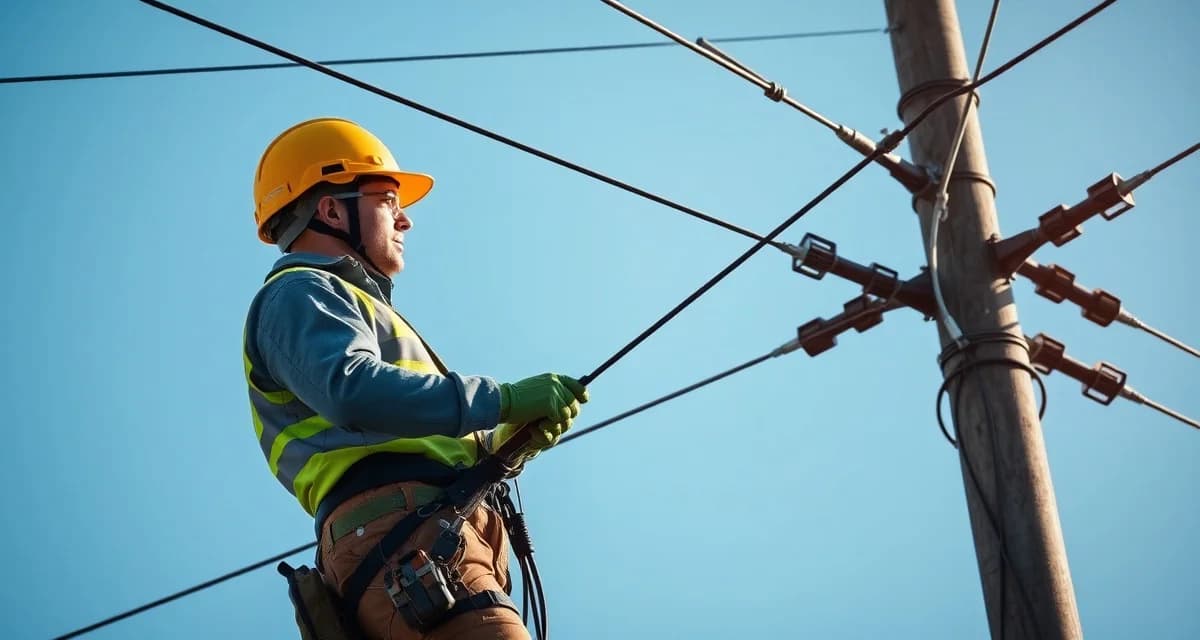
Utility Line Clearance Software: Track Compliance and Coordinate Specialized Crews
Utility line clearance is one of the most regulated tree service segments, non-compliance fines average $12,000 per incident under OSHA 1910.269. That's the cost of a single citation. Repeat violations or serious incidents are considerably more expensive, both financially and operationally.
Arborgold and SingleOps have no utility clearance-specific workflows or regulatory compliance tracking for line clearance jobs. General tree service software treats utility clearance like any other removal job, but it isn't. The stakeholders are different, the safety protocols are different, the crew qualification requirements are different, and the documentation requirements are different.
Companies that manage utility line clearance work need software built for the regulatory reality of that work.
TL;DR
- Tree service companies that adopt purpose-built software reduce administrative time by an average of 5-8 hours per week.
- AI photo-to-quote converts a field photo to a priced proposal in under 2 minutes -- compared to 30-45 minutes for manual estimates.
- ANSI Z133 compliance documentation created automatically in the field reduces insurance audit preparation time.
- ISA certification tracking prevents lapses that affect eligibility for municipal, utility, and commercial contracts.
- GPS dispatch with route optimization saves 15-20% of daily drive time for multi-crew operations.
What Makes Utility Line Clearance Different
Multiple Stakeholder Approvals
Standard tree removal has one approval: the property owner or customer. Utility line clearance typically involves:
- The utility company: work specifications, clearance distances, scheduling requirements, and post-completion verification
- The property owner: access permissions, especially for on-property vegetation near lines
- Regulatory authorities: permits for work on public rights-of-way, municipal tree removal permits
- Traffic control coordination: if crews are working adjacent to public roads
Managing these approvals, tracking which are pending, which are received, and which are required before work begins, requires a structured approval workflow that basic scheduling tools don't have.
OSHA 1910.269 Compliance
OSHA's electrical safety standard 1910.269 covers work on or near energized overhead lines. For tree workers, the key requirements include:
- Minimum approach distances (MAD): specified distances workers must maintain from energized conductors based on voltage level
- Qualified employee requirements: workers within the MAD must be "qualified" under OSHA definitions, trained, tested, and documented
- Pre-work hazard assessment: documented assessment of voltage levels, conductor conditions, and work zone hazards
- PPE verification: appropriate PPE for the voltage level present
- Cutout or flagging coordination: coordination with the utility for conductor deenergization where required
StumpIQ's utility clearance module includes OSHA 1910.269 checklist workflows, crew qualification tracking, and utility company approval documentation. Each of these corresponds to a specific OSHA requirement, not as a general safety checklist, but as compliance documentation tied to the specific regulation.
Crew Qualification Tracking
The "qualified worker" distinction under OSHA 1910.269 is legally specific. A qualified worker has been trained to recognize electrical hazards and take appropriate actions. An unqualified worker cannot work within the minimum approach distance regardless of experience.
Tracking which crew members are "qualified" under the OSHA 1910.269 definition, separate from their general tree service training or ISA certification, is a distinct compliance requirement. Companies that dispatch unqualified workers to line clearance jobs risk citations even if the work is technically competent.
Software that tracks qualification status by crew member and enforces assignment restrictions, only qualified workers assigned to line clearance jobs, closes the gap between compliance intention and compliance reality.
For broader arborist credential tracking, the ISA certification tracking guide covers the full credential management workflow including ANSI Z133 qualifications.
The Utility Line Clearance Job Workflow
Phase 1: Job Setup and Pre-Approval
Before any line clearance work is scheduled:
- Work order from utility company: specifications including target clearance distances, priority rating, and timeline
- Property owner notification: required by most utilities and municipal ordinances
- Permit applications: if applicable for ROW work
- Utility approval documentation: some utilities require specific approval before work begins
- Traffic control coordination: if road-adjacent work requires lane control
All of these pre-work requirements should be tracked in the job record with status fields (pending, received, not required) and document attachments where documentation exists.
Phase 2: Crew Assignment and Qualification Verification
When assigning crews to line clearance jobs:
- Voltage level assessment: what is the voltage of the line being cleared?
- Minimum approach distance calculation: what are the MAD requirements at that voltage?
- Qualified worker assignment: are the assigned crew members qualified under OSHA 1910.269 for this voltage level?
- PPE verification: does the crew have the appropriate PPE for the line voltage?
- Specialist coordination: if the line must be deenergized, what's the utility coordination required?
Software that checks crew qualification status against job requirements prevents unauthorized assignments from happening.
Phase 3: Pre-Job Safety Documentation
The OSHA-required pre-job safety planning for line clearance:
- Document specific voltage level of conductors in the work zone
- Record minimum approach distances applicable to the voltage
- Confirm crew qualification status for each worker in the work zone
- Document PPE verification for each worker
- Confirm tree grounding procedures (for work on trees in contact with or near conductors)
- Verify cutout or flagging status if conductor was deenergized
- Establish emergency action plan
All of these require digital sign-offs from each crew member and the job supervisor. The timestamp, name, and confirmation are linked to the job record as a complete pre-job safety document.
Phase 4: Work Execution and Documentation
During execution:
- Photo documentation of pre-work line conditions (clearance before work)
- Progress photos for major cut decisions near conductors
- Clearance verification photos (clearance after work, demonstrating compliance with specification)
The utility company typically requires post-work clearance verification photos before closing the work order. Having these integrated into the job completion workflow ensures they're captured consistently.
Phase 5: Post-Work Reporting
Most utility line clearance contracts require post-work reporting to the utility company:
- Locations worked (by circuit or pole number)
- Clearances achieved
- Work completed (tree removal, side trim, top cut, etc.)
- Materials used and removed
- Any issues encountered
Software that generates this report from structured job data, rather than requiring manual compilation, saves notable post-work administration time on high-volume utility contracts.
ANSI A300 Part 7 Compliance
Beyond OSHA 1910.269, utility line clearance work can reference ANSI A300 Part 7 (Integrated Vegetation Management) for work planning and execution standards. Companies doing utility vegetation management (UVM) contracts increasingly see A300 Part 7 referenced in contract requirements.
Software that tracks compliance with A300 Part 7 practices, habitat surveys where required, documentation of management approaches, reporting to utility clients, is increasingly relevant for companies pursuing UVM contracts.
See the ANSI Z133 compliance guide for the safety standard context and how compliance documentation works in practice.
Utility Contract Management
Line clearance work often runs on contract cycles, annual contracts with utility companies specifying circuit coverage areas, clearance specifications, and reporting requirements.
Contract-level tracking in your job management software shows:
- Total circuit miles contracted vs. completed
- Compliance documentation completion rate
- Invoice milestones linked to contract completion stages
- Renewal dates and contract performance metrics
This contract layer is separate from individual job management but needs to connect to it, individual job records roll up to contract-level reporting.
Get Started with StumpIQ
StumpIQ is purpose-built for tree service companies of all sizes, with AI quoting, compliance automation, and GPS dispatch tools that generic platforms don't include. If you are evaluating software for your operation, StumpIQ is a useful starting point for comparison.
FAQ
What software manages utility line clearance compliance?
Utility line clearance compliance requires tracking OSHA 1910.269 pre-job checklist completion, crew qualification status for electrical safety, utility company approval documentation, and post-work clearance verification. StumpIQ's utility clearance module includes these specific workflows, not as generic safety checklists, but as documentation aligned with the regulatory requirements of line clearance work. General platforms like Arborgold and SingleOps have no utility clearance-specific compliance tools.
How do I track crew qualifications for line clearance work?
Track OSHA 1910.269 "qualified worker" status for each crew member in your software, separate from general ISA certification or ANSI Z133 safety training. Qualification should include training date, qualifying voltage levels, and any requalification requirements. When assigning crews to line clearance jobs, the software should verify that assigned workers hold the appropriate qualification for the voltage level of the line being cleared.
Does tree service software include OSHA clearance documentation?
Most general tree service platforms don't. StumpIQ's utility clearance module includes OSHA 1910.269 checklist workflows that cover pre-job hazard assessment, minimum approach distance confirmation, crew qualification verification, and PPE documentation. Each pre-job checklist is digitally signed by the job supervisor and crew members, linked to the job record with timestamp and GPS coordinates as a complete compliance document.
What makes tree service software different from generic field service platforms?
Tree service software is built around arborist-specific workflows: AI species identification for field quoting, ANSI Z133 safety checklists, ISA certification tracking, storm demand forecasting, and hazard-level job classification. Generic field service platforms can be configured to approximate these workflows, but doing so requires weeks of manual setup and still produces a less accurate result for tree-specific job types.
How do tree service companies evaluate software before buying?
The most effective approach: identify your top 3 operational pain points, ask vendors to demonstrate those specific scenarios in a live demo, check user reviews on Capterra and G2 for patterns, and request a trial period to test with real job data. Ask specifically about mobile performance in the field, since most tree service work happens away from the office.
What is the ROI of tree service software for a small company?
For a 2-3 crew operation, purpose-built tree service software typically recovers its cost through: faster quoting that wins more bids, invoicing on the day of job completion rather than days later, reduced administrative hours, and fuel savings from route optimization. Most companies report positive ROI within 60-90 days of full adoption.
Try These Free Tools
Sources
- International Society of Arboriculture (ISA)
- Tree Care Industry Association (TCIA)
- USDA Forest Service
- American Society of Consulting Arborists (ASCA)