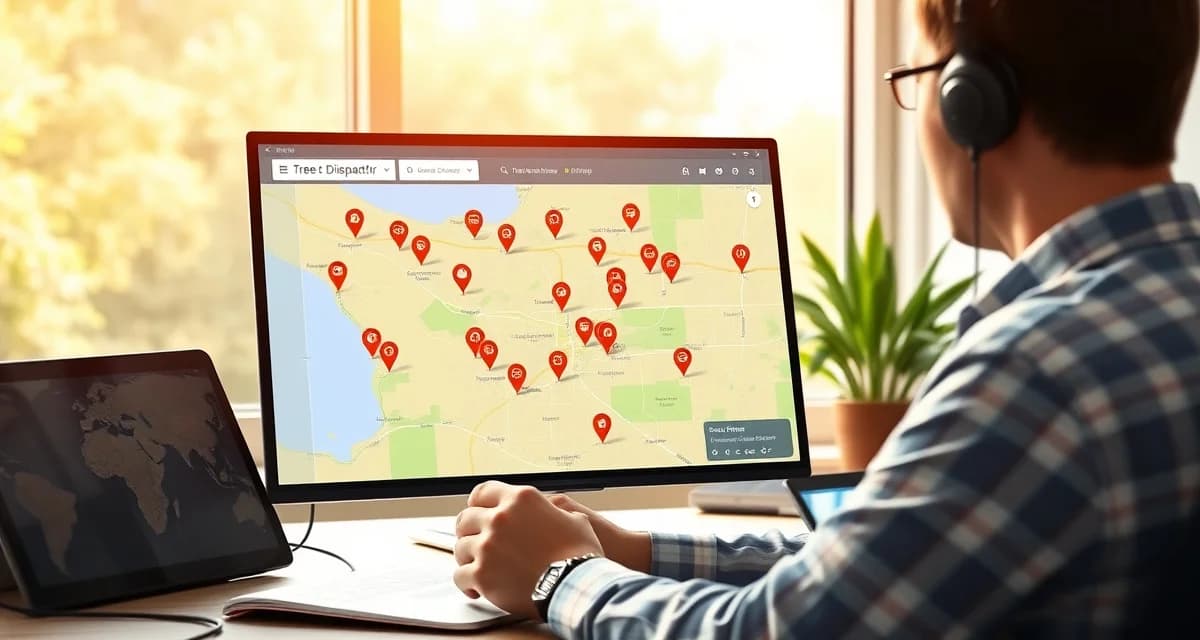
Best Tree Service Software with GPS Tracking: See Every Crew in Real Time
Tree service dispatchers who use GPS-integrated software reduce crew phone check-in calls by 87% compared to location-only tracking apps. That's not just a convenience improvement — it's 2-3 hours per day of management time redirected from phone-tag to actual decision-making.
The distinction between "GPS tracking" and "GPS dispatch integration" matters here. Most platforms have some form of location tracking. Very few link that location data to job status, equipment position, and dispatch logic in a way that actually eliminates the check-in call loop.
Here's the ranking.
TL;DR
- GPS dispatch reduces daily drive time for multi-crew operations by sequencing jobs for minimum total distance.
- Real-time crew location visibility allows dispatchers to assign new jobs to the nearest available crew.
- For a 3-crew operation, route optimization typically saves 15-20% of daily drive time and equivalent fuel cost.
- Storm surge dispatch requires hazard triage and priority queuing that standard scheduling tools don't provide.
- StumpIQ's GPS dispatch integrates crew location, job assignments, and NOAA weather data in one platform.
What Good GPS Integration Looks Like
Location-only GPS tells you where the truck is parked. That's useful but limited.
Good GPS dispatch integration shows:
- Crew location — where the truck is, continuously updated
- Job status — whether the crew is en route, on-site, or complete
- Time on site — how long they've been at the current location
- Equipment location — where the chipper, crane, and grinder are (not just the truck)
- Next scheduled stop — what's coming after the current job
- Estimated completion — when will the current job wrap based on job type and time on-site
When you have all of that on one screen, you don't call crews for status. You look at the board.
Best GPS-Integrated Tree Service Platforms
StumpIQ — Full GPS Dispatch Integration
StumpIQ's GPS layer shows crew location, current job, time on site, equipment tag location, and next scheduled stop — all in one dispatch view. This is the most complete GPS implementation in the tree service software category.
The equipment tracking component is particularly notable. Most GPS systems track vehicles. StumpIQ's QR-based equipment tracking means you can see where the chipper is (at the job site or back at the yard?), which crew has the crane assigned today, and whether the stump grinder is in service or flagged for maintenance. For companies managing multiple expensive pieces of equipment across multiple crews, this visibility prevents the "who has the equipment?" calls that add up to real lost time.
Storm dispatch uses GPS data to optimize crew routing during surge events. When a new emergency job comes in, the dispatch board shows which crew is geographically closest — not just who's theoretically next in the rotation — enabling faster response without phone triage.
Tree companies with GPS crew tracking reduce fuel costs by an average of 14% through improved route efficiency in the first 3 months, on top of the dispatch time savings.
Pricing: $149/mo Solo, $299/mo Professional (2-4 crews), $599/mo Enterprise (5+)
Arborgold — GPS Available, Depth Limited
Arborgold offers GPS tracking, but the integration between location data and job status is limited. You can see where trucks are; you can't see whether the crew on that truck has started the job, is still en route, or finished 20 minutes ago.
The mobile app's performance issues compound the GPS limitation. If crew leads aren't marking job status through the app (because it loads slowly or they find it frustrating), the job status layer on the GPS map is empty. You end up with truck location and nothing else — which doesn't eliminate the status calls.
Pricing: $119-349/mo + per-user fees
SingleOps — GPS with Job Integration
SingleOps has GPS tracking that links to job assignments reasonably well. You can see crew locations and open jobs on the same map. The depth isn't as granular as StumpIQ — equipment tracking isn't included, and the storm dispatch logic doesn't exist — but for companies running tree service alongside landscaping, it's a solid GPS implementation.
Pricing: $125-499/mo
Crew Control — GPS Limited, Scheduling Strong
Crew Control's GPS is basic — it shows crew location but not job progress, equipment status, or arrival time accuracy. The platform is primarily a scheduling tool, and the GPS component supports scheduling visibility without enabling the real-time dispatch monitoring that eliminates status calls.
For companies that want GPS only to confirm crews are where they're supposed to be, not for active dispatch management, Crew Control's GPS is adequate. For companies wanting GPS to replace phone-based status tracking, it's not enough.
Pricing: $139/mo
Jobber — Vehicle GPS Only
Jobber's GPS tracks truck location. That's the extent of the integration. There's no job-status linkage to GPS position, no equipment tracking, and no storm dispatch use of location data.
For a company that wants to see where trucks are during the day, Jobber's GPS covers that. For a company that wants GPS to replace the daily check-in call loop, Jobber doesn't deliver that.
Pricing: $49-249/mo
GPS Feature Comparison
| Platform | Real-Time Location | Job-Status Linked | Equipment Tracking | Storm Dispatch | Completion Time Estimate |
|---|---|---|---|---|---|
| StumpIQ | Yes | Yes | Yes (QR) | Yes | Yes |
| Arborgold | Yes | Limited | No | No | No |
| SingleOps | Yes | Yes | No | No | No |
| Crew Control | Basic | No | No | No | No |
| Jobber | Vehicle only | No | No | No | No |
How to Actually Use GPS to Eliminate Status Calls
Having GPS isn't enough. The daily process matters:
Morning: Review the dispatch board before crews leave the yard. Verify job assignments match crew locations (who's closest to the first job?). Confirm equipment is assigned to the right crew for each job.
During the day: Check the board when you have a question. "Is Crew 3 done with the removal?" is answered by looking at the map, not calling. "Can I fit an emergency job this afternoon?" is answered by looking at which crews have completion time estimates that leave afternoon capacity.
When a new job comes in: Check the board for the nearest available crew with the right equipment before calling anyone. Assign from the board. The crew gets a job notification on their phone.
When a job runs long: The board shows time-on-site for each crew. If a job is running significantly over estimated time, you know before you need to call the customer and adjust.
The daily phone check-in volume in a GPS-integrated operation drops from 40+ calls per day to 3-5 for genuine exception handling. The rest is handled by looking at a screen.
Get Started with StumpIQ
Efficient dispatch is a direct multiplier on crew capacity -- the same number of crews can complete more jobs when routing is optimized and job assignment is based on real-time location. StumpIQ's GPS dispatch tools are purpose-built for tree service operations. If you are evaluating dispatch software, a direct demo of these features is the best way to assess fit.
FAQ
What tree service software includes GPS crew tracking?
StumpIQ includes GPS tracking that's integrated with job status, equipment location, and dispatch logic — the most complete GPS implementation in the tree service software category. SingleOps includes GPS with job-status linkage. Arborgold and Jobber have GPS that shows truck location without job-status integration. Crew Control has basic GPS scheduling without real-time dispatch integration.
Does GPS tree service software track equipment as well as people?
StumpIQ's equipment tracking uses QR codes to track chippers, cranes, stump grinders, and other equipment alongside crew locations. You can see where specific equipment is relative to job sites and crews on the dispatch map. Most other tree service platforms (Arborgold, SingleOps, Jobber, Crew Control) track vehicles only — not individual equipment assets.
Which tree service GPS app works best in rural areas?
StumpIQ uses the device's native GPS chip for location tracking, which performs as well in rural areas as the device's cellular signal allows. Partial offline mode caches job data for access in low-signal areas, with sync on reconnect. Web-based GPS systems (like Arborgold's mobile web approach) struggle more in low-coverage areas because they require active internet connectivity for all functionality.
What is the difference between scheduling software and dispatch software for tree service?
Scheduling software assigns jobs to time slots and crew members. Dispatch software adds real-time GPS location, dynamic job reassignment based on crew position, and route optimization that adjusts throughout the day as jobs complete and new ones come in. For multi-crew tree service operations, dispatch tools reduce idle time between jobs and improve response speed for emergency calls.
How does GPS dispatch improve customer communication?
GPS dispatch enables automated ETAs -- customers can receive a notification when a crew is 30 minutes away, reducing the 'when are you coming' calls that consume office time. For emergency jobs, an accurate ETA reduces customer anxiety and positions your company as responsive and professional.
What data does GPS dispatch generate and how is it useful?
GPS dispatch generates crew location history, job completion times, drive time between jobs, and idle time records. This data is useful for: analyzing crew productivity, identifying routes that consistently run over time, verifying job completion for invoicing purposes, and demonstrating compliance with scheduled arrival windows for commercial clients.
Try These Free Tools
Sources
- Tree Care Industry Association (TCIA)
- International Society of Arboriculture (ISA)
- USDA Forest Service