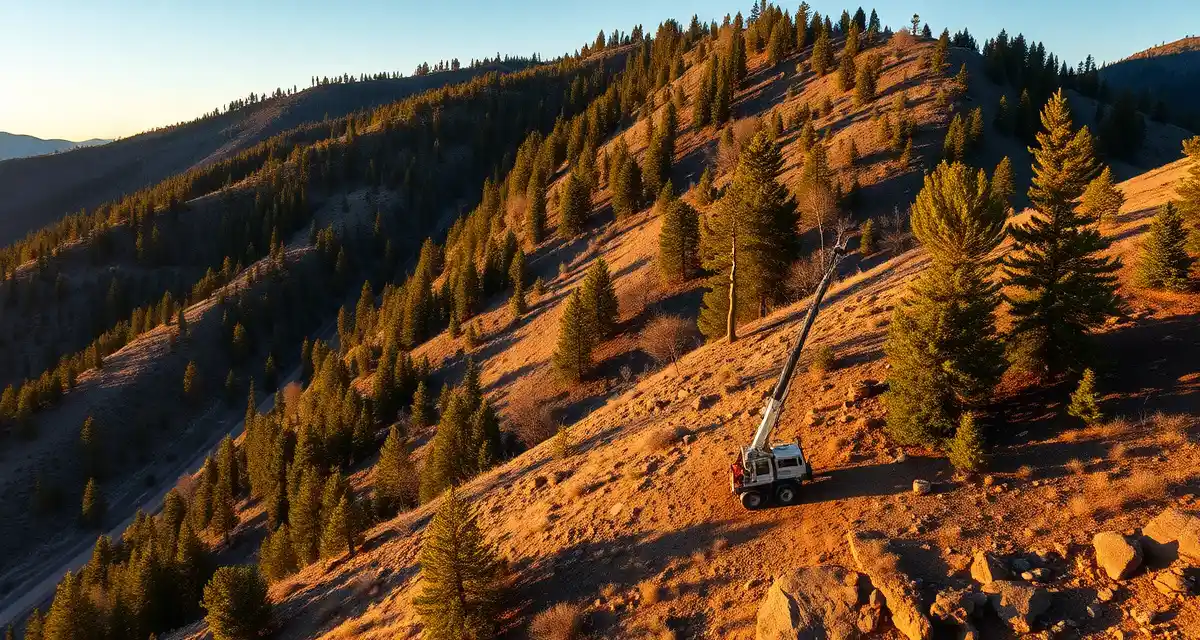
Tree Service Software for Colorado Companies: Mountain Terrain and Fire Risk
Colorado tree work is unlike any other state. You're quoting jobs at 8,000 feet with steep slope access, altitude-affected equipment, and customers whose properties sit in wildfire buffer zones. Generic field service software wasn't built for any of that, and it shows in the quotes your estimators are sending out.
Colorado's tree service market grew 44% between 2020 and 2025, driven by wildfire buffer clearing work and rapid Front Range suburban expansion. That growth is real money, but only if your pricing holds up under the specific conditions your crews face every day.
TL;DR
- Tree service software for Colorado companies needs to handle local species, weather patterns, and regional job types.
- Generic field service platforms require weeks of manual configuration before they handle tree-specific workflows correctly.
- StumpIQ includes pre-built job types for regional species and storm response relevant to this market.
- NOAA-integrated storm forecasting allows 24-48 hour preparation before severe weather events increase call volume.
- Pre-built ANSI Z133 compliance checklists and ISA certification tracking are ready from day one without custom setup.
The Pricing Problem Mountain Tree Companies Face
Here's what happens when Colorado companies use generic quoting tools: the estimator looks at a job, the software applies a flat rate, and the crew shows up to find 40-degree slope access, no equipment path, and a 2-hour setup to get the chipper anywhere near the tree.
Arborgold's quoting module has no terrain-difficulty multipliers. Colorado companies routinely underprice steep-access mountain tree jobs, and it happens consistently, across every estimator, because the tool doesn't account for what the job actually requires.
Manual adjustment works until your estimators are quoting 12 jobs a day during peak season. Then it fails.
What Colorado-Specific Software Does Differently
StumpIQ's AI quoting includes an access-difficulty multiplier that adjusts pricing for terrain steepness, slope access, and equipment transport complexity. When your estimator photos a job on a 35-degree hillside west of Boulder, the quote reflects the actual labor and setup time, not the flat-terrain rate.
For wildfire clearance work, StumpIQ includes fuel reduction and defensible space clearing as native job types with their own pricing parameters. You don't have to hack a standard removal quote to cover what's actually a different scope of work.
Key Software Features for Colorado Tree Companies
Terrain-adjusted quoting: Access difficulty multipliers built into the AI quote prevent the margin loss that comes from flat-rate pricing on complex mountain jobs.
Wildfire clearance job types: Defensible space and fuel reduction work are included as primary job categories, not custom workarounds.
Seasonal forecasting: Colorado's Front Range has distinct spring and fall peak windows. Pre-scheduling crews before demand spikes reduces the scramble that costs billable hours.
Mobile quoting at elevation: Your estimators need quotes that work on-site, in areas with spotty connectivity. Offline-capable mobile apps matter when you're quoting at altitude.
Pricing by Tree Type and Terrain in Colorado
The combination of species and terrain makes Colorado pricing more variable than most states. Ponderosa pine on a steep north-facing slope with limited equipment access is not the same job as cottonwood removal in a flat Aurora backyard, but general platforms price them the same way.
Aspen removal, common across mountain communities, requires different timing and equipment than Front Range suburban oak work. Software that accounts for species-specific factors alongside terrain variables gives your estimators a consistent framework instead of gut-feel adjustments.
For arborist software built for Colorado conditions, see our guide on tree service management software and our overview of lot clearing software for wildfire buffer work.
Get Started with StumpIQ
StumpIQ gives Colorado tree service companies pre-built workflows for regional species, storm response, and compliance documentation -- without the weeks of configuration that generic platforms require. If you are evaluating software for your Colorado operation, StumpIQ is designed for exactly this market.
What is the best tree service software for Colorado companies?
StumpIQ is built with terrain-difficulty multipliers that account for mountain access constraints, a feature generic platforms like Arborgold and SingleOps don't offer. For Colorado companies doing steep-slope and wildfire clearance work, purpose-built quoting accuracy matters more than price.
How do I price mountain terrain tree removal in Colorado?
Accurate mountain pricing requires accounting for slope access, equipment transport complexity, and setup time in addition to the tree itself. A terrain-difficulty multiplier in your quoting tool, or a clear manual adjustment framework, prevents the consistent underpricing that happens when estimators apply flat rates to complex access jobs.
Does tree service software handle wildfire clearance job types?
StumpIQ includes defensible space clearing and fuel reduction as native job types with their own pricing parameters. Most general field service platforms require you to customize standard removal templates to cover wildfire buffer work, which leads to inconsistent pricing and scope creep.
What features matter most for tree service companies in Colorado?
Tree service companies in Colorado need software that handles the local species mix, regional storm risk, and the balance between urban and rural market pricing. AI photo identification trained on regional species and pre-built storm dispatch workflows reduce configuration time and improve field response speed.
Does StumpIQ support tree service companies across Colorado?
Yes. StumpIQ's AI species identification covers North American species including those common in Colorado, and the platform's GPS dispatch and storm forecasting tools work across all service areas. Pricing templates can be configured for both urban and rural market rates within the same account.
How does storm demand forecasting work for regional tree service companies?
StumpIQ monitors NOAA weather data for your service area and predicts surge demand before storms arrive. When conditions indicate elevated risk, the platform activates the emergency dispatch queue and notifies you so you can pre-position crews and extend scheduling windows before incoming call volume peaks.
Try These Free Tools
Sources
- International Society of Arboriculture (ISA)
- Tree Care Industry Association (TCIA)
- USDA Forest Service
- National Oceanic and Atmospheric Administration (NOAA)