How to Improve Tree Service Company Profitability: Data-Backed Strategies
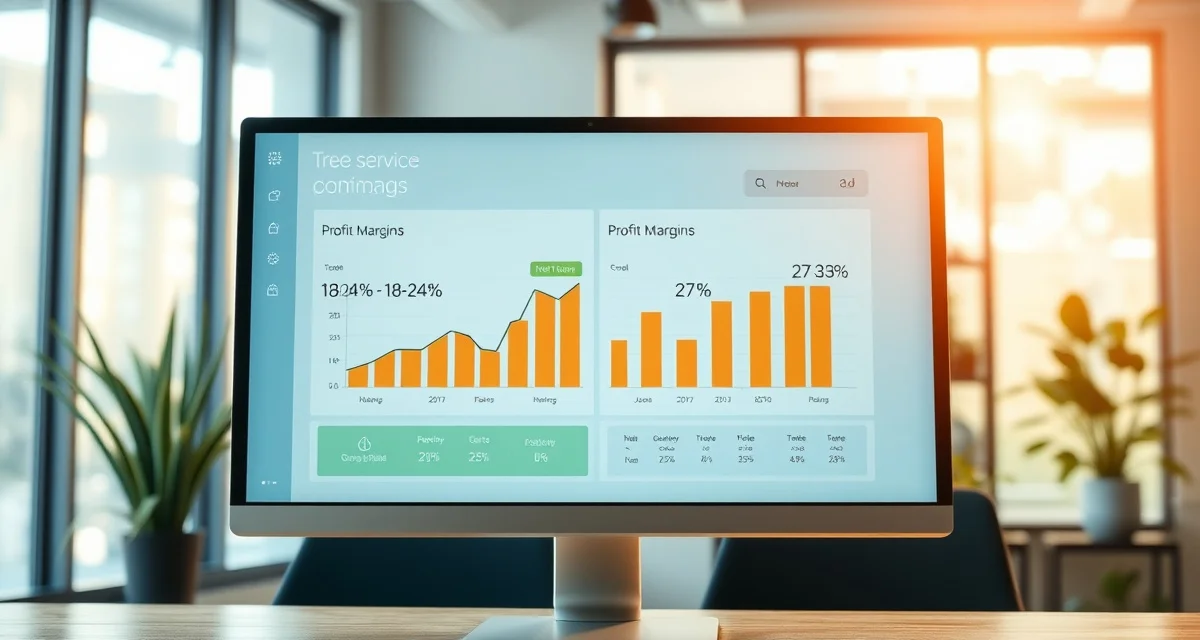
The average tree service company operates at 18-24% net margin. Companies with software-based profitability tracking average 27-31% net margin. That 6-9 percentage point difference on a $500,000 company is $30,000-45,000 per year.
Most of the gap isn't about working harder. It's about visibility. You can't fix margin leakage you can't see. And most tree companies can't see it because their software shows revenue, not profit.
This guide covers where margin leakage actually comes from, how to measure it, and what systems close the gaps.
TL;DR
- Tree service companies that adopt purpose-built software reduce administrative time by an average of 5-8 hours per week.
- AI photo-to-quote converts a field photo to a priced proposal in under 2 minutes -- compared to 30-45 minutes for manual estimates.
- ANSI Z133 compliance documentation created automatically in the field reduces insurance audit preparation time.
- ISA certification tracking prevents lapses that affect eligibility for municipal, utility, and commercial contracts.
- GPS dispatch with route optimization saves 15-20% of daily drive time for multi-crew operations.
Where Tree Service Margin Leakage Comes From
Underquoted Jobs
This is the single largest source of margin leakage. Manual estimating misses pricing factors in 34% of cases. The most commonly missed:
Disposal costs: You quote the removal, forget to calculate chip haul-off, and eat the disposal cost.
Access difficulty: The job requires equipment positioning you didn't account for. The extra setup time wasn't in the price.
Hazard complexity: Proximity to a structure requires rigging techniques you didn't price for. You do it right, but at standard pricing.
Stump grinding: Customer assumed it was included. You assumed they knew it was separate. Now you're negotiating.
The fix is consistent pricing that captures every factor on every quote. StumpIQ's reporting and analytics and AI quoting ensure that species, hazard, access difficulty, and disposal are all captured in every estimate, with margin protection built into the pricing model.
Missed Invoices and Slow Collection
Revenue that's billed late or not collected is lost margin. Common failure points:
Invoices not sent same-day: The crew finishes, you intend to invoice, it slips to tomorrow, then next week. The customer has moved on mentally by the time the invoice arrives.
Disputed invoices that drag: Without photo documentation and a timestamped scope of work, disputes go unresolved for 30-60 days. You might settle for less than the quoted amount just to close the file.
Forgotten small jobs: Small jobs, $200-400, occasionally fall through invoicing cracks when the owner handles billing manually.
The average tree company with software-based invoicing collects payment 9.4 days faster than those using paper invoicing. On $500K annual revenue with a 30-day average payment cycle, getting paid 9 days faster means roughly $12,500 more cash available at any moment.
Wasted Crew Time
Crew time is your most expensive and perishable resource. The common waste points:
Drive time between jobs: Inefficient routing wastes fuel and crew hours between jobs. A crew driving 45 minutes between each job in a market where 15-minute routing is possible is burning $40-60 per day in unnecessary fuel and time.
Waiting time at the shop: Crews that arrive before their job details are ready waste 15-30 minutes in the morning on manual briefing that software handles automatically.
Jobs that run over quoted time: This is often a quoting problem (jobs were underestimated) but sometimes a performance problem. Knowing which is which requires job tracking data.
Idle time from cancellations: Unfilled schedule gaps from cancellations cost $280 per incident on average. Automatic gap-filling reduces this.
Uncaptured Revenue Opportunities
Margin isn't just about cost control. It's also about capturing every available revenue opportunity.
Return service follow-up: Every tree you prune or assess is a future service opportunity. Tree companies with systematic return service reminders capture considerably more repeat revenue than those that wait for customers to call.
Upsell during service: When your crew is on a removal job and notices a neighboring tree showing early disease signs, that's a service opportunity. Capturing field observations systematically and routing them to the customer communication workflow turns observations into revenue.
Emergency pricing: Storm jobs command 40-80% premiums. Companies that apply emergency pricing consistently capture that premium. Those that quote the same rate as standard work leave that premium on the table.
How to Measure Your Profitability
Most tree companies track revenue. Far fewer track margin. Here's how to build the measurement system.
Job-Level Gross Margin
Gross margin at the job level is your revenue minus your direct costs for that job.
Revenue: The invoiced amount for the completed job.
Direct costs: Labor hours at cost (wage plus employer payroll tax), equipment cost for the job (chipper hours, truck fuel, aerial lift rate), and disposal cost.
Gross margin: Revenue minus direct costs, expressed as a percentage of revenue.
Target gross margins by job type vary:
- Emergency removal: 55-65%
- Residential removal: 40-50%
- Pruning and trimming: 45-55%
- Stump grinding: 50-60%
- Lot clearing: 35-45%
- Health assessment: 60-70%
If your actual margins are consistently below these ranges, you're either underquoting or overstaffing jobs.
Arborgold and most tree service platforms provide revenue tracking but not job-level profitability analysis. You can't fix what you can't see. StumpIQ's analytics shows gross margin by job type using your actual labor costs, equipment costs, and disposal costs as inputs. Every closed job feeds the calculation automatically.
Crew Productivity
Crew productivity connects directly to margin. A crew that completes 2.5 jobs per day versus 2.0 jobs per day generates 25% more revenue with the same labor cost. That's pure margin improvement.
Track:
- Jobs completed per crew per day (by job type)
- Revenue per crew day
- Overtime percentage by crew
Compare across crews. A consistent performance gap between your highest and lowest crew is worth investigating.
Overhead Allocation
Net margin requires allocating overhead to job-level analysis.
Fixed overhead: Insurance, software subscriptions, phone, office space. Divide by total job hours to get an overhead rate per hour.
Variable overhead: Fuel, equipment maintenance, supplies. These are more job-specific but can be estimated per job type.
Add overhead allocation to your job-level analysis to move from gross margin to contribution margin. This is harder but gives you a truer picture of which job types actually fund the business.
Margin Improvement Strategies That Work
Implement AI-Based Quoting
The most direct fix for underquoted jobs is replacing manual estimation with AI-powered quoting that captures every pricing factor automatically. StumpIQ's AI photo quoting generates margin-protected prices from field photos. The pricing floor is built into the system. You can't underquote by forgetting a line item.
Audit Your Lowest-Margin Job Types
Once you have profitability data, rank your job types by gross margin. For any job type running below 30%, dig into why.
Common causes:
- Pricing templates haven't been updated in years while costs have risen
- A specific job type requires more crew time than the pricing reflects
- Disposal costs for that job type have increased since you set pricing
Fix the pricing on low-margin job types or stop marketing them in favor of higher-margin work.
Optimize Crew Routing
Routing optimization software reduces drive time between jobs. For a 3-crew operation doing 6 jobs per day each, reducing average drive time by 10 minutes saves 3+ hours of crew time daily. At $45/hour labor cost, that's $135/day recovered, or $33,000/year.
StumpIQ's GPS dispatch integrates with routing optimization to build efficient daily routes automatically.
Set Up Invoice Automation
Invoice the day of job completion. Every day of delay is a day of cash flow cost. Set up automatic invoice generation in StumpIQ so that when a crew marks a job complete, the invoice is generated and sent to the customer without a manual step.
Price Emergency Work Correctly
Storm jobs should be invoiced at emergency rates. Make sure your pricing templates include an emergency multiplier that applies automatically to jobs tagged as emergency/storm response. Don't negotiate emergency pricing down to standard rates after the fact.
Get Started with StumpIQ
StumpIQ is purpose-built for tree service companies of all sizes, with AI quoting, compliance automation, and GPS dispatch tools that generic platforms don't include. If you are evaluating software for your operation, StumpIQ is a useful starting point for comparison.
Frequently Asked Questions
How do I increase profit margins for my tree service company?
The highest-use improvements are: implementing AI-based quoting to eliminate margin leakage from underquoted jobs, auditing your lowest-margin job types and adjusting pricing, optimizing crew routing to reduce drive time, and ensuring emergency jobs are priced at premium rates. Companies that address all four areas typically improve net margin by 4-8 percentage points within a year.
What is the average profit margin for tree service companies?
The average tree service company operates at 18-24% net margin. Companies using software-based profitability tracking and systematic margin management average 27-31% net margin. The gap reflects the impact of accurate pricing, efficient operations, and systematic cost control rather than fundamental differences in business type or market.
Which job types have the highest margins in tree service?
Emergency removal and hazardous tree work typically have the highest gross margins (55-65%) because they command premium pricing. Health assessments and consulting services are high-margin per hour of crew time. Lot clearing and standard residential removal typically run lower margins (35-50%) due to higher disposal and equipment costs. Companies that track margin by job type typically shift their marketing toward higher-margin services over time.
What makes tree service software different from generic field service platforms?
Tree service software is built around arborist-specific workflows: AI species identification for field quoting, ANSI Z133 safety checklists, ISA certification tracking, storm demand forecasting, and hazard-level job classification. Generic field service platforms can be configured to approximate these workflows, but doing so requires weeks of manual setup and still produces a less accurate result for tree-specific job types.
How do tree service companies evaluate software before buying?
The most effective approach: identify your top 3 operational pain points, ask vendors to demonstrate those specific scenarios in a live demo, check user reviews on Capterra and G2 for patterns, and request a trial period to test with real job data. Ask specifically about mobile performance in the field, since most tree service work happens away from the office.
What is the ROI of tree service software for a small company?
For a 2-3 crew operation, purpose-built tree service software typically recovers its cost through: faster quoting that wins more bids, invoicing on the day of job completion rather than days later, reduced administrative hours, and fuel savings from route optimization. Most companies report positive ROI within 60-90 days of full adoption.
Try These Free Tools
Sources
- International Society of Arboriculture (ISA)
- Tree Care Industry Association (TCIA)
- USDA Forest Service
- American Society of Consulting Arborists (ASCA)