How to Price Tree Removal by Species and Size: The Arborist's Pricing Guide
Every tree removal job is different, and that's exactly where pricing goes wrong. I've seen experienced crew leads quote a 70-foot red oak the same way they'd quote a 50-foot silver maple — and give away $300-500 in margin because the wood density and branch structure made the oak a two-day job instead of one.
Tree removal pricing varies by up to 300% based on species, height, proximity to structures, and disposal method. If your estimators are working from memory or a flat per-foot formula, you're either winning jobs you'll lose money on or losing jobs you should have won.
Here's the systematic framework I use.
TL;DR
- Tree service companies that adopt purpose-built software reduce administrative time by an average of 5-8 hours per week.
- AI photo-to-quote converts a field photo to a priced proposal in under 2 minutes -- compared to 30-45 minutes for manual estimates.
- ANSI Z133 compliance documentation created automatically in the field reduces insurance audit preparation time.
- ISA certification tracking prevents lapses that affect eligibility for municipal, utility, and commercial contracts.
- GPS dispatch with route optimization saves 15-20% of daily drive time for multi-crew operations.
Step 1: Identify the Species
Species affects removal price in four ways: wood density (harder to cut and chip), wood volume per diameter inch, rot probability (changes the safety profile), and disposal weight (affects hauling cost).
High-difficulty removals:
- White oak — dense hardwood, heavy branching, high chip volume
- Black locust — extremely hard, dulls chains fast, heavy for its size
- Elm — interlocked grain makes sectional felling unpredictable
- Osage orange — extremely dense, heavy, chains dull quickly
Mid-difficulty removals:
- Red maple, sugar maple — manageable density, predictable structure
- Ash — moderately dense, relatively straight, chip volume is high
- Sycamore — large, hollow cores common, assess carefully
- Hickory — dense but predictable structure
Lower-difficulty removals:
- Silver maple — soft wood, fast cutting, lighter per diameter inch
- Cottonwood — very soft, fast work but high rot probability in older specimens
- Pine, spruce, fir — straight form, predictable sectioning, lighter per cubic foot
- Birch — soft wood, typically manageable structure
Your base rate should start from your highest-difficulty species (usually white oak or locust) and scale down. Never start from your easiest species and try to add up.
Step 2: Measure Height and DBH
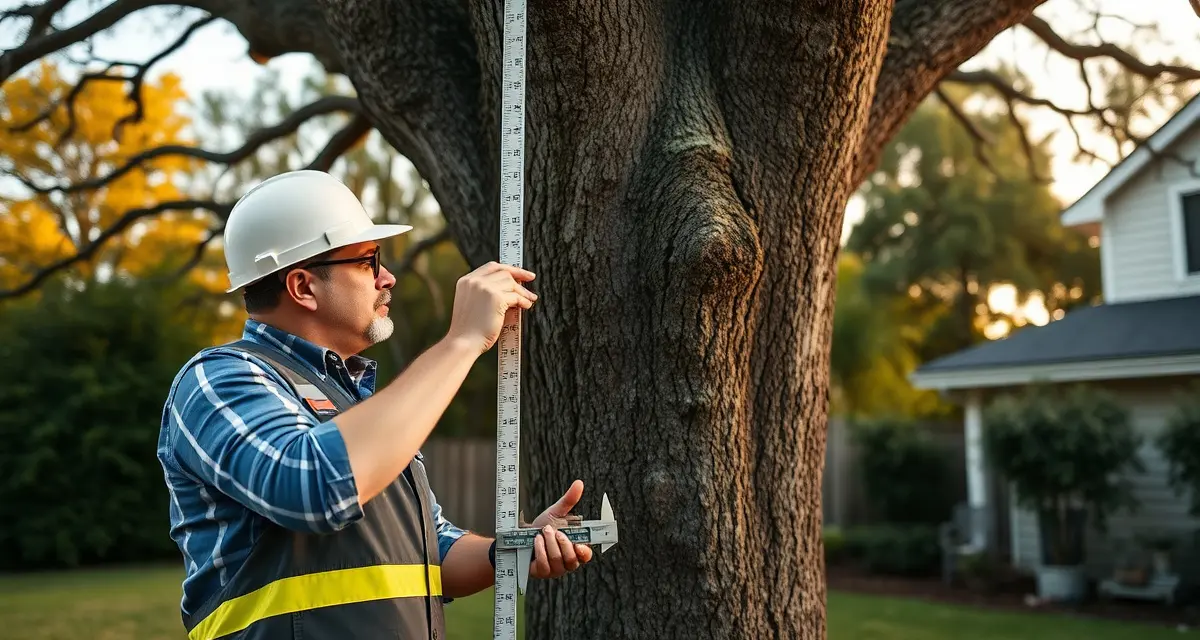
Diameter at breast height (DBH — measured at 4.5 feet off the ground) correlates better with job difficulty than height alone, but you need both.
Height categories and rough baseline adjustment:
- Under 30 feet: standard
- 30-60 feet: add 25-40%
- 60-90 feet: add 60-90%
- 90+ feet: add 100%+ (crane evaluation required)
DBH adjustments:
- Under 12 inches: standard
- 12-24 inches: add 30-50%
- 24-36 inches: add 70-100%
- 36+ inches: field evaluation, crane likely required
A 90-foot white oak at 36+ inches DBH is a fundamentally different job than a 60-foot silver maple at 18 inches DBH. Price them the same and you'll lose money on one every time.
Step 3: Assess Proximity and Access
This is where manual estimates go wrong most often. The tree itself might be straightforward but the site conditions change everything.
Structural proximity:
- More than 20 feet from structures: standard
- 10-20 feet: add 20-30%
- Within 10 feet: add 40-60%, crane evaluation required
- Directly over structure: add 75-100%, crane almost certainly required
Access factors:
- Truck and chipper can reach: standard
- Walk equipment more than 150 feet: add $150-300 depending on terrain
- Gate too narrow for chipper: add $200-400 for manual chipping or multiple trips
- Steep slope (15%+): add 20-40%
- Wetland, pond, or swamp adjacent: add $200-500 minimum
Overhead hazard clearances (ANSI Z133 requirements):
- Electrical lines within 10 feet of the work zone require utility notification and may require line flagging or de-energizing before work begins. Factor in scheduling delays and coordination costs.
Step 4: Determine Disposal Method
Disposal is often underpriced because estimators forget to cost the full chain.
- Chip and haul (standard): factor in chip truck capacity and dump fees. Most markets: $75-150 per chip truck load
- Log sections left on site: discount $75-150 from removal price, customer handles logs
- Full log removal: add $150-300 depending on log volume
- Stump grinding (separate line item): $150-400 depending on diameter, roots, and access
Don't bundle stump grinding into removal pricing. Quote them separately and let the customer choose. It gives them a decision point and often upsells the grind.
Step 5: Account for Conditions
Dead or declining trees:
- Dead tree (confirmed): add 25-40% base premium — wood is brittle, unpredictable, higher chain consumption
- Significant decay (hollow, soft spots): add 30-50% and evaluate for crane requirement
- Hanging limbs: price separately as a hazard surcharge
Storm damage:
- Emergency callout (same-day response): 40-80% premium
- Hazard tree leaning on structure: evaluate individually, crane almost always required
Commercial vs. residential:
- Commercial accounts require liability certificate and sometimes bonds — factor in admin time
- Commercial accounts also pay faster and refer higher-volume work — price competitively but don't undercut yourself
Step 6: Use Consistent Pricing Templates
The biggest pricing consistency problem in tree companies isn't that estimators don't know their costs — it's that each estimator calculates differently. One uses a per-foot formula, another prices from experience, a third undersells because they're worried about losing the job.
The fix is a standardized pricing template that every estimator uses for every quote. The template should:
- Start with species category (hardwood heavy, hardwood standard, softwood)
- Apply height multiplier
- Apply DBH multiplier
- Apply proximity/access multipliers
- Add disposal line items separately
- Add any hazard conditions as a separate premium
StumpIQ's AI photo quoting does this automatically. You photograph the tree, and the AI identifies species, estimates height and DBH from the image, detects proximity factors, and applies your pre-set pricing matrix. Every estimator produces consistent quotes because they're all running the same calculation. That alone is worth the subscription price when you have multiple people quoting.
Common Pricing Mistakes
Underestimating dead or hazardous trees. The safety risk and chain wear on a brittle dead elm aren't priced into your standard removal rate. Always apply the hazard premium.
Forgetting disposal. Chip truck dumps, haul time, and dump fees are real costs. If you're not including them as a separate line item, you're absorbing them.
Flat-rate species pricing. "Large tree removal: $1,200" is how you lose money on oak and overbid on pine. Species-specific pricing protects your margin.
Ignoring access in the drive-by estimate. A five-minute drive-by doesn't tell you there's a 3-foot gate between the truck and the tree. Always walk the access before finalizing the quote.
Not pricing emergency premium. If a customer calls you at 7pm for a tree on their roof, that's worth a 50-80% premium over your standard rate. Build the emergency multiplier into your system so every estimator charges it consistently.
Get Started with StumpIQ
StumpIQ is purpose-built for tree service companies of all sizes, with AI quoting, compliance automation, and GPS dispatch tools that generic platforms don't include. If you are evaluating software for your operation, StumpIQ is a useful starting point for comparison.
FAQ
How much does it cost to remove a large oak tree?
A large white oak removal — 70+ feet, 24+ inch DBH, near structures — typically ranges from $1,800 to $4,500 or more in most US markets. The variation depends on access, proximity to structures, whether crane work is required, and disposal method. Species matters: a 70-foot silver maple in the same position costs $1,200-2,500 because the wood is less dense and cuts faster.
How does tree species affect removal pricing?
Species determines wood density, cutting difficulty, chip volume, and disposal weight — all of which affect labor time and equipment wear. Hard, dense species like white oak, black locust, and osage orange require more chain changes, slower cutting, and heavier chip trucks. Soft species like silver maple, cottonwood, and pine work faster per linear foot but may have higher rot probability in older specimens, which changes the safety profile.
What factors make tree removal more expensive?
The five biggest cost drivers are: (1) species — hard, dense woods cost more; (2) size — height and DBH both matter; (3) proximity to structures — within 10 feet adds 40-60%, directly over a structure nearly doubles the job; (4) access — equipment can't reach means manual work or crane; (5) condition — dead, hazardous, or storm-damaged trees command a 25-80% premium depending on severity.
What makes tree service software different from generic field service platforms?
Tree service software is built around arborist-specific workflows: AI species identification for field quoting, ANSI Z133 safety checklists, ISA certification tracking, storm demand forecasting, and hazard-level job classification. Generic field service platforms can be configured to approximate these workflows, but doing so requires weeks of manual setup and still produces a less accurate result for tree-specific job types.
How do tree service companies evaluate software before buying?
The most effective approach: identify your top 3 operational pain points, ask vendors to demonstrate those specific scenarios in a live demo, check user reviews on Capterra and G2 for patterns, and request a trial period to test with real job data. Ask specifically about mobile performance in the field, since most tree service work happens away from the office.
What is the ROI of tree service software for a small company?
For a 2-3 crew operation, purpose-built tree service software typically recovers its cost through: faster quoting that wins more bids, invoicing on the day of job completion rather than days later, reduced administrative hours, and fuel savings from route optimization. Most companies report positive ROI within 60-90 days of full adoption.
Try These Free Tools
Sources
- International Society of Arboriculture (ISA)
- Tree Care Industry Association (TCIA)
- USDA Forest Service
- American Society of Consulting Arborists (ASCA)