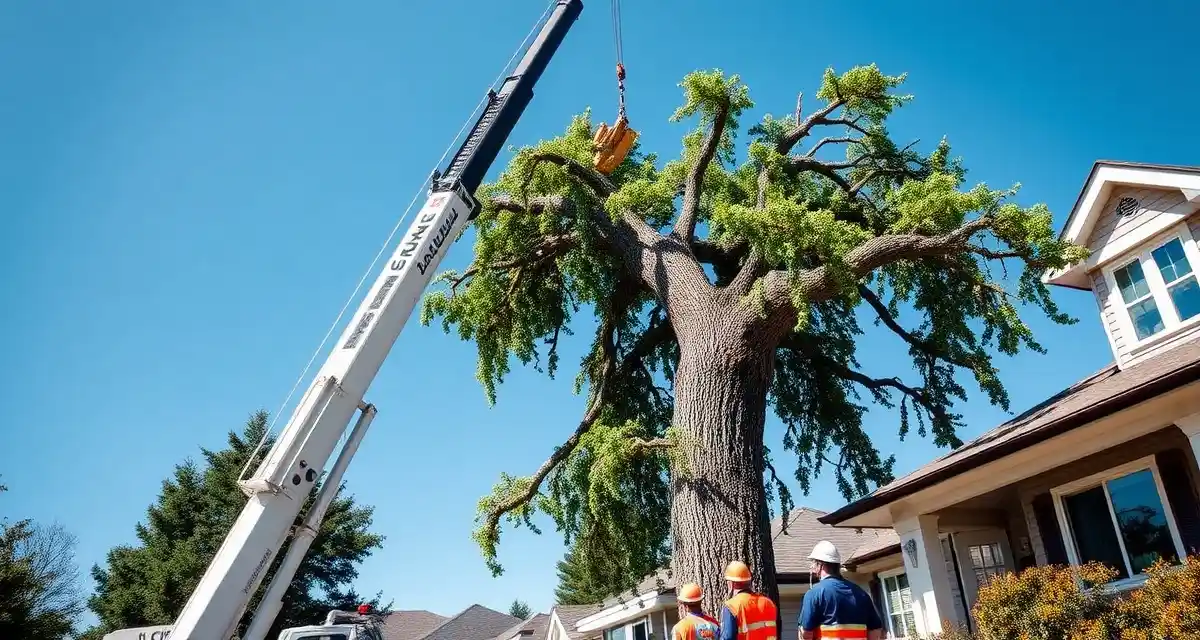
How to Price Crane Tree Removal Jobs: Equipment and Complexity Factors
Crane tree removal jobs underpriced by just 10% generate $450-900 in margin loss per job, a common outcome with manual estimation. The math is simple: a crane job that runs $4,500-9,000 with a 10% error means $450-900 that you worked for but didn't get paid for. And unlike a small residential removal where an estimating error is a $50 lesson, a crane job pricing error is one that can wipe out a week of profits.
Crane removal pricing requires capturing four distinct cost categories: the crane rental itself, the expanded crew requirements, the hazard and complexity factors that affect how long the job runs, and site-specific variables that add time and cost. Miss any of these categories and you're eating the difference.
TL;DR
- Tree service companies that adopt purpose-built software reduce administrative time by an average of 5-8 hours per week.
- AI photo-to-quote converts a field photo to a priced proposal in under 2 minutes -- compared to 30-45 minutes for manual estimates.
- ANSI Z133 compliance documentation created automatically in the field reduces insurance audit preparation time.
- ISA certification tracking prevents lapses that affect eligibility for municipal, utility, and commercial contracts.
- GPS dispatch with route optimization saves 15-20% of daily drive time for multi-crew operations.
Category 1: Crane Rental Costs
Crane rental is quoted in hours, with a minimum rental period (typically 4 hours) and an hourly rate beyond that. Current market rates for operator-included crane rental in most US markets run $250-500/hour depending on crane size and region.
The key estimation challenge is that crane rental time is not the same as tree removal time. Crane rental time includes:
- Crane mobilization and setup at the site
- Rigging setup on the tree before cuts begin
- Actual removal time
- De-rigging and crane breakdown
- Crane demobilization from site
For a typical residential crane removal, mobilization and setup alone account for 60-90 minutes of rental time before a single cut is made. Your estimate needs to account for this, not just the cutting and rigging time.
Practical approach: estimate removal time conservatively, then add a minimum of 90 minutes for mobilization and setup. Round up to the nearest hour for billing, since that's how crane operators typically charge. A job you estimate at 3 hours of actual removal time is a 4.5-5 hour crane rental.
Rental cost components to capture:
- Base hourly rate x estimated total hours
- Mobilization fee (if the crane operator charges one separately, some do for jobs beyond a certain distance)
- Fuel surcharge if applicable
- Operator overtime if the job may run beyond standard hours
Category 2: Crew Size and Labor
Crane removal is a multi-crew operation. A standard removal might involve two people. A crane job requires more:
- Climber/groundwork lead: The person in the tree or on the lift coordinating cuts and rigging attachment
- Crane spotter: A dedicated person communicating between the climber and the crane operator, critical for safety
- Ground crew (2-3 people): Managing rigging drop zones, moving sections, chipping or staging debris
- Crane operator: Typically provided by the crane company, but factor their role into your timing estimates
For a job that normally takes 2 people half a day, crane removal typically requires 4-5 people for the same elapsed time. Your labor cost effectively doubles or more compared to a standard removal.
Calculate labor at your fully-loaded crew cost (wages plus burden), not just hourly pay rate. The difference matters on a 6-hour crane job.
Manual crane job estimates miss rental time overruns and multi-crew coordination costs, these are the most common sources of margin destruction on crane work. StumpIQ's crane removal job type calculates crane rental time, multi-crew labor, and hazard factors into one itemized quote, which is why purpose-built tools outperform manual estimation on complex jobs.
Category 3: Hazard and Complexity Factors
Not all crane removals are equal. The factors that make a crane job more complex add time and risk:
Structure proximity. Removing a tree over a house, with a drop zone that puts 1,000 lb. log sections within 10 feet of the roof, requires more precision, more rigging coordination, and slower crane movements than the same tree over an open yard. This adds time to every lift.
Power line proximity. Jobs near power lines require additional clearance planning, may require utility coordination or line cover, and extend the planning and execution time. Some utility companies require a standby crew for line proximity work.
Multiple section complexity. A tree with competing leaders, unusual branching, or internal rot that changes how sections behave under the crane requires more rigging setups and slower execution. Budget more time per section than your baseline.
Site access constraints. If the crane can't reach its optimal position due to a fence, slope, or other access constraint, you'll be lifting at longer boom radius, which affects load limits and execution speed. Document access constraints at the site visit and adjust crane sizing requirements accordingly.
Dead or structurally compromised tree. Dead wood rigging attachment points are less reliable. Factor in additional rigging setup time and note this in the proposal.
Complexity modifiers, expressed as additional hours on the crane rental estimate:
- Simple crane job, good access, open drop zone: base estimate
- One structure in the drop zone: add 1-1.5 hours
- Structure directly under, tight drop zone: add 2-3 hours
- Utility proximity requiring line coordination: add 2-4 hours plus utility coordination cost
- Compromised tree requiring pre-rigging of limbs: add 1-2 hours
Category 4: Site-Specific and Cleanup Variables
Debris management. Crane removal generates sections that need to be moved, processed, or staged. For large removals, a dedicated disposal truck or dumpster on site may be necessary. Factor debris volume into your estimate and decide whether chipping, staging for later pickup, or direct truck loading is the most efficient approach.
Stump grinding. If included in the job, factor grinding time separately. The stump after a crane removal may be a standard grind or may involve roots that are more exposed or accessible than normal.
Lawn and landscaping protection. Crane mobilization over a lawn creates tire ruts. If the driveway isn't accessible, you may need crane mats to distribute weight. Some clients expect protection measures that add cost and setup time.
Post-job cleanup. Crane jobs generate more debris over a wider area than standard removals. Budget cleanup time accordingly.
Building the Complete Crane Job Estimate
A practical structure for your crane removal estimate:
- Crane rental: Hours x rate + mobilization
- Multi-crew labor: Crew hours x fully-loaded rate (remember: more people than standard)
- Complexity modifier: Additional hours for site-specific factors
- Debris management: Chipping, haul-away, dumpster if needed
- Stump grinding: If included
- Site protection: Crane mats, landscape protection if required
- Margin: Apply your standard job margin percentage to the full cost
Crane tree removal software that has this structure built into the job type catches the categories that manual estimation misses. Tree service quoting tools that apply crane job complexity factors systematically prevent the 10% underpricing errors that make crane work unprofitable.
The Contingency Discussion
One final element on crane jobs: the overrun conversation. Crane rental by the hour means an unforeseen complication, a section that behaves unexpectedly, a utility issue that appears mid-job, equipment access that's more constrained than it appeared during the site visit, adds real cost that wasn't in the original estimate.
Some companies include a contingency line item (typically 10-15% of crane rental cost) in crane job proposals, clearly labeled. Others build the contingency into their estimate without a separate line. Either way, having the overrun conversation with the customer before the job starts protects your relationship if the crane runs long.
Get Started with StumpIQ
StumpIQ is purpose-built for tree service companies of all sizes, with AI quoting, compliance automation, and GPS dispatch tools that generic platforms don't include. If you are evaluating software for your operation, StumpIQ is a useful starting point for comparison.
Frequently Asked Questions
What factors affect crane tree removal pricing?
Crane tree removal pricing is driven by crane rental hours (including mobilization time), expanded crew requirements (typically 4-5 people versus the standard 2-3 for regular removal), complexity factors like structure or utility proximity, debris management costs, and site access constraints. Each factor adds time to the crane rental and/or labor cost. A job that looks simple can become considerably more expensive if access is poor, the tree is structurally compromised, or structures in the drop zone require extra caution during each lift.
How do I calculate crane rental cost in a tree removal estimate?
Start with your local crane rental rate per hour (typically $250-500/hour with operator). Estimate actual cutting and rigging time based on tree size and number of sections. Add 90 minutes minimum for mobilization and setup. Add complexity time for site-specific factors. Round up to the nearest billing hour. This total is your crane rental cost. The most common estimating error is calculating only cutting time and forgetting that the crane clock runs from when the operator arrives until they leave.
How much extra should I charge for crane versus standard tree removal?
Crane tree removal typically costs 2-4 times a standard removal of the same tree, depending on site conditions. The premium comes from crane rental costs (which don't exist on standard jobs), expanded crew requirements, and the additional coordination and planning time that crane work requires. The customer comparison to make in your proposal is that crane removal is not "more expensive" for the same work, it's a different service requiring specialized equipment and a larger crew that protects their property from damage that would result from ground-based removal.
What makes tree service software different from generic field service platforms?
Tree service software is built around arborist-specific workflows: AI species identification for field quoting, ANSI Z133 safety checklists, ISA certification tracking, storm demand forecasting, and hazard-level job classification. Generic field service platforms can be configured to approximate these workflows, but doing so requires weeks of manual setup and still produces a less accurate result for tree-specific job types.
How do tree service companies evaluate software before buying?
The most effective approach: identify your top 3 operational pain points, ask vendors to demonstrate those specific scenarios in a live demo, check user reviews on Capterra and G2 for patterns, and request a trial period to test with real job data. Ask specifically about mobile performance in the field, since most tree service work happens away from the office.
What is the ROI of tree service software for a small company?
For a 2-3 crew operation, purpose-built tree service software typically recovers its cost through: faster quoting that wins more bids, invoicing on the day of job completion rather than days later, reduced administrative hours, and fuel savings from route optimization. Most companies report positive ROI within 60-90 days of full adoption.
Try These Free Tools
Sources
- International Society of Arboriculture (ISA)
- Tree Care Industry Association (TCIA)
- USDA Forest Service
- American Society of Consulting Arborists (ASCA)