How to Prevent Tree Service Equipment Theft: Tracking and Security Guide
Equipment theft costs the average tree company $8,400 per year. But the real cost is higher when you factor in job delays, insurance claims, and replacement equipment lead times. A crew without a chainsaw isn't working. A company without its chipper is turning down jobs.
A study of tree service companies found that equipment theft increases by 34% in companies that don't use digital asset tracking systems. That gap reflects two things: digital inventory makes theft harder to conceal and easier to investigate, and companies with visible tracking systems are less attractive targets.
Here's how to build a tracking and security system that protects your equipment without spending a fortune.
TL;DR
- Tree service companies that adopt purpose-built software reduce administrative time by an average of 5-8 hours per week.
- AI photo-to-quote converts a field photo to a priced proposal in under 2 minutes -- compared to 30-45 minutes for manual estimates.
- ANSI Z133 compliance documentation created automatically in the field reduces insurance audit preparation time.
- ISA certification tracking prevents lapses that affect eligibility for municipal, utility, and commercial contracts.
- GPS dispatch with route optimization saves 15-20% of daily drive time for multi-crew operations.
The Most Commonly Stolen Tree Service Equipment
Chainsaws: High-value, easy to carry, impossible to identify without serial number records. The number one target for theft from job sites and trucks.
Climbing gear: Ropes, harnesses, and climbing hardware are expensive and portable. Theft from tool bags on job sites is common.
Hand tools: Loppers, pruners, and specialty hand tools disappear constantly from job sites and truck beds. Each piece is small, but cumulative losses add up.
Power equipment: Pole saws, leaf blowers, and stump grinders are targets at night when trucks are parked.
Trailers: Unlocked trailers left at job sites overnight are stolen regularly, particularly in rural areas.
Aerial equipment: Aerial lifts and chippers left at large job sites overnight are high-value targets. These are the most expensive single-item losses.
Building Your Equipment Inventory
You can't track what isn't recorded. The first step is a complete digital inventory of every piece of equipment worth protecting.
For each item, record:
- Item name and description
- Make, model, and serial number
- Purchase date and cost
- Current estimated value
- Photo of the item (including serial number location)
- Assigned crew or location
Start with your highest-value items: chainsaws, aerial equipment, specialized climbing gear, and power tools over $200. Add smaller items over time.
Jobber and Arborgold have no equipment-level tracking. Stolen tools are discovered when a crew arrives on-site without them. StumpIQ's equipment tracking module uses QR codes to tag every piece of equipment. Each scan updates the item's last-known location in the system.
StumpIQ's tree service management software shows the last known location of every tagged item, which is useful both for theft investigation and for the much more common problem of equipment misplacement between job sites.
QR and GPS Tagging Options
QR code tags: Inexpensive, durable, and effective for inventory tracking. You scan the tag with your phone to check an item in or out, update its location, or log an inspection. The limitation is that QR tags require an active scan to update location. If a chainsaw is stolen between check-outs, the last location is wherever it was last scanned.
GPS trackers: Active GPS trackers update location continuously and can be embedded in or attached to equipment. Tile, Apple AirTag, and purpose-built GPS trackers are all options. The limitation is battery life (AirTags last about a year; dedicated GPS trackers are shorter) and size (some equipment won't accommodate a tracker discreetly).
Best approach: QR code tags for your full inventory in StumpIQ, with GPS trackers on your 4-5 highest-value items (most expensive chainsaw, the aerial lift if it's left on sites overnight, the trailer).
Job Site Security Practices
Never leave equipment unattended at job sites overnight: If it can fit in the truck, it should go in the truck at the end of the day. The convenience of leaving equipment staged for the next morning is not worth the theft risk.
Lock everything that can be locked: Truck beds should have locking covers. Tool boxes should have padlocks. Trailers should have hitch locks and wheel boots for overnight storage.
Establish a check-out system: Before leaving a job site, crews run through their equipment checklist. Every item that went in should come out. Misplaced equipment is caught before the truck drives away rather than discovered the next morning.
Job site visibility: Equipment left at large commercial job sites should be in the most visible, well-lit area possible. Thieves prefer to work where they're not seen.
Communication with clients: For multi-day commercial jobs, discuss security arrangements with the client. Some commercial properties have security cameras or security personnel. Knowing where those assets are helps you stage equipment in covered areas.
Truck and Facility Security
Truck security overnight: Keep trucks in a locked facility when possible. A locked gate or garage is a notable deterrent. If you're parking trucks on the street or in an unsecured driveway, thieves have all night with no risk of being observed.
Truck bed security: Locking truck bed covers reduce opportunistic theft. Smash-and-grab theft from open truck beds is one of the most common equipment loss scenarios.
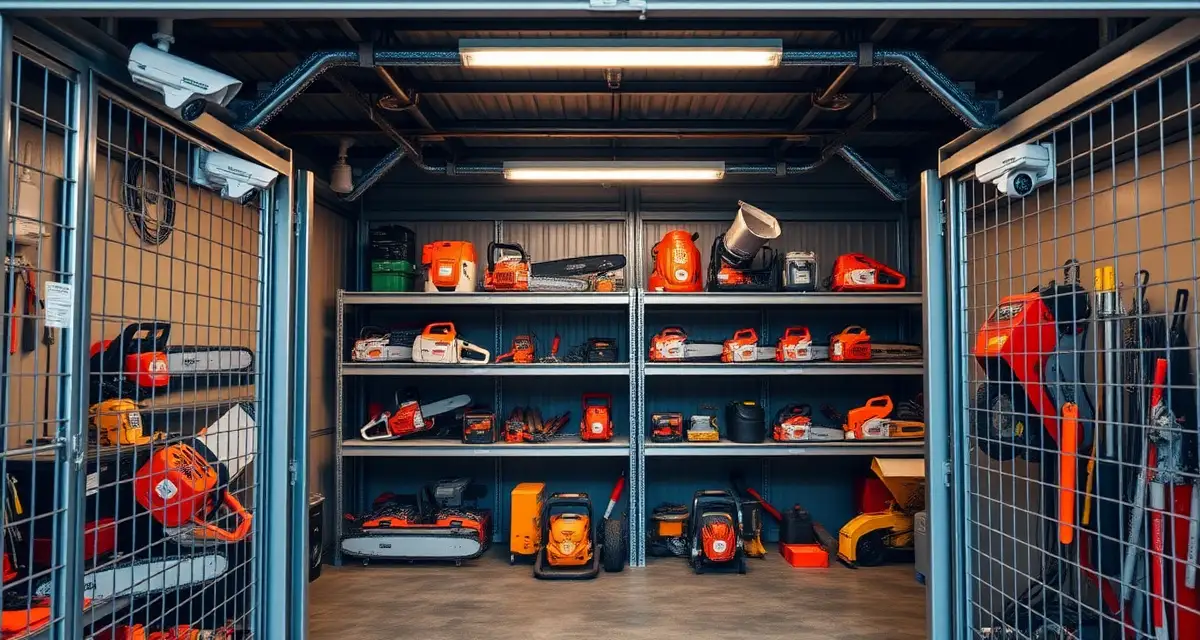
Facility cameras: Security cameras at your equipment storage facility cost less than a single chainsaw theft. Visible cameras deter theft and provide footage if theft occurs.
Inventory location: Don't display your most valuable equipment in ways that advertise it from the road. A shop visible from the street showing $40,000 in chainsaws, climbing gear, and tools is a target.
What to Do When Equipment Is Stolen
Report it immediately: Contact police within 24 hours of discovering the theft. Provide the serial numbers, photos, and QR code records from your inventory. Police recovery rates are much higher when the victim has complete records.
File your insurance claim: Contact your insurer with the police report number and your equipment inventory records. This is where your digital inventory pays off. A claim with photos, serial numbers, and purchase records processes faster and closes at higher value than a claim based on recalled information.
Post to theft reporting networks: Many areas have contractor and landscaper Facebook groups and forums where stolen equipment is reported and shared. A stolen chainsaw in your city is sometimes recovered quickly through community reporting.
Update your inventory: Mark the stolen item as lost in your equipment tracking system. This prevents future confusion about its location.
Review your security practices: Theft is often a symptom of a security gap. What allowed this theft? Where was the equipment when stolen? What can be changed to prevent recurrence?
Marking Equipment to Deter Theft
Engraving: Engrave your company name and a unique number on visible surfaces. Engraved equipment is harder to sell because it's visibly identified. Equipment supply stores often have engraving tools available, or buy an inexpensive rotary tool.
High-visibility paint: Mark your equipment with a distinctive color or pattern. A chainsaw with a bright orange handlebar grip or a company-specific marking is identifiable and harder to resell.
Documentation photos: Take photos of each item showing the serial number and any identifying features. Store these in your equipment inventory alongside the item record. When a police officer or pawnshop checks your claim against a serial number, your photos support positive identification.
Insurance for Tree Service Equipment
Your equipment represents a large portion of your business value. Make sure it's properly insured.
Commercial inland marine insurance covers equipment that travels with your business, including tools and equipment on job sites and in trucks. This is different from your commercial auto insurance, which covers the vehicles but typically not the equipment inside.
Review your policy annually: As you add equipment, your coverage needs grow. An equipment inventory list is your baseline for confirming adequate coverage. StumpIQ's equipment tracking module can export a current inventory report for your insurance review.
Know your deductibles and coverage limits: A policy with a $2,500 deductible per item isn't useful for chainsaw claims. Review your per-item and aggregate limits against your actual equipment values.
Get Started with StumpIQ
StumpIQ is purpose-built for tree service companies of all sizes, with AI quoting, compliance automation, and GPS dispatch tools that generic platforms don't include. If you are evaluating software for your operation, StumpIQ is a useful starting point for comparison.
Frequently Asked Questions
How do I track my tree service equipment to prevent theft?
StumpIQ's QR-based equipment tracking assigns a scannable tag to every piece of equipment. Check-in and check-out scans update each item's location in the system. The last known location is visible in the dashboard, and the inventory record includes photos, serial numbers, and purchase information for police reports and insurance claims.
What happens when tree service equipment is stolen on the job?
File a police report within 24 hours with the serial numbers and photos from your equipment inventory. Contact your inland marine insurance provider with the police report and your inventory documentation. Report the stolen items to local contractor networks where stolen equipment is often re-listed for sale. The recovery rate for equipment with complete records is notably higher than for equipment without.
Does equipment tracking software help recover stolen tools?
Digital inventory with serial numbers and photos is the documentation that makes police recovery possible and insurance claims process at full value. GPS trackers on high-value items like chainsaws can provide real-time location data to law enforcement. QR-based systems in StumpIQ don't provide real-time GPS, but the last-scan location and complete equipment record are still valuable for police and insurance purposes.
What makes tree service software different from generic field service platforms?
Tree service software is built around arborist-specific workflows: AI species identification for field quoting, ANSI Z133 safety checklists, ISA certification tracking, storm demand forecasting, and hazard-level job classification. Generic field service platforms can be configured to approximate these workflows, but doing so requires weeks of manual setup and still produces a less accurate result for tree-specific job types.
How do tree service companies evaluate software before buying?
The most effective approach: identify your top 3 operational pain points, ask vendors to demonstrate those specific scenarios in a live demo, check user reviews on Capterra and G2 for patterns, and request a trial period to test with real job data. Ask specifically about mobile performance in the field, since most tree service work happens away from the office.
What is the ROI of tree service software for a small company?
For a 2-3 crew operation, purpose-built tree service software typically recovers its cost through: faster quoting that wins more bids, invoicing on the day of job completion rather than days later, reduced administrative hours, and fuel savings from route optimization. Most companies report positive ROI within 60-90 days of full adoption.
Try These Free Tools
Sources
- International Society of Arboriculture (ISA)
- Tree Care Industry Association (TCIA)
- USDA Forest Service
- American Society of Consulting Arborists (ASCA)