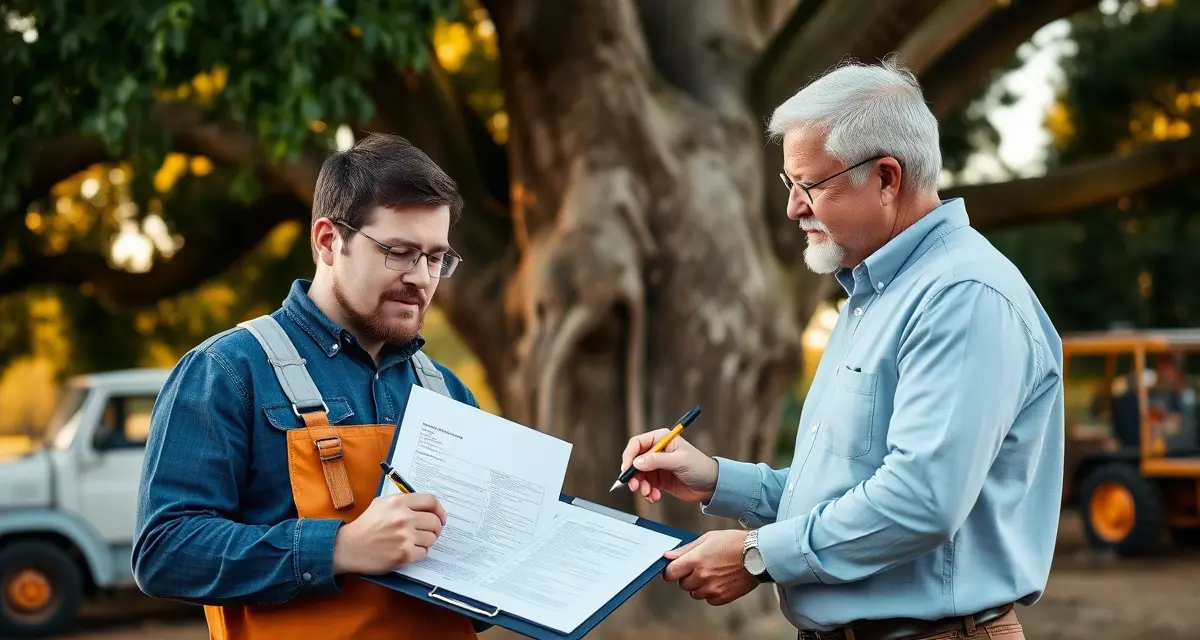
How to Create Tree Service Contracts: Protect Your Work and Get Paid
Tree companies with signed contracts before job start reduce post-completion payment disputes by 67% compared to verbal-only agreements. That's not a surprise, a customer who signed a document describing exactly what you'd do and what they'd pay has less room to dispute either.
Most tree companies are somewhere between two extremes: a one-page proposal that serves as a loose agreement, and a full legal contract with signatures, witnesses, and notarized copies. Neither extreme is usually right. What works is a well-structured proposal document that includes contract terms, delivered digitally, signed before work begins.
Here's what that document needs to include and how to make signing easy enough that customers actually do it.
TL;DR
- Tree service companies that adopt purpose-built software reduce administrative time by an average of 5-8 hours per week.
- AI photo-to-quote converts a field photo to a priced proposal in under 2 minutes -- compared to 30-45 minutes for manual estimates.
- ANSI Z133 compliance documentation created automatically in the field reduces insurance audit preparation time.
- ISA certification tracking prevents lapses that affect eligibility for municipal, utility, and commercial contracts.
- GPS dispatch with route optimization saves 15-20% of daily drive time for multi-crew operations.
What Every Tree Service Contract Must Include
1. Scope of Work: Be Specific
This is where most disputes start. "Remove the oak tree" isn't a sufficient description. Which oak? What happens to the debris? Is stump grinding included? What about the surface roots that spread 6 feet from the trunk?
A complete scope of work includes:
- Species and location of each tree being worked on ("the 40-foot red oak in the northeast corner of the backyard, approximately 15 feet from the fence")
- Work being performed on each tree (full removal vs. trimming, and what trimming specifically means)
- Debris handling, chipped and blown to curb, logs stacked for customer, debris hauled away
- What's excluded, if the stump is not included, say so explicitly
- Access requirements, gate must be unlocked, vehicle access to backyard, power line clearance staging area needed
2. Price and Payment Terms
- Total price for the described scope
- Deposit requirement and when it's due (typically at proposal acceptance for jobs over $1,000-1,500)
- Payment due date for the balance (Net 15 from invoice is standard for residential)
- Accepted payment methods
- Late fee policy ("Invoices unpaid after 30 days subject to 1.5% monthly finance charge")
3. What's Not Included
Explicitly stating what the contract doesn't cover prevents upsell-or-dispute situations when the customer expects something you didn't quote.
Common exclusions to state clearly:
- Underground root removal (beyond the visible trunk area)
- Treatment of surrounding turf or landscaping
- Repair of any pre-existing property damage near the work area
- Permits (if the customer is responsible for obtaining them)
- Future work on trees not identified in this proposal
4. Liability and Property Damage
This section is where the legal protection lives. At minimum:
- Your company's insurance coverage: "ABC Tree Service carries $2M general liability insurance. Certificate available on request."
- Responsibility for property damage caused by tree work: "ABC Tree Service is responsible for damage directly caused by our crew's actions within the specified work area. ABC Tree Service is not responsible for damage caused by falling debris from unstable or previously damaged trees beyond reasonable professional prediction."
- Customer responsibility for disclosing known hazards: "Customer is responsible for notifying ABC Tree Service of any known underground utilities, structures, or hazards that may affect the safety of the work."
5. Cancellation Terms
- Customer cancellation policy: 48-72 hours notice required for full deposit refund; less than 48 hours forfeits deposit
- Your right to cancel: reserve the right to cancel or reschedule due to unsafe weather or site conditions
6. Dispute Resolution
A simple clause stating that disputes will first be addressed by direct communication, then by mediation if unresolved, and only then by legal action, in your jurisdiction, reduces the nuclear-option escalation that occasionally happens with difficult customers.
How to Get Customers to Sign Tree Service Contracts
Arborgold allows contract attachment to jobs but doesn't generate contracts or ensure customer signature before work begins. StumpIQ's proposal system includes contract terms in the proposal document, customers accept terms digitally before the job is confirmed.
The mechanism matters. If your contract is a separate PDF that customers need to print, sign, scan, and email back, most won't bother. By the time they do, the job may have already started, making the contract largely ceremonial.
What actually works:
- Embed contract terms in the proposal document itself. When the customer reviews your quote, they're simultaneously reading the terms. There's no second document to track.
- Digital signature at quote acceptance. When the customer clicks "Accept Proposal," they're simultaneously agreeing to the terms. One tap, legally binding in virtually all US jurisdictions under the Electronic Signatures in Global and National Commerce (E-SIGN) Act.
- No ambiguity about what constitutes acceptance. The proposal should state explicitly: "By accepting this proposal, you agree to the payment terms, scope of work, and conditions described above."
This is how professional services companies, architects, engineers, consultants, handle agreement signatures. The proposal is the contract. Acceptance creates the agreement.
Is an Electronic Signature on a Tree Service Contract Legally Valid?
Yes, in all 50 US states. The E-SIGN Act (2000) and the Uniform Electronic Transactions Act (UETA), adopted by most states, establish that electronic signatures carry the same legal weight as wet signatures for most commercial contracts.
For a tree service proposal acceptance to qualify as a legally binding electronic signature:
- The customer must have clear intent to sign, clicking a button that says "Accept Proposal" or "Agree and Sign" satisfies this
- The customer must have consented to doing business electronically, implied by the fact that they're reviewing and accepting an electronic document
- You must be able to produce the signed document and proof of when it was accepted, your software should log this automatically
Courts have consistently upheld electronically accepted service agreements in commercial disputes. For the disputes you're most likely to face, a customer claiming you did more or less than agreed, or refusing payment on a completed job, an electronically accepted proposal with clear scope and payment terms is as protective as a wet-signed paper contract.
When to Involve an Attorney
Standard residential tree service contracts don't require custom legal work. A well-structured proposal template with the sections described above covers the scenarios you're most likely to encounter.
Situations where legal review is worth the cost:
- Commercial contracts over $25,000 with liability provisions
- Municipal or government contracts with specific indemnification requirements
- Contracts with insurance carriers for storm work at specific liability thresholds
- Non-solicitation or non-compete agreements with subcontractors or employees
For standard residential and small commercial work, the investment is in having a good template, not in per-job legal review.
For more on proposal tools and quoting workflows, see our guides on tree service quoting software and how to write a tree service proposal.
Get Started with StumpIQ
StumpIQ is purpose-built for tree service companies of all sizes, with AI quoting, compliance automation, and GPS dispatch tools that generic platforms don't include. If you are evaluating software for your operation, StumpIQ is a useful starting point for comparison.
What should a tree service contract include?
Every tree service contract should include: a specific scope of work identifying each tree and the work being performed, price and payment terms with deposit requirements, explicit exclusions listing what's not covered, liability and insurance language, cancellation terms, and a dispute resolution clause. The scope of work is where most disputes originate, be as specific as possible about which trees, what work, and what happens with debris.
How do I get customers to sign a tree service contract?
Embed contract terms directly in your proposal document so customers review them as part of accepting the quote. Use digital acceptance, a button click that creates an electronic signature, rather than requiring customers to print, sign, and return a paper document. StumpIQ's proposal system includes contract terms in the proposal document, with digital acceptance required before the job is confirmed.
Is an electronic signature on a tree service contract legally valid?
Yes. The E-SIGN Act (2000) and UETA establish that electronic signatures are legally equivalent to wet signatures for commercial service contracts in all 50 states. For a tree service proposal acceptance to qualify, the customer needs clear intent to sign, consent to electronic transactions, and you need a logged record of when the acceptance occurred. Standard proposal software that records acceptance timestamps satisfies these requirements.
What makes tree service software different from generic field service platforms?
Tree service software is built around arborist-specific workflows: AI species identification for field quoting, ANSI Z133 safety checklists, ISA certification tracking, storm demand forecasting, and hazard-level job classification. Generic field service platforms can be configured to approximate these workflows, but doing so requires weeks of manual setup and still produces a less accurate result for tree-specific job types.
How do tree service companies evaluate software before buying?
The most effective approach: identify your top 3 operational pain points, ask vendors to demonstrate those specific scenarios in a live demo, check user reviews on Capterra and G2 for patterns, and request a trial period to test with real job data. Ask specifically about mobile performance in the field, since most tree service work happens away from the office.
What is the ROI of tree service software for a small company?
For a 2-3 crew operation, purpose-built tree service software typically recovers its cost through: faster quoting that wins more bids, invoicing on the day of job completion rather than days later, reduced administrative hours, and fuel savings from route optimization. Most companies report positive ROI within 60-90 days of full adoption.
Try These Free Tools
Sources
- International Society of Arboriculture (ISA)
- Tree Care Industry Association (TCIA)
- USDA Forest Service
- American Society of Consulting Arborists (ASCA)