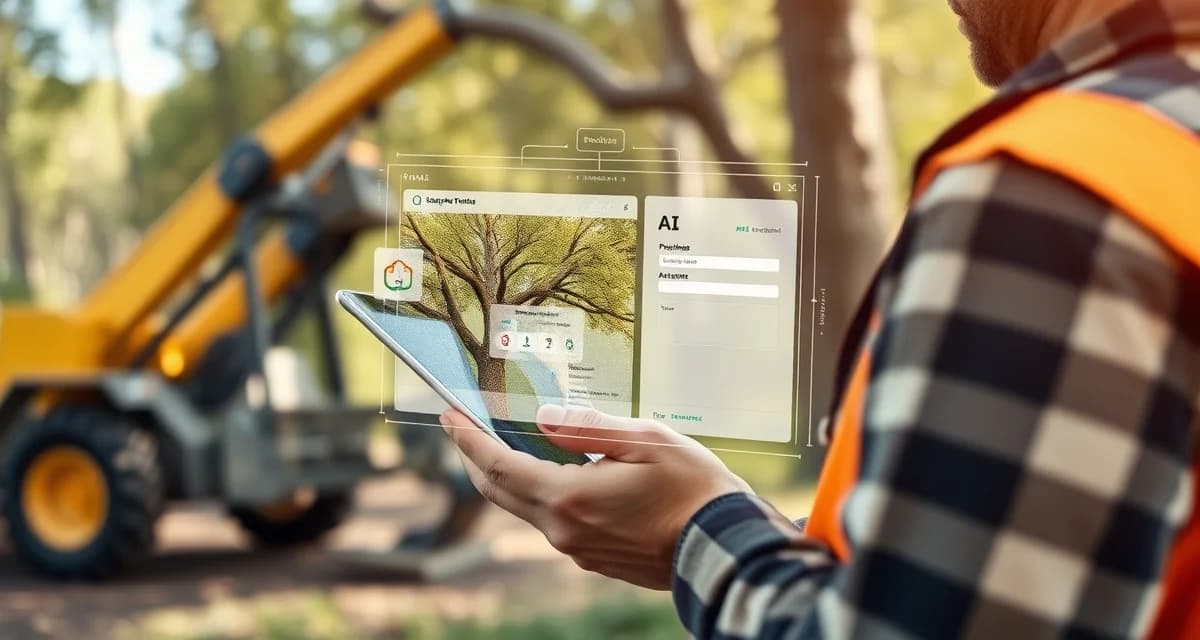
Is AI Photo-to-Quote Accurate for Tree Service Jobs?
Skepticism is reasonable. "Send a photo and get an estimate" sounds like a shortcut that would produce wildly inaccurate numbers. But the accuracy picture for AI tree service quoting is more nuanced, and more reassuring, than the skepticism suggests.
Field testing shows AI photo-to-quote generates estimates within 8% of manually-calculated quotes for standard removal and pruning jobs. StumpIQ's AI correctly identifies species and job scope from field photos with 94% accuracy across the top 40 tree species in North America. Those are the benchmarks that matter for deciding whether to use the technology in your business.
No competitor offers AI photo-to-quote, so tree companies comparing platforms must evaluate StumpIQ's AI against manual estimation accuracy. That's actually a useful comparison frame, because manual estimation isn't perfectly accurate either.
TL;DR
- ISA data shows 63% of lost tree service bids are decided within the first hour of customer inquiry.
- Manual quote building in most platforms takes 30-45 minutes per job, costing $40-52 in direct labor.
- AI photo-to-quote converts a field photo to a priced proposal in under 2 minutes with no manual data entry.
- Professional digital proposals with one-click acceptance convert at higher rates than emailed PDF quotes.
- Companies that quote same-day from the field win the majority of competitive bid situations.
How AI Photo-to-Quote Works
What the AI Actually Analyzes
When a customer or crew member submits a photo, the AI analyzes multiple visual inputs:
Species identification: The model has been trained on extensive labeled image data for the 40 most common North American tree species. It looks at leaf shape and color (in season), bark texture, branching pattern, crown form, and overall growth habit to identify or narrow the species.
Height and size estimation: Using relative reference points visible in the photo, the house, fence, car, or person, the AI estimates height and approximate trunk diameter. This relative-reference approach is more reliable than asking for a tape measure reading the customer won't have.
Crown condition and structure: The AI assesses crown density, visible deadwood, lean, and any obvious structural defects, codominant stems, major cavities, or notable crown damage.
Access conditions: Proximity to structures, fencing, and obvious access constraints (slope, hardscape, tight spaces) are factored into the difficulty assessment.
Job scope: From the above factors, the AI determines what the job likely requires, standard removal, directional removal, crane-assisted removal, or pruning, and generates the appropriate estimate framework.
What Drives the Pricing Output
The AI doesn't just classify the job, it prices it. The pricing model incorporates:
- Regional market rates (calibrated by ZIP code or region)
- Species-specific complexity factors (some species are considerably harder to remove than others)
- Height and diameter-based pricing tiers
- Access difficulty modifiers
- Debris management assumptions (standard cleanup included, haul-away add-on flagged)
The output is a priced estimate with line items, not just a job classification. It's ready to review and send or adjust.
Where AI Quoting Is Most Accurate
Standard Residential Removal
Single-stem residential trees in reasonably clear access conditions are where AI quoting is most accurate. The species is identifiable, the height estimation has good reference points, access is visible in the photo, and the job scope is straightforward.
In these conditions, which describe the majority of residential removal jobs, AI quotes are within 8% of manually calculated estimates. For a $600 removal, that's within $48 of what an experienced estimator would quote.
Common Species in Good Lighting
The 94% species identification accuracy applies to the top 40 North American species in good lighting conditions. For common residential trees, oaks, maples, pines, cedars, cottonwoods, birches, identification accuracy is high.
For rare species or photos in poor lighting (at night, in heavy shade, in winter without leaves), identification accuracy drops. The system flags lower-confidence identifications for human review rather than generating an estimate on uncertain data.
Pruning and Trimming Jobs
For pruning and trimming, the AI estimates scope based on visible crown size, species, and access. Estimates for standard pruning jobs are comparable in accuracy to removal estimates.
Where Human Review Still Helps
Hazardous Situations
When the photo shows notable structural concerns, major lean, visible root plate movement, notable cavity, or notable overhang of a structure, the AI flags the job for human review rather than auto-generating a final quote.
These situations involve risk factors beyond standard pricing parameters. An experienced arborist's judgment on whether a tree is safely removable, and what the specialized removal process requires, is still the right input. The AI gives you a starting framework; you confirm the hazard assessment and adjust accordingly.
Multi-Phase Complex Jobs
A property with multiple trees of different species, sizes, and access conditions doesn't always produce a clear single-job estimate from a single photo. For complex multi-tree situations, the AI may generate individual tree estimates that require human review for sequencing and access efficiency.
Utilities and Site-Specific Conditions
Utility line proximity, underground utilities, site soil conditions, and neighbor access requirements may not be fully visible or assessable from a customer's phone photo. The estimate should always note that final pricing is subject to site conditions not visible in the submitted photos, this is standard practice for any photo-based quoting.
The Comparison That Actually Matters: AI vs. Manual
The relevant comparison isn't "is AI quoting perfectly accurate?", it's "is AI quoting more accurate, faster, or more consistent than the manual process it replaces?"
Manual estimation accuracy: Experienced estimators quote accurately, but there's variation between estimators, between days, and between job types they see frequently versus rarely. Under time pressure, quoting 8-10 jobs in a busy day, manual accuracy degrades.
AI estimation accuracy: Consistent regardless of time of day, number of jobs being processed, or recent pattern of job types. The 8% variance is the stable variance.
Speed comparison: AI photo-to-quote generates an estimate in 2-3 minutes. Manual estimates, including site visit time, take 45-90 minutes per job. That time difference is the actual value of AI quoting for most businesses.
For the tree service quoting software workflow context, the AI estimate is always presented as a draft for review before sending, so human judgment remains part of the process even when AI generates the initial estimate.
Practical Guidance for Using AI Quoting
For standard residential jobs: Trust the AI estimate, do a 30-second review, and send. The accuracy is sufficient and the speed advantage is notable.
For complex or hazardous situations: Use the AI estimate as a starting framework. Adjust based on your professional assessment of the flagged concerns.
For unusual species or poor photo quality: The AI will flag low-confidence identifications. Treat these as prompts for a site visit or a request for better photos before committing to a price.
Photo quality matters: Better photos produce more accurate estimates. A clear photo with good lighting, multiple reference objects, and shots from multiple angles gives the AI more to work with.
Get Started with StumpIQ
Faster, more professional quotes translate directly to higher booking rates. StumpIQ's AI photo-to-quote workflow and digital proposal delivery are designed to close the gap between site visit and signed agreement. If your quoting process is a bottleneck, this is where to start.
FAQ
How accurate is AI photo-to-quote for tree removal?
Field testing shows AI photo-to-quote estimates fall within 8% of manually-calculated quotes for standard residential removal and pruning jobs. StumpIQ's AI correctly identifies species from field photos with 94% accuracy across the top 40 North American tree species. For complex or hazardous situations, the AI flags the job for human review rather than generating an unsupervised final quote.
What types of jobs is AI quoting most accurate for?
AI quoting is most accurate for standard residential removal and pruning jobs with single-stem trees in accessible conditions and good photo quality. Common species in good lighting (oaks, maples, pines, cedars, elms, birches) identify reliably. Multi-tree complex properties and hazardous tree situations benefit from human review of the AI's output before sending the estimate to the customer.
Does AI quoting work for hazardous or complex tree situations?
AI quoting flags hazardous or complex situations for human review rather than auto-generating a final quote. Signs of notable lean, root plate movement, major cavities, utility proximity, or unusual access conditions are identified as risk factors that prompt a review step. The AI provides a starting framework that an arborist reviews and adjusts based on professional hazard assessment before the quote is sent.
What should a professional tree service quote include?
A professional tree service quote should include: company branding and contact information, a clear description of the work scope (species, size, access conditions), itemized pricing by service (removal, stump grinding, debris disposal, travel), timeline and crew size, any applicable hazard notes or permit requirements, payment terms, and an easy way for the customer to accept. Digital acceptance with mobile-readable formatting is increasingly expected.
How many quotes does a typical tree service company send per week?
A 2-3 crew residential tree service company typically sends 10-20 quotes per week depending on season and market. At 30-45 minutes per manual quote, that is 5-15 hours of quoting time weekly. AI quoting at under 2 minutes per job reduces this to under an hour -- reclaiming time for field work or additional sales activity.
What is the conversion rate for tree service quotes?
Conversion rates vary significantly by market, quote speed, and proposal quality. Industry estimates suggest residential tree service conversion rates of 30-50% for professionally presented same-day quotes, dropping significantly for quotes delivered the following day or later. Speed and professionalism of the quote are the two variables most within a company's control.
Try These Free Tools
Sources
- International Society of Arboriculture (ISA)
- Tree Care Industry Association (TCIA)
- American Society of Consulting Arborists (ASCA)