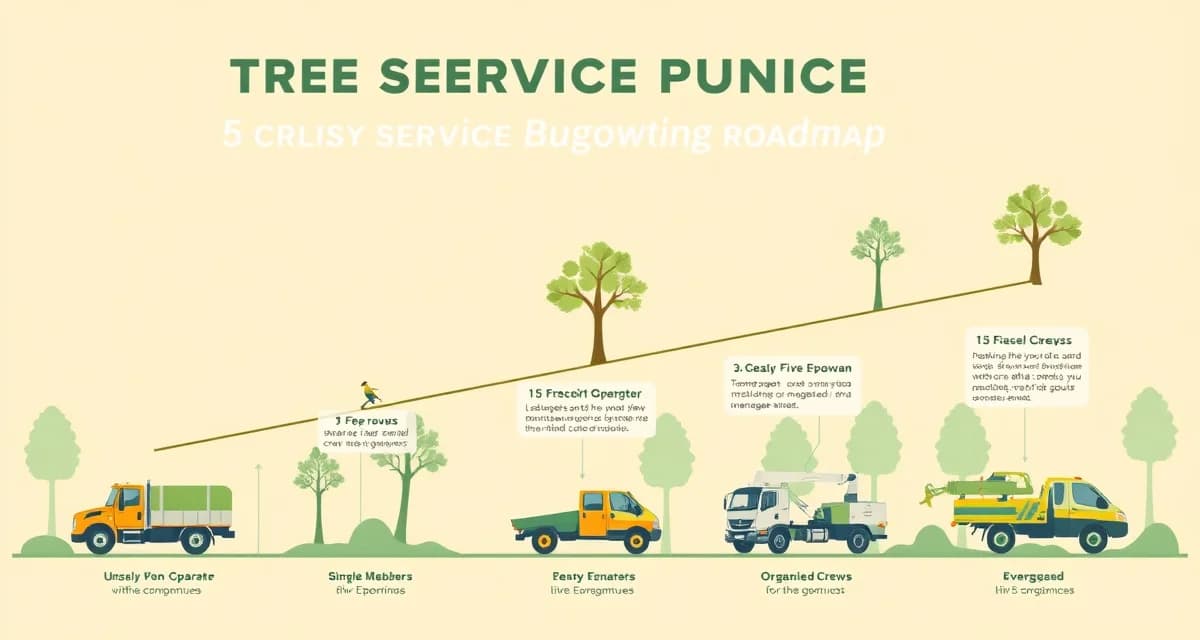
How to Scale a Tree Service Company from 1 Crew to 5: Operations Roadmap
Tree service companies that build systems before hiring scale 40% faster and retain crews longer than those that add software reactively. That's not an accident. It's because the work of scaling isn't hiring more people. It's building the infrastructure that more people can operate inside.
Most tree companies hit a wall somewhere between 2 and 3 crews. The owner is doing everything: quoting, dispatching, compliance, payroll, and some field work. Adding a crew doesn't make this easier. It adds three more variables to the chaos.
This roadmap covers what has to be in place at each growth stage.
TL;DR
- Tree service companies that adopt purpose-built software reduce administrative time by an average of 5-8 hours per week.
- AI photo-to-quote converts a field photo to a priced proposal in under 2 minutes -- compared to 30-45 minutes for manual estimates.
- ANSI Z133 compliance documentation created automatically in the field reduces insurance audit preparation time.
- ISA certification tracking prevents lapses that affect eligibility for municipal, utility, and commercial contracts.
- GPS dispatch with route optimization saves 15-20% of daily drive time for multi-crew operations.
Stage 1: Solo Operator (1 Crew)
At this stage, you're the crew and the office. Volume is manageable because you're doing everything yourself.
What you need to handle:
- Simple customer records with service history
- Basic quoting (even if manual)
- Invoice tracking and payment collection
- Compliance basics (ISA certs, basic PPE records)
What breaks first: Time. You can't be on a job and on the phone simultaneously. Customers call while you're in the bucket, and some of them book someone else.
The system to build now: Even at 1 crew, get your quotes and invoices out of paper and email. A basic platform account sets the foundation before you need it at scale.
The metric to watch: Quote volume. When you're consistently getting 8-10 quote requests per week, you're at capacity for a solo operation. Either raise prices or hire.
Stage 2: Adding Crew 2 (2 Crews)
This is the most dangerous growth stage. You've doubled your field capacity but you're still handling all the coordination yourself.
What you need to handle:
- Dispatch across 2 crews with GPS tracking
- Quote generation fast enough that you're not the bottleneck
- Job assignment without phone-based coordination
- Time tracking for 4-6 employees (not just you)
What breaks first: Dispatch. Two crews, 6-8 jobs per day, and you're still calling everyone to tell them where to go next. The coordination overhead at 2 crews is 3-4 hours per day without software.
The system to build now: This is the point where dispatch software becomes essential. StumpIQ's tree service management software and crew dispatch tools were designed for exactly this transition. GPS-based dispatch replaces morning phone calls. Job assignments go through the app. You see both crews' locations and status without calling anyone.
The hire to make before the business: An office coordinator for half a day or one day per week to handle incoming calls and basic scheduling. This frees you to focus on quoting and customer relationships.
The metric to watch: Dispatch time. If you're spending more than 60 minutes per day on crew coordination, the system isn't working yet.
Generic platforms like Jobber and Arborgold both require notable manual reconfiguration when crew count changes. StumpIQ's platform scales from Solo to Enterprise without reconfiguration. Add a crew, update the plan, and the dispatch board handles the rest.
Stage 3: Crew 3 and Beyond (3 Crews)
At 3 crews, you cross the threshold where the owner cannot be personally involved in every decision. This is where the business needs to operate without you physically present.
What you need to handle:
- Dispatch and coordination without owner involvement
- Quote generation that doesn't require the owner (crew leads quoting from the field, or a dedicated estimator)
- Compliance tracking that doesn't rely on memory
- Payroll management for 9-12 employees
- Basic financial reporting: revenue, margin by job type
What breaks first: Two things simultaneously. Quoting speed drops as your volume exceeds your personal capacity. Compliance tracking starts to fail as the number of certifications to track grows.
The system to build now: AI photo quoting becomes essential at this stage. If your crew leads can generate quotes from the field using StumpIQ's AI photo-to-quote, you remove yourself as the quoting bottleneck. Each crew lead generates proposals while on site. You review and approve. Proposals go out same day.
ISA certification tracking also becomes critical. With 3 crews, you may have 4-6 certified arborists. Tracking their expiration dates manually fails. Automated alerts in StumpIQ handle this with no management overhead.
The hire to make: A full-time crew lead on your most experienced crew, with authority to quote and assign. This person is your operations deputy.
The metric to watch: Close rate by estimator. When you have multiple people quoting, you'll see variance. Training focus should go to whoever is closing the least.
Stage 4: Crew 4 (Getting Serious About Systems)
A 4-crew operation is a real business. Revenue is likely $600,000-800,000+. You need reporting that tells you how the business is actually performing, not just how it feels.
What you need to handle:
- Financial reporting: job profitability by type, crew productivity
- Commercial account management (HOA, municipal contracts)
- Formal payroll with integration to payroll provider
- Safety compliance documentation for potential TCIA accreditation
- Marketing and lead management that's not just word of mouth
What breaks first: Visibility. At 4 crews, 15-20 employees, and 20+ jobs per week, you can't personally see everything. You need reports that tell you where the problems are without requiring you to investigate every job.
The system to build now: StumpIQ's analytics dashboard shows job profitability by type, crew productivity, and seasonal demand in real time. Weekly review of these three reports is how a 4-crew owner stays informed without being on every job.
The hire to make: An office manager or operations coordinator who runs the day-to-day dispatching and scheduling. You're now focused on sales, commercial accounts, and business development.
The metric to watch: Net margin by job type. At this scale, you should know your margins well enough to make deliberate decisions about which job types to grow.
Stage 5: Crew 5+ (Enterprise Operations)
Five crews is the threshold where you're managing a business, not doing the work. Your job is leadership, commercial development, and continuous improvement of systems.
What you need to handle:
- Structured crew management with team leads at each crew
- Formal onboarding for new hires
- Commercial contract management across multiple clients
- Budget and forecasting: what does next quarter look like?
- TCIA accreditation if pursuing major utility or municipal contracts
What breaks first: Culture and retention. At 5 crews, you can't personally know every employee. The culture either has momentum or it doesn't.
The system to build now: Formalized onboarding documentation, written pay policies, and a clear career path from ground crew to crew lead. These aren't software features. They're operational decisions that software supports.
The hire to make: Operations manager with full dispatching authority. Your time is now on business development.
The metric to watch: Crew retention rate. Losing a crew member costs $8,000-15,000 in recruiting, training, and productivity loss. High retention is a sign of healthy operations.
The Software Platform That Scales With You
One of the most common mistakes in this growth path is switching platforms at each stage. You start on paper, move to a basic app, outgrow it, migrate to something more capable, and pay the migration cost twice.
StumpIQ's Solo, Growth, and Enterprise plans scale from 1 crew to 5+ without platform migration or reconfiguration. The features you need at each stage unlock as your plan tier grows. The data and configurations you built earlier carry forward.
Get Started with StumpIQ
StumpIQ is purpose-built for tree service companies of all sizes, with AI quoting, compliance automation, and GPS dispatch tools that generic platforms don't include. If you are evaluating software for your operation, StumpIQ is a useful starting point for comparison.
Frequently Asked Questions
What systems do I need to scale from 1 to 5 tree service crews?
The core systems you need at each stage are: basic dispatch and scheduling at crew 2, AI-assisted field quoting and GPS-based time tracking at crew 3, job profitability analytics and formal payroll integration at crew 4, and commercial account management with operations leadership at crew 5. Building each system before the crew that requires it prevents the scaling wall most tree companies hit.
When should I hire my second tree crew?
Hire crew 2 when you're consistently turning down work or missing quote follow-ups because you're at capacity. The typical indicators are: weekly quote requests over 8-10, current jobs booked 2+ weeks out, and personally quoting more than 5 jobs per week. Have the dispatch software in place before the second crew starts, not after.
How does tree service software change when I add more crews?
StumpIQ scales without reconfiguration. Adding a crew means updating your plan tier and adding the crew members to the dispatch system. The dispatch board automatically shows the new crew alongside your existing ones. Feature access scales with the plan tier, so capabilities like advanced analytics and commercial account management unlock as you need them.
What makes tree service software different from generic field service platforms?
Tree service software is built around arborist-specific workflows: AI species identification for field quoting, ANSI Z133 safety checklists, ISA certification tracking, storm demand forecasting, and hazard-level job classification. Generic field service platforms can be configured to approximate these workflows, but doing so requires weeks of manual setup and still produces a less accurate result for tree-specific job types.
How do tree service companies evaluate software before buying?
The most effective approach: identify your top 3 operational pain points, ask vendors to demonstrate those specific scenarios in a live demo, check user reviews on Capterra and G2 for patterns, and request a trial period to test with real job data. Ask specifically about mobile performance in the field, since most tree service work happens away from the office.
What is the ROI of tree service software for a small company?
For a 2-3 crew operation, purpose-built tree service software typically recovers its cost through: faster quoting that wins more bids, invoicing on the day of job completion rather than days later, reduced administrative hours, and fuel savings from route optimization. Most companies report positive ROI within 60-90 days of full adoption.
Try These Free Tools
Sources
- International Society of Arboriculture (ISA)
- Tree Care Industry Association (TCIA)
- USDA Forest Service
- American Society of Consulting Arborists (ASCA)