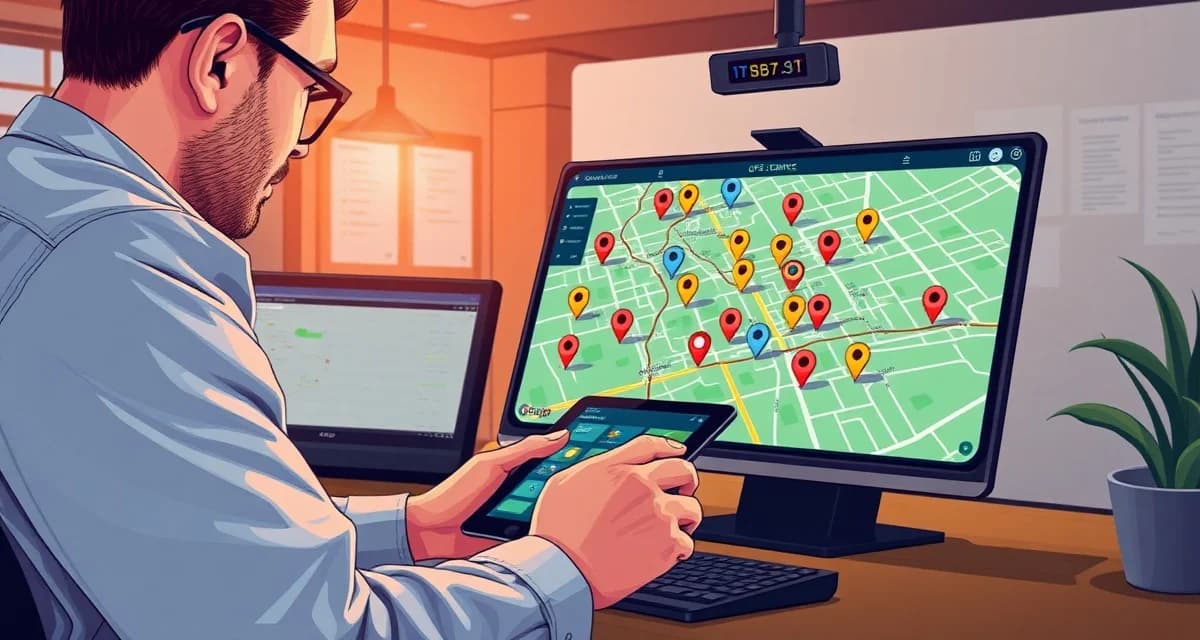
Crew Control GPS and Dispatch Capabilities Compared: What Tree Companies Need to Know
GPS and dispatch capability determines how efficiently your crews move between jobs. For tree service, this matters more than it does for simpler service industries. Tree jobs take unpredictable amounts of time. Emergency calls drop in without warning. Crew locations need to be visible when a homeowner calls asking where you are.
Crew Control at $139/mo for scheduling only, with no quoting, GPS depth, or AI capabilities, offers very basic location features. Crew Control users spend an average of $85-140/mo on additional tools to fill functionality gaps, and GPS depth is one of the gaps that drives that spend.
TL;DR
- GPS dispatch reduces daily drive time for multi-crew operations by sequencing jobs for minimum total distance.
- Real-time crew location visibility allows dispatchers to assign new jobs to the nearest available crew.
- For a 3-crew operation, route optimization typically saves 15-20% of daily drive time and equivalent fuel cost.
- Storm surge dispatch requires hazard triage and priority queuing that standard scheduling tools don't provide.
- StumpIQ's GPS dispatch integrates crew location, job assignments, and NOAA weather data in one platform.
What Crew Control Offers for GPS and Dispatch
Crew Control's dispatch capability is focused on schedule assignment and crew communication. You can assign jobs to crews, send schedule updates, and view a basic map of job locations. That's about the extent of it.
There's no real-time GPS tracking of crew vehicles. There's no route optimization. There's no visibility into which crew is closest to an emergency call or how far out your teams are from completing current jobs. The dispatch view is more of a calendar with a map overlay than a true GPS dispatch tool.
What Tree Service Dispatch Actually Requires
Crew dispatch for tree service has different requirements than a standard service industry. Consider:
Variable job duration. A trimming job quoted for 2 hours might run 3.5 hours due to hidden deadwood. GPS visibility lets you see this in real time and adjust the afternoon schedule before it falls apart.
Emergency response. A homeowner calls with a tree on a power line. You need to know which crew is closest and available. Without real-time GPS, you're calling your crew supervisors one by one.
Multi-crew coordination. Large removals often need two crews coordinating arrival and sequencing. Seeing both crews on a live map is far more reliable than text messages.
Proof of service. Customers occasionally dispute visit times. GPS arrival and departure records resolve these disputes without argument.
Crew Control's basic map view doesn't cover any of these use cases in a meaningful way.
The Route Optimization Gap
For tree companies that run multiple daily jobs across a service area, route optimization saves meaningful time and fuel cost. If you can sequence 8 jobs efficiently, you might run 3 routes instead of 4. That's a full crew shift recovered, not a minor convenience.
Crew Control has no route optimization. Jobs go on the schedule in whatever order you put them. Optimizing routes is a manual process that someone has to redo every time a job moves or an emergency comes in.
GPS Depth vs. Basic Location
The distinction between GPS depth and basic location features matters for understanding what Crew Control offers. Basic location tells you a crew was at a job address. GPS depth means:
- Real-time vehicle tracking with live map view
- Speed and route history
- Geofence arrival and departure logging
- Integration between GPS data and job records
Tree service management software purpose-built for arborists typically includes GPS depth as a core feature. Crew Control's offering is basic location at best.
Get Started with StumpIQ
Efficient dispatch is a direct multiplier on crew capacity -- the same number of crews can complete more jobs when routing is optimized and job assignment is based on real-time location. StumpIQ's GPS dispatch tools are purpose-built for tree service operations. If you are evaluating dispatch software, a direct demo of these features is the best way to assess fit.
Frequently Asked Questions
Is Crew Control good for tree service GPS dispatch?
Crew Control's GPS and dispatch capabilities are limited for tree service operations. The platform provides basic job assignment and schedule views but lacks real-time GPS vehicle tracking, route optimization, geofence logging, and emergency dispatch tools. For tree companies that handle emergency callouts, multi-crew coordination, or need to optimize routes across a service area, Crew Control's basic location features are insufficient. Many Crew Control users end up adding a separate GPS tracking subscription, which adds to the already typical $85-140/mo in add-on costs.
What are the main GPS dispatch complaints about Crew Control from tree companies?
Tree companies report three main GPS dispatch issues with Crew Control: no real-time vehicle tracking, no route optimization, and no emergency dispatch workflow. When an emergency call comes in, operators can't immediately identify which crew is closest. Route optimization requires manual work that has to be redone whenever the schedule changes. Crew arrival and departure times are self-reported rather than GPS-logged, creating disputes with customers who question service timing. For companies that need live operational visibility, Crew Control's dispatch view is inadequate.
What is a better alternative to Crew Control for tree service GPS dispatch?
Purpose-built tree service platforms include GPS depth and route optimization as standard features. Crew dispatch for tree service tools designed for arborists provide real-time vehicle tracking, proximity-based emergency dispatch, and route sequencing for multi-stop days. Tree service management software that integrates GPS with job records gives you documented arrival times, automated geofence triggers, and complete crew visibility without a separate GPS subscription. The difference between a dispatch tool designed for tree service and a basic scheduling calendar with a map layer is significant.
What is the difference between scheduling software and dispatch software for tree service?
Scheduling software assigns jobs to time slots and crew members. Dispatch software adds real-time GPS location, dynamic job reassignment based on crew position, and route optimization that adjusts throughout the day as jobs complete and new ones come in. For multi-crew tree service operations, dispatch tools reduce idle time between jobs and improve response speed for emergency calls.
How does GPS dispatch improve customer communication?
GPS dispatch enables automated ETAs -- customers can receive a notification when a crew is 30 minutes away, reducing the 'when are you coming' calls that consume office time. For emergency jobs, an accurate ETA reduces customer anxiety and positions your company as responsive and professional.
What data does GPS dispatch generate and how is it useful?
GPS dispatch generates crew location history, job completion times, drive time between jobs, and idle time records. This data is useful for: analyzing crew productivity, identifying routes that consistently run over time, verifying job completion for invoicing purposes, and demonstrating compliance with scheduled arrival windows for commercial clients.
Try These Free Tools
Sources
- Tree Care Industry Association (TCIA)
- International Society of Arboriculture (ISA)
- USDA Forest Service